
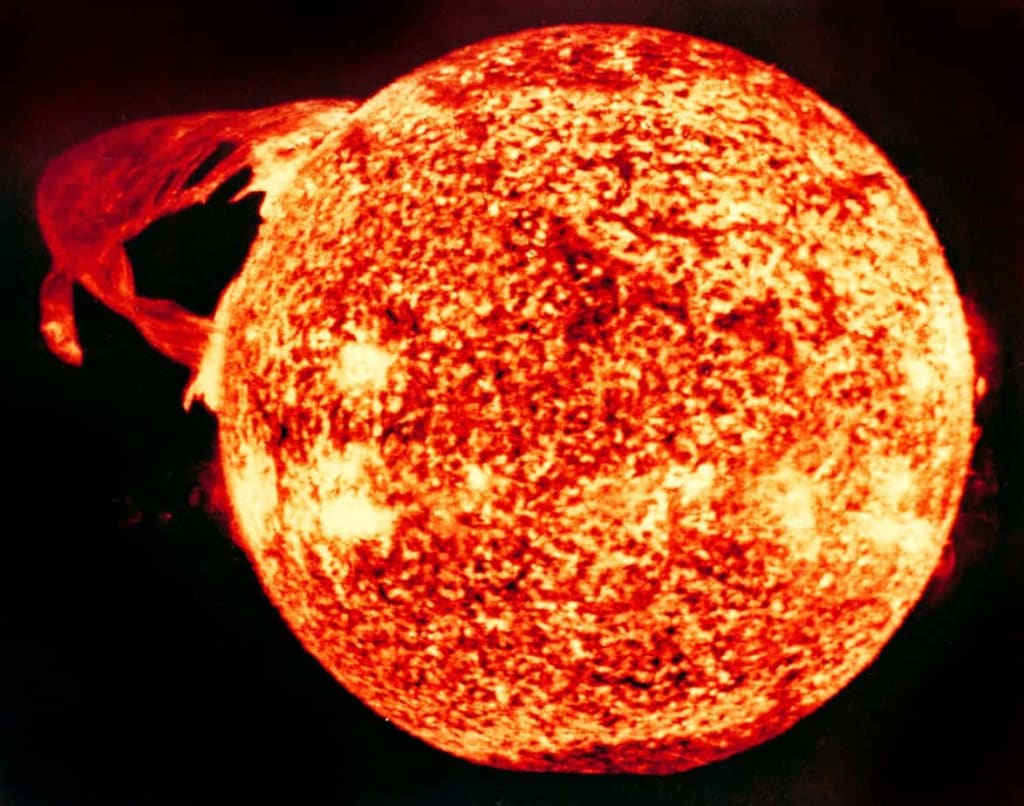
The Sun's Lost Twin
It is a well-known fact that our sun, as far as stars go, is rather unremarkable. It is a yellow dwarf, one of millions in the universe. However, despite its lack of uniqueness, we hold it in high regard as it is the only star we have and it provides us with life. Nevertheless, it was not always this way. Once upon a time, the sun had a twin, possibly an evil one. What became of it? Let us explore.
The birthplace of our sun was a giant molecular cloud, also known as a dark nebula. These clouds are filled with gas, dust, and piles of stars, and have no clear boundaries, often taking on strange and unusual forms. Some of these clouds are even visible to the naked eye as dark spots across the bright Milky Way. Our sun was born from one of these molecular clouds approximately four and a half billion years ago. Waves of energy passed through the cloud, collecting material and compressing it into dense nuclei, resulting in the birth of a protostar. This protostar was a ball of lukewarm hydrogen and helium, and over millions of years, the temperature and pressure inside the ball increased, leading to the birth of a star - our sun.
However, not all of the materials in the molecular cloud turned into the sun. The remaining materials began to revolve around the new star and gradually turned into planets, including our Earth. It is possible that, at the same time as our sun, another star was born - the lost twin of the sun, made from the same materials under the same conditions. Recent statistical models have shown that many stars appear not individually, but in clusters or at least with one sibling. After further research, scientists confirmed that most stars form inside molecular clouds and are born with a companion. Sometimes these companions stay together, forming double, triple, and other star systems, while other times their paths diverge forever. It is possible that our sun had a sibling, perhaps not just one, but a whole cluster of little brothers and sisters, and one bigger twin with similar mass and other characteristics.
However, if this is the case, where is the lost twin of the sun? One hypothesis suggests that it may not be as benevolent as one might hope. In the 1980s, scientists noticed a pattern in the Earth's history - approximately every 27 million years, large-scale extinctions occurred on our planet. Astronomer Richard Mueller suggested that there may be a celestial body causing these events - a dwarf star that we cannot see due to its dimness, located about one and a half light years away from us. This star rotates around the sun in a huge orbit, taking approximately 27 million years to complete. When it gets closest to the sun, it causes complete chaos, changing the trajectories of comets in the Oort cloud or the Kuiper belt, resulting in mass extinctions. This hypothetical star was named Nemesis, after the ancient Greek deity of retribution.
While recent studies have called into question the theory of regular mass extinctions, the possibility of Nemesis or a similar celestial body still exists. Even if Nemesis itself does not exist, the probability that our sun had a twin remains high. Evidence of the lost twin may be found in the Oort cloud, a huge cloud in the outer limits of our solar system consisting of comets and other rocks. Scientists have noticed that this region seems to be too heavy, indicating that there are remnants of something in it. When scientists included a possible second sun in their calculations, it fit perfectly, like a missing piece of a puzzle.
However, the lost twin is most likely already very far away, possibly hundreds of light years away from us. It could be anywhere in the Milky Way, making it difficult to locate. Even if we were to find all the stars similar to our sun, there is no way of knowing which one was truly the twin of the sun. Therefore, the lost twin will most likely remain lost, and our sun will remain forever lonely.
In conclusion, while the idea of the lost twin of the sun may seem like a sad story, it is important to remember that if we had two suns, the solar system may never have become what it is today, and life may not exist. We should be grateful for the sun's sacrifice, and appreciate the beauty of our sunsets.
About the Creator
Enjoyed the story? Support the Creator.
Subscribe for free to receive all their stories in your feed.
Comments
There are no comments for this story
Be the first to respond and start the conversation.