
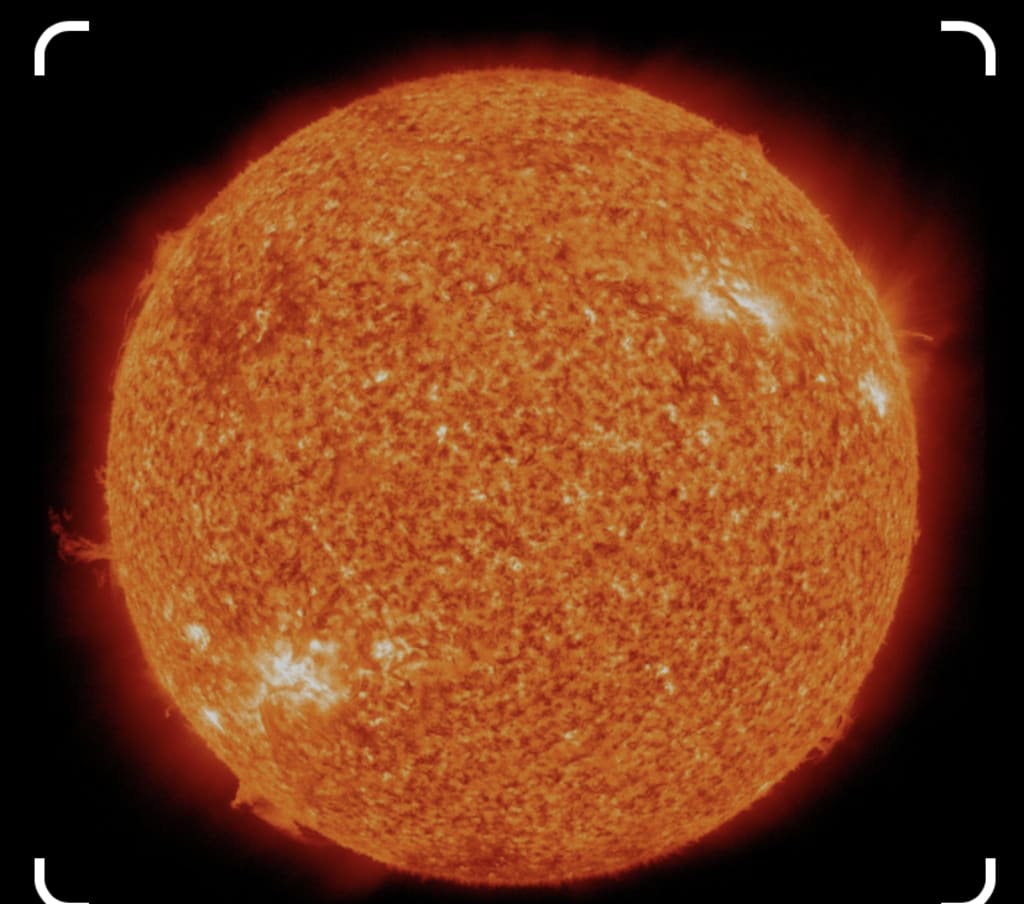
Certainly! The sun is a fascinating and vital star at the center of our solar system. Here are some key points about the sun:
Composition: The sun is primarily composed of hydrogen (about 74% of its mass) and helium (about 24% of its mass). The remaining 2% consists of trace amounts of heavier elements like oxygen, carbon, and iron.
Size: The sun is an average-sized star, classified as a yellow dwarf. Its diameter is about 1.4 million kilometers (870,000 miles), which is approximately 109 times that of Earth. However, there are much larger stars in the universe.
Energy production: The sun generates energy through a process called nuclear fusion. In its core, hydrogen nuclei combine to form helium, releasing an enormous amount of energy in the process. This energy is radiated outwards, heating the sun's surface and causing it to emit light and heat.
Temperature: The surface temperature of the sun, known as the photosphere, is around 5,500 degrees Celsius (9,932 degrees Fahrenheit). However, the temperature increases dramatically in the sun's outer atmosphere, known as the corona, reaching millions of degrees Celsius.
Sunspots: Sunspots are temporary dark spots that appear on the sun's surface. They are cooler regions caused by intense magnetic activity. Sunspots often occur in pairs or groups and follow an 11-year cycle known as the solar cycle.
Solar flares and prominences: Solar flares are powerful explosions on the sun's surface caused by the release of magnetic energy. They release a tremendous amount of energy and can produce bursts of X-rays and high-energy particles. Prominences, on the other hand, are large loops of plasma that extend from the sun's surface into its outer atmosphere.
Solar wind: The sun constantly emits a stream of charged particles known as the solar wind. These particles, mainly protons and electrons, travel through space and can interact with the Earth's magnetic field, causing phenomena like auroras.
Importance for life on Earth: The sun is crucial for sustaining life on Earth. It provides light and heat necessary for photosynthesis, which is the primary process by which plants convert sunlight into energy. The sun also influences Earth's climate and weather patterns.
Sun's lifespan: The sun is about 4.6 billion years old and is currently in the middle of its main sequence phase. It is estimated to have a total lifespan of around 10 billion years. In the future, the sun will exhaust its hydrogen fuel and undergo significant changes, eventually evolving into a red giant and then shedding its outer layers to become a white dwarf.
Understanding the sun and its various aspects is essential not only for scientific research but also for practical applications such as solar energy and space weather forecasting.
Energy output: The sun is incredibly powerful and emits a staggering amount of energy. Its total power output, known as its luminosity, is about 3.8 x 10^26 watts. This energy is what fuels life on Earth and drives the various processes occurring within the sun.
Solar eclipses: Solar eclipses occur when the moon passes between the sun and the Earth, casting a shadow on the Earth's surface. During a total solar eclipse, the moon completely blocks the sun, revealing the sun's outer atmosphere, or corona. These rare and awe-inspiring events provide an opportunity to study the sun's outer layers.
Solar cycles: The sun undergoes a roughly 11-year solar cycle, characterized by changes in the number and intensity of sunspots. This cycle is associated with changes in solar activity, including solar flares and coronal mass ejections (CMEs). Solar maximum refers to the peak of the solar cycle when solar activity is highest, while solar minimum is the period of lowest activity.
Solar mass and gravity: The sun's mass is approximately 330,000 times that of Earth. Its immense gravitational pull holds the planets of the solar system in their orbits. The sun's gravity also causes the planets to revolve around it and keeps other celestial objects, such as comets and asteroids, within the solar system.
Solar wind and magnetosphere: The solar wind, a stream of charged particles emitted by the sun, interacts with Earth's magnetic field, creating a region around the planet called the magnetosphere. The magnetosphere helps protect the Earth from the harmful effects of the solar wind, deflecting many of the charged particles.
Neutrinos: The sun emits vast numbers of neutrinos, subatomic particles with extremely low mass and no electric charge. Neutrinos are produced in the nuclear reactions occurring in the sun's core. They pass through matter easily and provide valuable information about the sun's interior.
Solar energy: The sun is a tremendous source of renewable energy. Solar panels, also known as photovoltaic cells, harness sunlight and convert it into electricity. Solar energy is clean, abundant, and sustainable, making it a crucial component in efforts to reduce reliance on fossil fuels and mitigate climate change.
Sun-like stars: The sun is classified as a G-type main-sequence star, also known as a yellow dwarf. There are billions of stars in the universe, and the majority are similar to or smaller than the sun. Studying the sun provides valuable insights into the behavior and evolution of other stars in the galaxy.
Continued research and exploration of the sun are vital for deepening our understanding of stellar physics, space weather, and the sun's influence on Earth and the solar system.
About the Creator
Enjoyed the story? Support the Creator.
Subscribe for free to receive all their stories in your feed.
Comments
There are no comments for this story
Be the first to respond and start the conversation.