
The sun isn't a raging bonfire
Did you know that the sun isn't really on fire
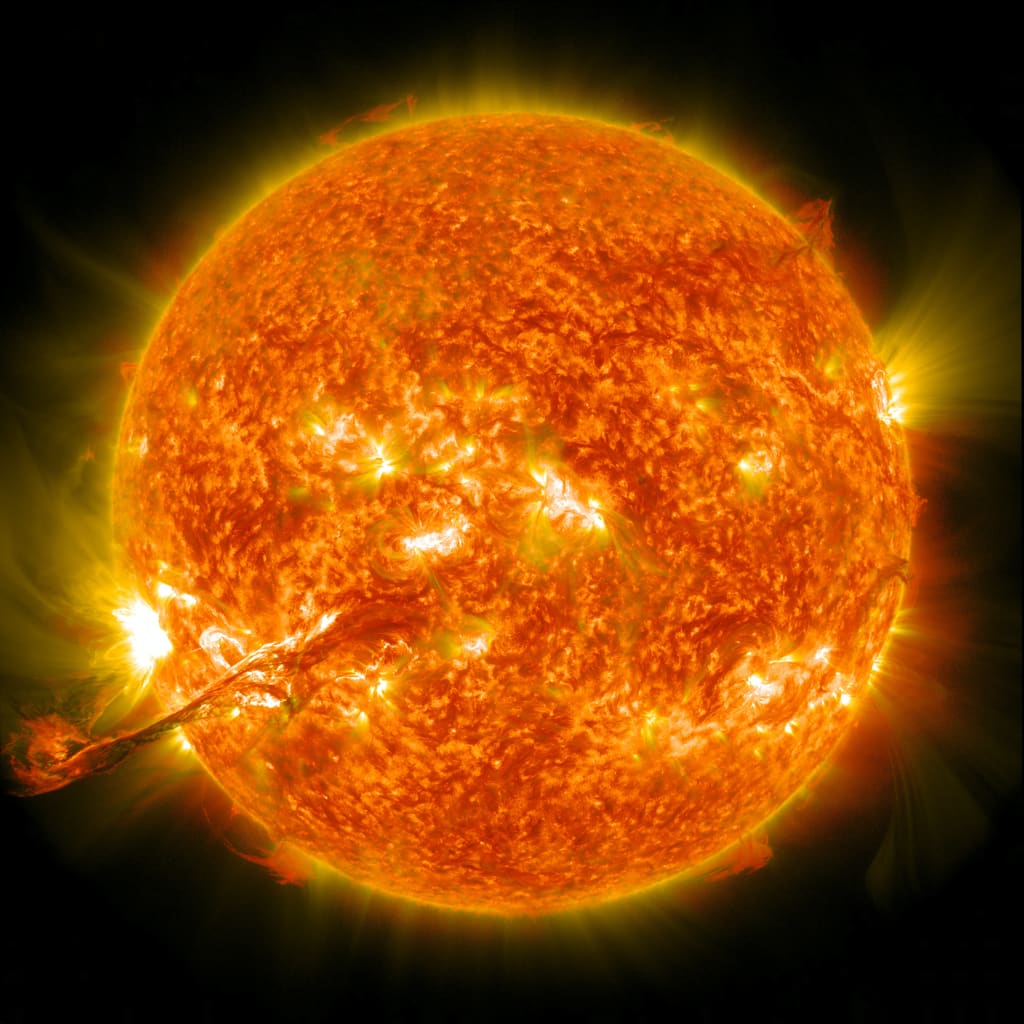
Did you know that the sun isn't a raging bonfire at the center of the solar system? It's not on fire; it's actually a nuclear reactor. Inside stars, hydrogen atoms fuse to form helium atoms, releasing enormous amounts of energy through nuclear fusion. This energy shoots out in all directions, eventually reaching you.
Now, let's explore some other seemingly fiery objects in our night sky. Meteors may appear to be on fire as they blaze through our atmosphere, but that's not the case. If you're lucky enough to catch a glimpse of a shooting star, what you're really seeing is the glow from the intense air pressure in front of the meteor as it speeds through our atmosphere. The rapid compression of air in front of the meteor heats things up until it glows brightly. As a result, meteors tend to burn up in our atmosphere, even though they aren't technically on fire.
Did you know that 2023 is projected to be the hottest year on record? The issue isn't just heat waves and wildfires; soon, you might not be able to eat raw oysters. Warming waters are fostering bacteria growth, making raw oysters unsafe to eat. Beer could also taste worse and be more expensive due to declining hops production in Europe, a consequence of hotter summers. Although we're not on track to meet our climate change goals, progress is still possible. The Inflation Reduction Act is investing nearly $370 billion in climate and clean energy initiatives. Despite the recent acceleration of global warming, humans are in the driver's seat, deciding the future of climate change.
While our atmosphere is our last line of defense, some space rocks are too big for the atmosphere to consume before crashing into Earth. In such cases, the idea of nuking a giant asteroid, as depicted in movies, is not a foolproof solution. Nuking it could break it into many smaller pieces, each posing a significant hazard to life on Earth. Hopefully, discussing the potential threat of asteroids hasn't scared you too much. If so, wipe those tears away because, in space, you can't cry in the same way you do on Earth. Due to microgravity, tears would gather into a watery blob that floats or sticks to the front of your face.
Speaking of microgravity, the notion of there being no gravity in space is misleading. Astronauts on the International Space Station aren't weightless; they're in a constant state of freefall due to their orbit around Earth. They're always falling but never landing. While the tagline "In space, no one can hear you scream" from the movie Alien is partially true, there are areas in space, like hot gas clouds around some black holes, where there may be enough particles to allow sound to travel.
You might have heard that planets have their own song, a concept rooted in ancient astronomers' theories about the Music of the Spheres. Although the planets don't produce music, their magnetic fields interacting with charged particles result in radio emissions that scientists have converted into sound waves. However, these eerie sounds might not be music to everyone's ears.
In space, there's mostly no sound due to the vacuum. While space is not a perfect vacuum, with a few stray atoms lurking in the voids between galaxies, the sound is significantly absent compared to Earth. Another myth dispelled is the idea of astronauts spontaneously exploding if exposed to space without a spacesuit. While space is harsh to the human body, the more realistic outcome would be a swift demise due to the lack of protection, not a dramatic explosion.
If you ever find yourself on a spacewalk, blowing air won't be enough to move you. Staying attached to handrails or having thrusters on your suit is crucial to staying close to your intended position. Despite the famous album by Pink Floyd, there isn't a dark side of the moon that's permanently dark. The moon is tidally locked to the Earth, showing the same side as it revolves around our planet. Each side of the moon receives sunlight every day.
To conclude our journey through space myths, let's return to Earth. Despite its appearance, Earth is not a perfect sphere. It's technically an oblate spheroid, slightly flattened at the North and South Poles and bulging at the equator. This shape resulted from the planet's formation, much like a ball of clay spinning and shaping over time.
Have these space myths made you wonder about other misconceptions you might have been told? Perhaps there are more lies to debunk, like those about dinosaurs, but that's a story for another day.
About the Creator
Enjoyed the story? Support the Creator.
Subscribe for free to receive all their stories in your feed.
Comments
There are no comments for this story
Be the first to respond and start the conversation.