
The Silent Giants in Our Yards: How to Spot a Dangerous Tree
A lush, green canopy doesn’t guarantee a structurally sound tree. Here is how to identify the hidden hazards lurking in your landscape before the next storm hits.

Most of us look at a mature shade tree and see nothing but benefits: a place to string a summer hammock, a natural canopy that lowers our afternoon cooling bills, and a beautiful, grounding anchor for our landscaping. Because we naturally associate green leaves with vitality, we tend to assume that a tree with a full canopy is strong and safe.
Unfortunately, this assumption is one of the most common—and dangerous—misunderstandings in property ownership.
Tree health and tree stability are two entirely different things. A tree can be actively fighting a severe foliage disease, look completely bare, and still possess a trunk strong enough to withstand gale-force winds. Conversely, a fast-growing oak with brilliant green leaves might be suffering from extensive internal wood rot. It can be biologically thriving but structurally doomed, making it a quiet hazard waiting for a strong gust of wind.
How do you know if the towering giant in your yard is a guardian or a liability? You do not need a forestry degree to spot the warning signs, but you do need to know where to look.
The Rule of the Target Professionals use a specific framework to evaluate danger. For a tree to be considered a true hazard, it must have a target. If a decaying, hollow pine is slowly falling apart in an unpopulated forest, it is simply part of the natural ecological cycle. However, if that exact same tree leans over your driveway, your roof, or a neighborhood sidewalk, it becomes a severe liability. Risk assessment always starts with asking one simple question: if this falls, what will it hit?
Starting at the Foundation: Roots and Soil Begin your visual inspection at ground level. A tree is only as strong as its root system. Look closely at the dirt around the base of the trunk. If you notice the soil cracking, lifting, or heaving upwards, the root-soil plate is actively losing its grip on the earth. This makes the tree highly susceptible to blowing over. Additionally, take note of any major structural roots that have been severed by recent construction or show signs of advanced decay.
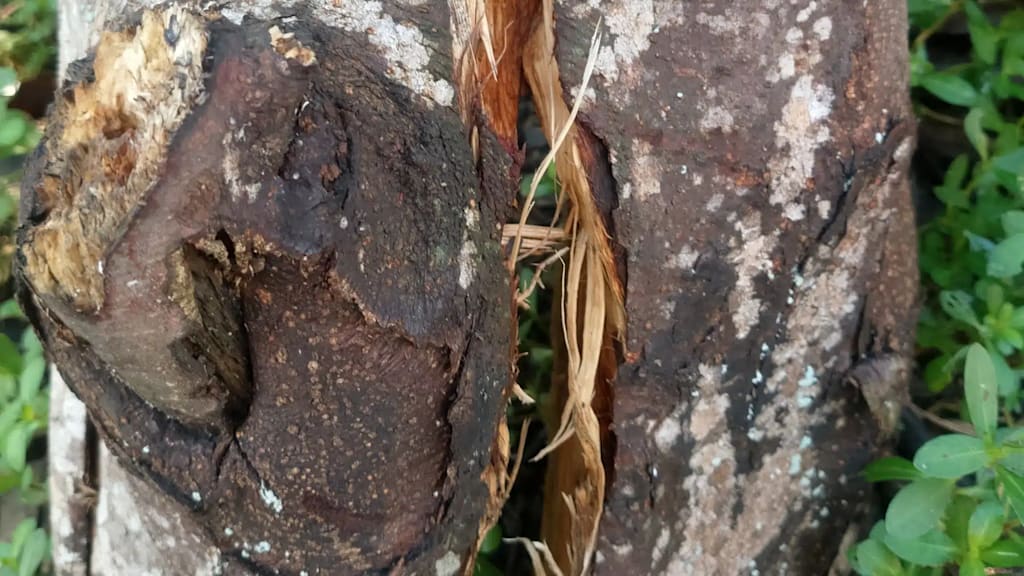
Examining the Core: Trunk and Wood Defects Next, examine the trunk. Gravity constantly tests the load-bearing capacity of the wood. While minor surface checking is normal, deep cracks are a major warning sign. Cracks running horizontally across a branch, or those that visibly flex when the wind blows, indicate the wood fibers are actively failing under the weight.
Watch out for large cavities and missing bark. While a hollow tree might look charming, cavities often hide extensive internal decay. If large sections of bark easily peel off, it means the vital tissue beneath has died.
The Fungal Warning Sign Pay attention to unexpected fungal growth. Mushrooms or conks growing out of the trunk or along exposed roots are not just an interesting garden feature. They are a strong indicator that wood-decaying fungi are actively consuming the tree's internal structural fibers from the inside out.
Assessing the Canopy and Posture The top of the tree acts like a giant sail, catching wind and transferring kinetic energy down the trunk. Keep an eye out for large, dead branches. Dead wood is surprisingly heavy, and as microorganisms break down the fibers, these branches can snap without notice.
Observe the tree's posture. Many trees develop a gradual lean over decades to seek sunlight, building strong reaction wood to support their weight. However, a tree that develops a sudden, severe lean—especially following a heavy rainstorm—is experiencing catastrophic root failure.
Proactive Care Over Panic Spotting a structural red flag does not automatically mean you must cut down a beautiful piece of nature. Modern tree care offers various solutions. A compromised tree can often be preserved safely through targeted weight-reduction pruning or by installing specialized steel cabling to support weak branches.
The secret to safe landscaping is proactive monitoring. Inspect your yard once a year and immediately after major storms. Addressing a weakened branch today is always better than dealing with the aftermath of a fallen tree tomorrow.
About the Creator
ORB Tree Service Marketing
ORB Tree Service Marketing provides SEO and local search strategies for the tree care and roofing industries. Follow us for insights on search optimization and lead generation for home services.
Enjoyed the story? Support the Creator.
Subscribe for free to receive all their stories in your feed.
Comments
There are no comments for this story
Be the first to respond and start the conversation.