
The Shore That Keeps Moving
For years I pushed my child toward a future I couldn't describe. Then he lay on an archway and watched a bug.
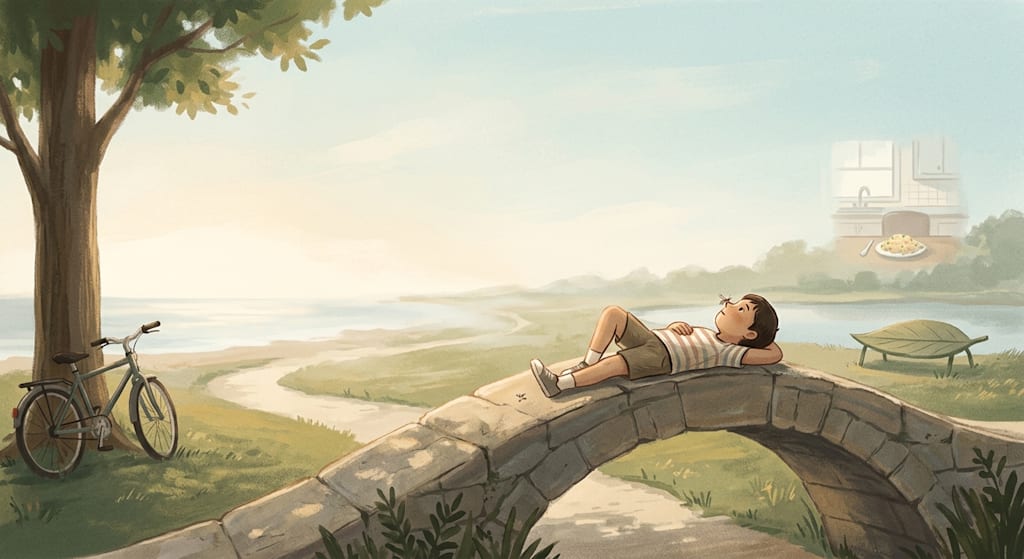
Once, my child went to the park by our compound to look for friends to play with. He didn't find anyone, but he lay down quite contentedly on the round archway. I took out my phone to take a picture of him, and he caught me. Lowering his voice, he said, "Don't make a sound. There's a bug on top of the archway (I don't know its name), and it's crawling very slowly." He just lay there, staring at it, as if guarding some enormous secret. I stood beside him for about two minutes. My legs began to ache, and my mind drifted to what we should cook for dinner. Suddenly he said, "It turned." There was a very serious kind of surprise in his voice.
Later, I often thought about that afternoon. A child's world is complete, so complete that a bug turning a corner can fill an entire dusk. We adults, by contrast, live like crumpled schedules, without even the courage to stop and look at a bug.
Many parents say they "cannot accept their child being mediocre," but what they cannot swallow is their own life. They feel they have lived too ordinarily, so ordinary that they are like a sheet of paper endlessly photocopied by life, and they desperately do not want their child to be printed the same way. In their hearts there is a "far shore": a place more polished, more composed, less easily outdone by others. But if you ask them what that shore looks like, most parents cannot say clearly. That shore has no coordinates. It exists in other people's mouths and eyes. So education becomes a battle against falling, against mediocrity: they are afraid that if the child relaxes even a little, he will drop into the mud they are struggling in.
This anxiety contains a cruel paradox: the more parents believe they themselves are mediocre, the more easily they narrow "not being mediocre" into a single straight log bridge. Grades must be near the top; the school must be a 985; the job must be in the system or at a big tech company; by thirty, one must be married, have a child, and own a home. Their imagination of "not being mediocre" is so impoverished that it makes one's heart ache. Because they have never experienced a richer sample of life, they can only take society's most mainstream ruler and treat it as the only lifesaving straw. But children are sensitive, independent, and growing up in a new era. What he receives is "Mom is very dissatisfied with herself," and the weight of it lands on him: he must win honor for her. The wish that he be happy never arrives. This is an inverted parent-child relationship. The child hurries along the road for his parents' regrets, pays for the "mediocrity" in his parents' minds, while the parents look for their own dignity in the child's report card.
Three years ago, the child of a cousin in my hometown got into the best high school in our county, and they invited us to a restaurant to celebrate. When the college entrance exam results came out this year, they were disappointed. The child had not gotten into the ideal university, and they began arranging for him to repeat a year and fight again. At the table, what the adults said most was "Give it another push," "We can't just settle," "Another year and maybe he'll get in." I noticed that the child kept his head down, picking at his rice, pushing a piece of braised pork from the edge of the bowl to the center, then back again. Someone asked him, "What do you think?" He said, "I'll listen to my dad." His voice was very soft, so soft that it seemed he was afraid someone might hear it. Later I thought: that admission notice from a university that was not the ideal one. Did the child really not want it? As parents, don't we need to calm down and listen carefully to what our child is saying? Repeating a year can be a choice, but it should not be an extension of the parents' unwillingness to accept things. If the child himself is willing to fight again, that is his courage; if the parents are merely renewing their own "unwillingness" on his behalf for another year, whose life is he living that year?
We see a large number of "hollow" children. In elementary school they grind at math olympiad; in middle school they grind at rankings; in college they grind at GPA. Then they enter society, and no one assigns them homework anymore, and they are lost. Because they have never lived a single minute for themselves. The fuel for all their effort is the fear of "not letting my parents down." How far can that fear push them? Probably not all the way to that shore; most will break down halfway. Many parents discover in middle age that even if the child gets into a famous school and a good unit, the stone in their heart has not landed. Because new comparisons arrive. A colleague's child earns a million a year; a neighbor's son-in-law is an executive; an old classmate's daughter married into a wealthy family. Only then do they vaguely sense that the "shore" is moving. You chase it, and it retreats; you use your child to reach for it, and it becomes a rope forever one inch short.
I often thought later about that afternoon when my child lay on the archway watching the bug. I also thought about a short bike ride this year, by a reservoir not far from my hometown. The child said he wanted to rest for a while on a leaf-shaped bench, to thank his legs and feet and his bottom too, and look at the water and feel the breeze, and he asked me to watch the bicycle by the roadside. When he said these things, he was as serious as if he were presiding over a ceremony. We adults probably find it hard to understand why "thank my legs and feet" is worth saying aloud. But it is these "useless" moments that let me see a child's most original goodwill and curiosity toward the world.
Last year, he kept pestering me to teach him how to cook. He said that so far he could only make instant noodles. So I taught him how to make egg fried rice. One weekend morning, while we were all sleeping in, he quietly got up and started making breakfast for us. I heard a bowl knock against the stove. Once, then again, unhurried. When I got up to look, he was standing on a stool reaching for the soy sauce bottle. His movements were not skilled, but they had a certain form, and more than anything, my heart felt warm. When the egg fried rice came to the table, the eggs were a bit broken and the rice a bit clumpy. His father took a bite and said, "Too salty." The child said, "Then tomorrow you can add the salt yourself." Then all three of us laughed. In that moment, education stopped being about carving a stone into jade. It became a matter of accompanying this stone to see what kind of mountain path it can roll out. Jade has jade's price; stone has stone's path. If you insist that stone become jade, the stone suffers, and so do you. If you roll along with the stone, you may see a road you have never taken.
Accepting a child's mediocrity means first accepting your own. This is self-reconciliation, and it is harder than lying flat. You have to admit that your life may not have a spotlight, but the joy when you pick out fresh strawberries at the market, the satisfaction after sleeping in on a weekend, the warmth when your partner hugs you: these trivial, ordinary moments are the marks of a life you have lived. If you can taste a little sweetness from these cracks, you will not treat your child as the sequel to your life. You will see him sitting at his desk staring into space, see the little figures he draws on scratch paper, see him clumsily building a shelter for a stray cat, see him secretly leaving a bit of rice to feed the ants under the tree. When you understand these "useless" yet shining moments, you will allow him to become a tree that blooms late, or even allow him to become a blade of grass that does not want to bloom at all.
I also know that structural pressure is not imaginary. The returns of education, job competition, social evaluation: they blow like wind on every family. A sentence like "You need to make peace with yourself" cannot shut the wind off. But because the wind is strong, we must not pack all our fear and stuff it into the child. Acceptance still requires boundaries. Acceptance means giving a bottom line and leaving blank space. The bottom line is health, safety, responsibility; the blank space is allowing him to stare into space, watch bugs, make egg fried rice, and take a path that is not so straight. Major choices should be returned to the child, or at least decided together. You can tell him the pros and cons of repeating a year, but do not press the "fight another year" button for him; you can hope he works hard, but do not make "you must stand out" the precondition for love.
Follow the stone down the mountain. Learn the path it chooses. When you no longer treat "mediocrity" as a shame, the child can walk out of the curse of "must rise above others" and explore his own life, perhaps ordinary but steaming with life. That is the shore he should go to. He walks it out himself. By then, you too can finally breathe out and manage your own days well. Your life is not over yet. Do not rush to stuff the relay baton into the child's hand; first live your own life open and at ease. If you taste sweetness from the cracks, the child will not have to hurry along for you. If you see that your own shore also has scenery, he will dare to go find his own shore.
That night, after the child came out of the shower, his hair still dripping, he suddenly asked me, "Mom, will that bug still be there tomorrow?" I said I didn't know. He said, "Then I'll go look again tomorrow." Then he padded back to his room in his slippers. I stood in the living room and heard him humming an off-key song. The tune turned this way and that, and finally turned into a melody I had never heard before.
About the Creator
Jin
Writer of reamstories
https://reamstories.com/jin
Enjoyed the story? Support the Creator.
Subscribe for free to receive all their stories in your feed. You could also become a paid subscriber, letting them know you appreciate their work.
Comments
There are no comments for this story
Be the first to respond and start the conversation.