
The Primordial Cloud: Where Everything Began
Part 15 of the Elucidation series. Previously: How Humanity Learned to See the World
• • •
Go back far enough, roughly fifteen billion years, and the entire universe was a cloud of hydrogen.
No stars. No planets. No elements heavier than hydrogen. No light in any meaningful sense. Just an immense, formless expanse of the simplest substance in existence: a single proton orbited by a single electron.
From this, from this almost nothing, everything you see, everything you know, everything you are, eventually emerged.
The First Act: Stars
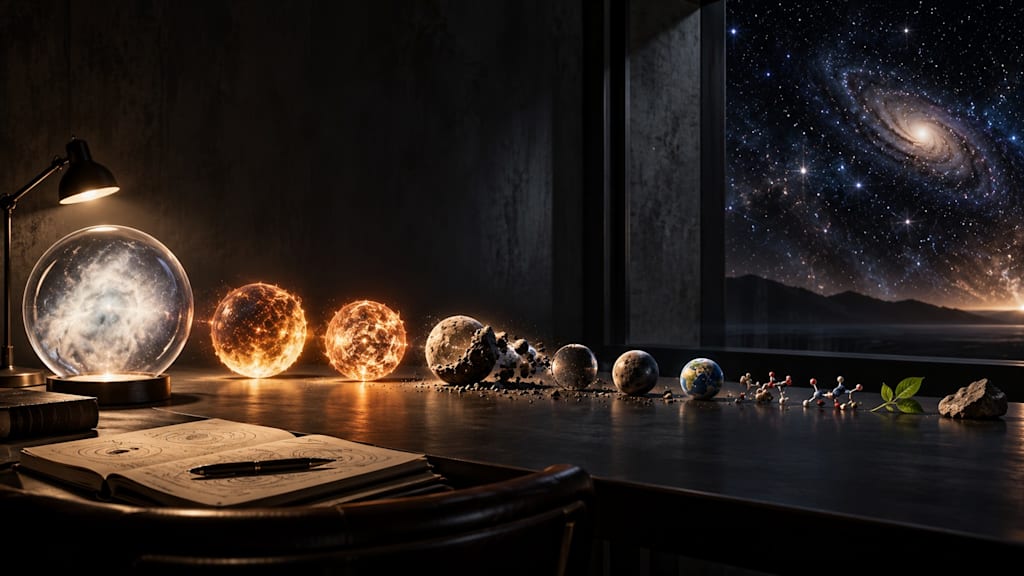
The hydrogen cloud was not perfectly uniform. Slight variations in density meant that some regions were fractionally denser than others. Gravity, operating over immense timescales, amplified those variations. Denser regions attracted more matter. The cloud began to clump.
As these clumps compressed, their cores grew hotter. Pressure and temperature rose until, at a critical threshold, nuclear fusion ignited. Hydrogen atoms were forced together to form helium, releasing enormous energy.
The first stars were born.
This was the first great act of complexity. From a uniform cloud, structured objects had appeared, objects with cores and surfaces, with internal processes, with energy flowing outward into the surrounding void. Something had come from almost nothing. Not by magic, but by the operation of the simplest physical forces on the simplest possible material.
The Second Act: Elements
Inside those first stars, the process continued. Helium was forged into carbon. Carbon into oxygen. Oxygen into heavier elements, step by step, up the periodic table. Each new element was more complex than the last, with more protons, more neutrons, more electrons, and more intricate internal structure.
When the most massive stars exhausted their fuel, they died in spectacular explosions called supernovae. These explosions scattered their newly forged elements across space. The elements mixed with surviving hydrogen clouds and from this enriched material, new generations of stars formed. Stars with planets around them. Planets with diverse chemical compositions.
The elements in your body, the calcium in your bones, the iron in your blood, the carbon in every cell, were manufactured inside stars that exploded billions of years before the Earth even existed.
The Third Act: Molecules
On planets with the right conditions, the right distance from their star, the right temperature, the right chemical mix, something new began. Atoms combined into molecules. Simple molecules combined into more complex ones.
This is where Professor Oparin's research becomes central. As he demonstrated, the path from simple chemistry to organic chemistry was not a sudden leap but a gradual, continuous process of increasing complexity. Carbon, with its extraordinary capacity to form diverse bonds, became the backbone of ever more elaborate molecular structures.
Amino acids. Nucleotides. Long chains of molecules with the capacity to store information and catalyze reactions. Each step was small. Each step followed from the chemistry of the previous one. But the cumulative direction was unmistakable: from simple toward complex, from uniform toward structured, from lifeless toward something that, given enough time and the right conditions, would begin to resemble life.
What This Journey Reveals
We are only partway through this journey, and already something remarkable is visible.
The process moves in one direction. From the simplest possible starting point, a cloud of hydrogen, it moves continuously toward greater complexity, greater structure, greater organization. At no point does it reverse. At no point does the universe, as a whole, become simpler.
Individual stars die. Individual molecules break apart. Entropy, the tendency toward disorder, operates everywhere. And yet, despite all of this, the overall movement is upward. The universe as a whole becomes more complex, more structured, more organized with each passing era.
This is not a philosophical interpretation imposed on the data. It is what the data shows. The hydrogen cloud is real. The stars are real. The elements are real. The molecules are real. And the direction, from simple to complex, from formless to structured, is visible in the evidence at every stage.
The question of what this direction means, whether it implies purpose, whether it has a destination, is a question for later. For now, it is enough to note that the direction exists. The story of existence is not random. It has a plot.
And the next chapter of that plot is the most extraordinary of all.
• • •
Next: From Hydrogen to Life: The Story of Matter**
Elucidation is a series of articles inspired by philosophical lectures given around 50 years ago. New articles are published weekly.
This article is part of the Elucidation series. The articles have been written and reviewed by the author with the assistance of AI.
About the Creator
Han Elucidation
Why do we exist? A searcher. Exploring existence, meaning, and what it means to be human through the Elucidation series.
Enjoyed the story? Support the Creator.
Subscribe for free to receive all their stories in your feed.
Comments
There are no comments for this story
Be the first to respond and start the conversation.