
The Mountain Has No Reservoir. So Why Did I Keep Expecting the Stream to Run?
I spent a week walking dry gullies in the Yongding River gorge. Most streams don't run all year. We just visit them when they do.
The question begins with a clause that is not true for most small mountain channels. Many streams do not run all year. When water is there, people call it a stream. When it is gone, they call it a gully. The same channel changes name, and the dry months disappear from memory.
For a week, we surveyed plants in the mountain gorge section of the Yongding River. The area ran thirty kilometers east to west and fifteen north to south. We walked every gully we could enter. In that whole area, I saw flowing water in two places. One was the main channel of the Yongding. The other was a spring. The rest, more than a dozen gullies, were dry. Not low. Not hidden under stones. Dry.
One gully is named Tianhejian, Sweet River Ravine. Jian means a ravine with flowing water. I have been there three times, including during the July and August flood season. I have never seen a drop in it. On the last visit, the soil was wet. The plants were green. This time, no effective rain had fallen for weeks. The soil was dust. Leaves curled on shrubs. Grasses had yellowed early. The channel had no water, and the plants had no water either. A square meter that held a dozen herb species last time held two or three still alive.
Yesterday we went to Qingshuijian, Clear Water Ravine, a small tributary of the Yongding. It was dry. The channel was full of Polygonum lapathifolium, a plant that likes wet ground. It stood there like evidence. Water had been there. It was not there then. Two gullies named for water. Two dry channels.
A stream that runs all year needs a reservoir inside the mountain. The reservoir on the surface is optional. Rain falls. Some evaporates. Some is caught by leaves. Some runs off. Some sinks. The water that sinks enters soil, cracks, aquifers, karst pipes, gravel deposits. In dry weather, it moves slowly and leaks into the channel. That is baseflow. It is small and steady. A stream can live on it through the year if the storage is large, the catchment is big, the rock holds water, and the rain is spread across seasons.
In northern China, most small gullies have none of that. The catchment is small. Soil is thin. Storage is limited. Forest and soil can slow water down. They cannot create it. After rain, a small stream may run for days. In Beijing, often no more than a week. Then it stops.
Hydrologists sort channels into perennial, intermittent, and ephemeral. Perennial channels have baseflow all year. Intermittent channels run part of the year. Ephemeral channels run only after rain. A word like stream hides this. It is a snapshot. The channel is not a stage prop. It changes with rain, season, heat, and what lies under the rock.
In the south, rain is spread more evenly. Groundwater is often closer. Perennial streams are common. In the north, the monsoon drops most rain in summer. Autumn, winter, and spring are dry. Small gullies go dry. There are exceptions: limestone, springs, high snowmelt. But exceptions are not the rule. A stream that runs all year is a local arrangement of geology, climate, and catchment. Mountains do not promise one.
We often see a stream once and make it permanent in our heads. We go in spring, see water. We go after rain, see water. We film it, post it, and forget the dry months. Then a dry gully looks wrong. But the dry gully is the same place. The water was a season. The channel is the place.
At Tianhejian, I saw mud shale weathering. It formed about 800 million years ago as mud in a shallow sea. Pressure turned it to rock. Weathering turns it back. Sea became mountain. Mountain became ravine. The ravine has held water and lost it many times. Our question about a stream running forever is a short blink in that record.
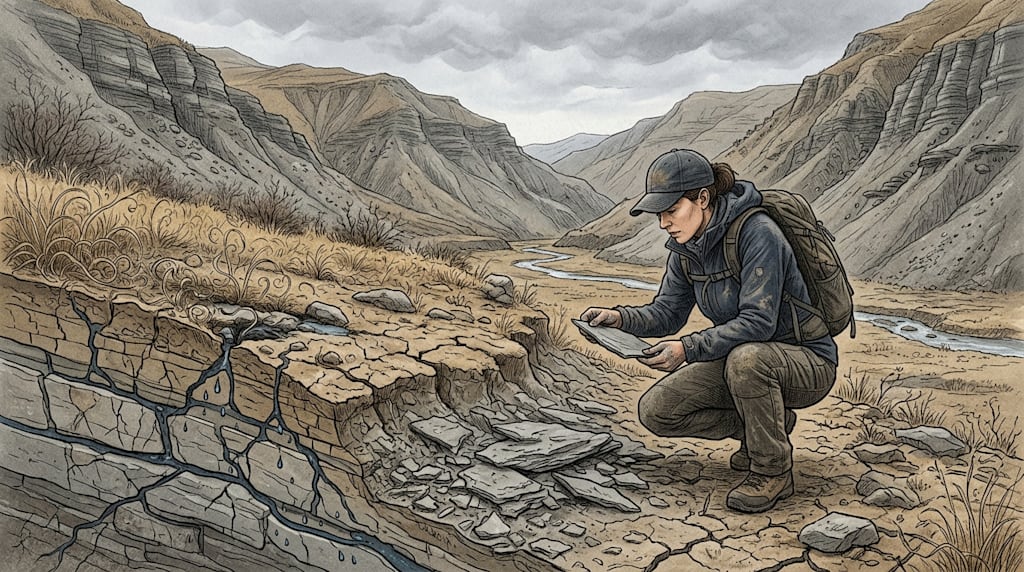
I crouched by the bank. I picked up a piece of shale. It split into thin sheets. Gray dust came off on my thumb. No water. The wind moved through the gully, pushed dry leaves against a stone, and stopped. I put the shale in my pocket. It was heavier than it looked. I walked out. The channel stayed dry.
About the Creator
Jin
Writer of reamstories
https://reamstories.com/jin
Enjoyed the story? Support the Creator.
Subscribe for free to receive all their stories in your feed. You could also become a paid subscriber, letting them know you appreciate their work.
Comments
There are no comments for this story
Be the first to respond and start the conversation.