
The melting of Antarctic ice shelves is happening far more quickly than anticipated, which is bad news for sea levels worldwide.
The significance of the Antarctic ice shelf

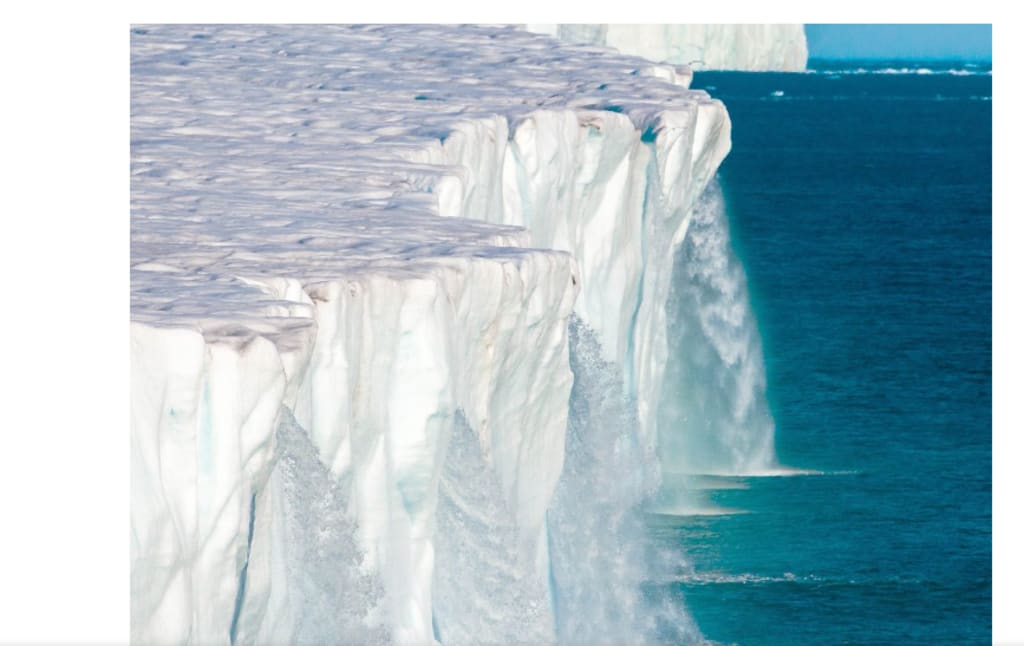
Antarctic ice shelves are being eaten away from underneath by warming oceans far more quickly than current models indicate. The mechanism behind it has been discovered in a recent study.
Warm water is trapped by grooves on the underside of the ice, concentrating its destructive force in the areas where it causes the greatest harm. There are important ramifications for sea level rise.
The iC3 Polar Research Hub in Tromsø, Norway, is the source of the study. Tore Hattermann and Qin Zhou were in charge of the study. Hattermann has been camping out on Antarctic ice shelves for hundreds of days, developing a thorough understanding of their physics.
The significance of the Antarctic ice shelf
Massive glaciers, which are enormous slabs of ice that extend across the ocean, have floating extensions called ice shelves. They essentially serve as a brake. They prevent gigatons of ice from sliding into the sea by slowing the glaciers' flow behind them.
That brake fails as ice shelves deteriorate. Sea levels rise more quickly than predictions based on stable shelves when the glaciers behind them accelerate and ice falls into the ocean. In some regions of Antarctica, this dynamic has already been noted. Polar ice shelf instability has been identified by the IPCC as one of the most significant and poorly understood risk variables in sea level science.
Under the ice, grooves
The Norwegian researchers discovered that ice shelves' undersides aren't smooth. It is channelled, with long formations that resemble grooves running along the ice's base. It turns out that certain grooves exhibit behaviour that no one had properly explained. The channels can hold relatively warm ocean water that passes beneath an ice sheet.
The water gets trapped in tiny circulation cells inside the grooves, where it sits against the ice and repeatedly transfers heat rather than passing through and going on. In comparison to adjacent smoother sections, melt rates in those channels can rise by around an order of magnitude.
In essence, the shape of the ice shelf foundation determines the location of the ocean's heat and concentrates it exactly where it is most harmful. We discovered that the ice shelf's underlying shape is more than just a passive characteristic. It can actively trap ocean heat in the precise locations where more melting is most important, according to Hattermann.
Not even frigid ice shelves are secure.
The Fimbulisen Ice Shelf in East Antarctica, which is typically colder than the rest of the continent and is therefore thought to be less immediately at risk, was the subject of the study. It could be necessary to change that assumption.
Hattermann stated, "We found that even tiny amounts of warmer water can significantly increase melting within the channels beneath the Fimbulisen Ice Shelf." Because of this, the channels may widen and, in the worst situation, compromise the integrity of the entire ice shelf.
"What is remarkable is that when the ice shelf base is channelled, even small inflows of warmer deep water can have a significant impact," Zhou continued. This implies that some ice shelves that scientists typically consider to be cold might be more brittle than anticipated.
Put another way, the areas of Antarctica that scientists have been least concerned about may merit greater attention than they have received.
How the research was carried out
The team combined a detailed map of the Fimbulisen ice shelf’s underside with a high-resolution model of the ocean cavity beneath it. In order to identify the precise impact of the channels on water flow, mixing, and melting, they contrasted models with a smoother ice base with a more realistic channelled one under both cooler and slightly warmer ocean conditions.
Long-term field observations from the area, some of which Hattermann himself gathered during protracted stays on the ice, were also incorporated into the paper.
Why models are making mistakes
The fact that the ice is melting more quickly than anticipated isn't the main issue here. The reason for this is because the models used by scientists and decision-makers to forecast sea levels completely fail to account for this mechanism.
Hattermann cautioned that "current climate models do not capture this effect." This implies that they run the risk of underestimating how sensitive the "cold" ice shelves along the coast of East Antarctica are to slight variations in the warming of coastal waters.
That is very important. Coastal planning, flood defences, infrastructure decisions – all of it depends on credible projections of how fast sea levels will rise and by how much. If East Antarctic melt rates are consistently underestimated by the models due to the absence of small-scale features beneath the ice, the forecasts feeding into those
Lastly, there are ecological repercussions. Variations in the amount of meltwater that enters the ocean have an impact on the marine ecosystems and circulation patterns surrounding Antarctica.
About the Creator
Enjoyed the story? Support the Creator.
Subscribe for free to receive all their stories in your feed.
Comments
There are no comments for this story
Be the first to respond and start the conversation.