
The Mars Child Who Landed on Earth
A Visitor from the Red Planet
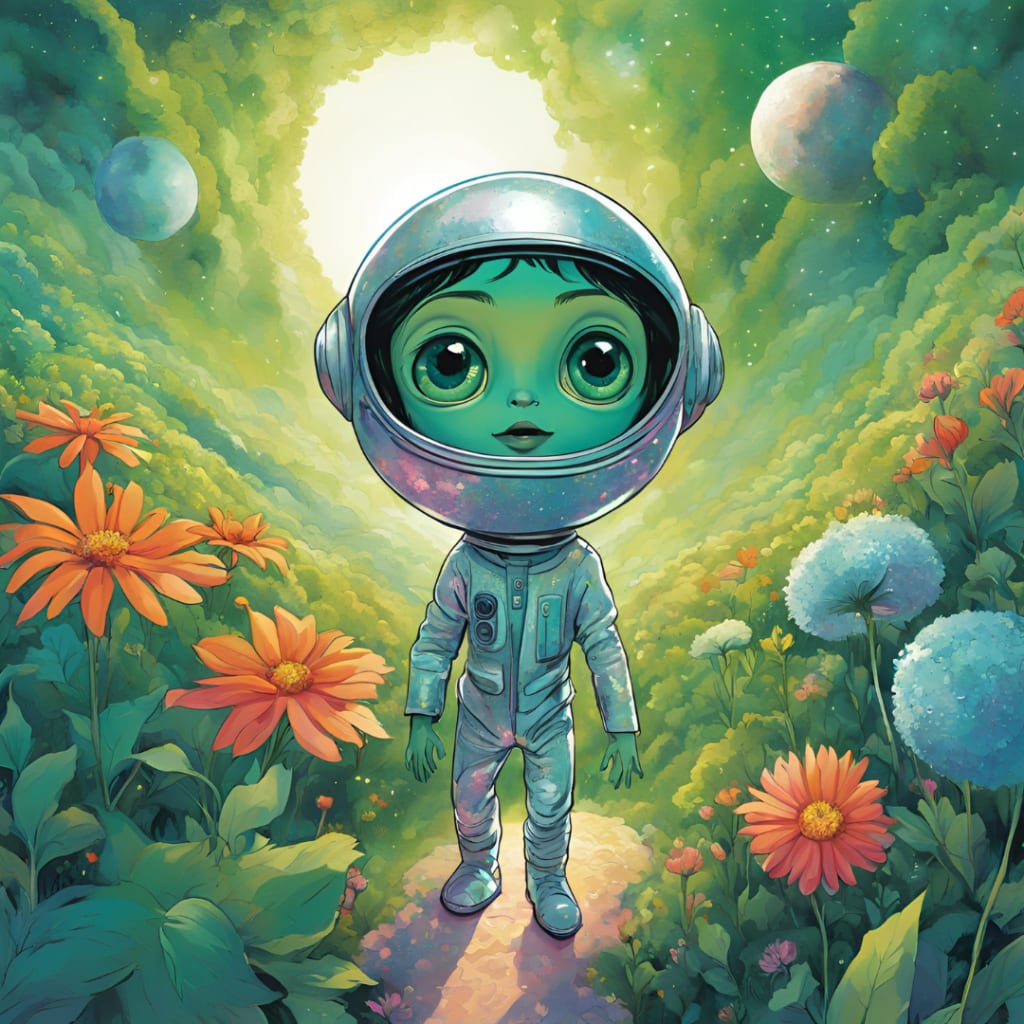
The Mars Child Who Landed on Earth For centuries, humanity dreamed of life beyond Earth. With advancements in space exploration, Mars had become a second home for humans. The Martian colonies thrived under massive bio-domes, adapting to a new way of life that relied on advanced technology and resourcefulness. Amid this evolution, a child named Kael was born on Mars, a being shaped by the crimson planet's harsh realities and distant from Earth’s vibrant embrace. Kael’s existence was a marvel. With lower gravity and thinner air, Martians had evolved differently. Kael was slender and agile, his lungs capable of extracting oxygen from even the thinnest air. His fiery red hair reflected the planet’s rugged terrain, and his eyes, deep emerald, seemed to glow under Mars's pale skies. But Kael was special not just because of his birth on Mars but because he dreamed of Earth—a planet he'd never seen, a world that felt like a legend. Kael grew up listening to stories of Earth’s blue oceans, lush forests, and endless skies. These tales, told by his grandmother, who had once lived on Earth, painted vivid images in his young mind. “Earth is alive,” she’d say. “It breathes, sings, and dances. Mars is our home now, but Earth... Earth is magic.” When Kael turned 15, a rare opportunity arose. An exchange program between Earth and Mars allowed select individuals to experience life on the other planet. Kael’s unwavering fascination with Earth earned him a place in this program. The day of his departure was bittersweet. His family gathered to bid him farewell, their faces a mixture of pride and worry. “Remember, Kael,” his mother said, holding his hands tightly, “Earth is beautiful but fragile. Treat it with care.” The journey to Earth was long and exhausting. As the spacecraft approached, Kael’s heart raced. From the window, he saw Earth—a swirling sphere of blue, green, and white. It was everything he imagined and more. The spacecraft landed in a secluded area to minimize media attention. As Kael stepped onto Earth’s surface, the air hit him—thick and humid, unlike anything he’d ever breathed. His legs wobbled under Earth’s stronger gravity, and the sunlight felt warmer, gentler than Mars’s cold rays. Kael’s host family, the Andersons, greeted him warmly. They lived in a small coastal town, their house nestled near a sprawling beach. It was a stark contrast to the sterile domes of Mars. The Andersons were patient and kind, helping Kael adjust to Earth’s peculiarities. The first thing Kael fell in love with was water. Mars had water, but it was scarce and confined to underground reservoirs. Here, oceans stretched endlessly. Kael spent hours at the beach, letting the waves kiss his feet and the salty breeze tangle his hair. He marveled at the sea creatures, their vibrant colors and curious shapes. Earth, however, was not without its challenges. The food was rich and diverse, but his Martian body struggled to digest it at first. The sounds of Earth—the chatter of birds, the rustle of leaves, the distant hum of cities—overwhelmed him. And then there were the people. Earthlings were louder, more expressive, their emotions raw and unfiltered. Kael found it fascinating and exhausting in equal measure. One evening, Kael sat with Mr. Anderson on the porch, watching the sun dip into the horizon. The sky turned hues of orange and pink, a sight that left Kael speechless. “On Mars,” Kael said, “the sunsets are blue. Beautiful, but lonely. Here, it feels like the sky is alive.” Mr. Anderson smiled. “That’s what makes Earth special, Kael. It’s alive in ways we don’t always understand. But it’s fragile, too. We’ve taken it for granted for far too long.” Kael nodded. He had seen traces of this fragility—pollution, deforestation, species on the brink of extinction. It reminded him of the stories his grandmother told about why humanity left Earth in the first place. As weeks turned into months, Kael grew accustomed to Earth’s ways. He attended school, sharing tales of Mars with curious classmates. He formed friendships, their bonds bridging the gap between worlds. One friend, in particular, stood out—a girl named Lena. She was fiery and inquisitive, her passion for the environment infectious. Lena introduced Kael to Earth’s wonders—hidden waterfalls, dense forests, and mountains that kissed the clouds. She also showed him the damage—rivers choked with plastic, trees felled for profit, animals struggling to survive. Kael felt a pang of guilt. On Mars, every resource was valued, every action weighed for its impact. Earthlings, he realized, had forgotten the importance of balance. One day, while exploring a forest, Kael stumbled upon an injured bird. Its wing was broken, its tiny body trembling with fear. Kael gently picked it up, cradling it in his hands. Lena helped him care for the bird, and after days of tender care, they released it back into the wild. The experience stirred something in Kael. Earth was beautiful, but it needed help. And maybe, just maybe, Kael could be that help. As his time on Earth neared its end, Kael began documenting everything he had learned. He wrote about Earth’s beauty and its struggles, its potential and its fragility. He planned to take these lessons back to Mars, to remind his people of the importance of harmony with nature. On his last night, Kael and Lena sat on the beach, watching the stars. “Will you come back?” Lena asked, her voice tinged with sadness. Kael smiled. “I will. But even if I don’t, I’ll carry Earth in my heart. And I’ll make sure Mars learns from it.” As the spacecraft ascended, Kael looked out the window, tears in his eyes. Earth grew smaller, but its impact on him remained vast. He thought of the bird he saved, the waves that lapped at his feet, the friendships that bridged galaxies. Back on Mars, Kael became an advocate for Earth, sharing its story with passion and urgency. His experiences sparked a movement, reminding Martians of their shared responsibility to protect not just their home but all homes in the cosmos. Kael’s journey was more than an exchange; it was a lesson in connection, compassion, and the enduring magic of a living planet. And though he was born on Mars, his heart belonged to Earth—a place that showed him what it truly meant to be alive.
About the Creator
Bhoopendra Patel
Hey there! I’m passionate about uplifting others through my writing and sharing inspiration. Writing has always been a way for me to connect with others and spread positivity.
Enjoyed the story? Support the Creator.
Subscribe for free to receive all their stories in your feed.
Comments
There are no comments for this story
Be the first to respond and start the conversation.