
The Lighthouse Beneath the Lake
An unfinished story, and why it remains unfinished

The Story
On the night the lake swallowed the lighthouse, Mara was twelve years old and hiding beneath her father’s workbench.
Storms came often to Blackwater, but this one sounded different. The thunder rolled not from the sky but from beneath the earth, as if something ancient were waking below the town. Rain hammered the windows. Wind rattled the roof. Through the cracks in the workshop walls, Mara could see flashes of white light from the shore.
Her father was pacing beside the radio, listening to static and fragments of voices.
“Repeat—structure failure at the lighthouse—evacuate the western docks—”
Then the signal died.
Mara knew the lighthouse better than anyone. It stood on a narrow spit of rock that jutted into Blackwater Lake, and her father maintained its machinery even though ships no longer used the route. Tourists liked it. Historians argued over it. Children dared each other to climb it at night.
But the townspeople avoided one subject entirely: the light beneath the lake.
Mara had heard whispers all her life. Fishermen spoke of pale glows moving under the water. Old Mrs. Vance claimed she had once seen stairs descending into the lake beside the lighthouse foundation. Others said the structure was built over something older, something the first settlers had tried to hide.
Her father dismissed the stories.
“Blackwater breeds legends the way swamps breed mosquitoes,” he always said.
Yet that night, his face was pale with fear.
He opened a metal cabinet and removed a rusted key attached to a leather cord. Mara had never seen it before.
“Stay here,” he told her.
“Where are you going?”
“To shut the beacon down.”
“The lighthouse is collapsing!”
“Exactly.”
He hesitated, then crouched beside her.
“If I’m not back by dawn, take this key to Mrs. Vance. No one else.”
Before Mara could ask why, he was gone.
The workshop door slammed shut behind him.
Mara waited for what felt like hours. The storm raged harder. At some point the power failed, plunging the town into darkness except for the distant flashes at the lake.
Then came the sound she would remember for the rest of her life.
A deep metallic groan.
Not thunder.
Not wind.
A sound like enormous gears grinding somewhere underwater.
Mara ran outside.
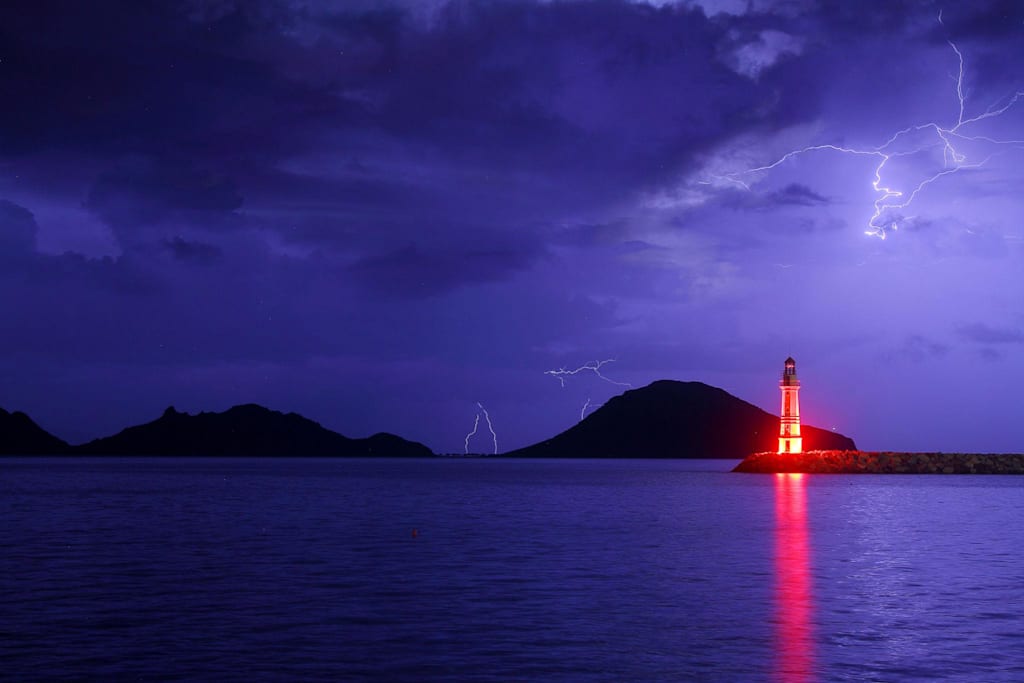
Rain soaked her instantly. People were gathering along the shore, shouting over the storm. The lighthouse tilted unnaturally, its beam sweeping across the water in frantic arcs.
Then the ground trembled.
The entire structure lurched sideways and slid into the lake.
For one impossible moment, the lighthouse remained upright in the water, half submerged, its light still spinning across the storm.
Then it sank.
The beam disappeared beneath the surface.
Silence spread across the crowd.
Even the storm seemed to pause.
And then the lake began to glow.
Pale blue light bloomed beneath the water where the lighthouse had stood. Lines of light spread outward like veins under glass. Shapes moved below the surface—too large to be fish, too smooth to be waves.
People backed away from the shore.
Someone screamed.
Mara stepped closer.
Through the rain, she saw something impossible rising from the depths: a spiral staircase made of black stone, emerging slowly from the glowing water.
At its top stood her father.
He was drenched, breathing hard, one hand gripping the railing. In the other hand he held a lantern burning with the same blue light as the lake.
Their eyes met across the storm.
“Mara,” he shouted, though the wind nearly stole the word. “You must never—”
The staircase shuddered.
Something enormous moved beneath it.
The water erupted upward.
Mara caught only fragments: her father falling, the lantern tumbling into the lake, a shape like a massive eye opening below the surface.
Then the staircase collapsed back into the water.
The glow vanished.
The lake became black again.
Her father was gone.
After that night, Blackwater changed. Officials called the collapse a tragic accident caused by erosion. Divers searched for weeks and found nothing—not the lighthouse, not the staircase, not a single stone.
Most people accepted the explanation because the alternative was unbearable.
Mara did not.
She gave the key to Mrs. Vance, who locked it away without explanation. When Mara begged for answers, the old woman only said:
“Some doors stay closed because they are kind enough to close themselves.”
Years passed. Mara left Blackwater, studied engineering, and tried to build a life far from the lake. But every few months she dreamed of blue light beneath dark water.
On the twentieth anniversary of the collapse, she returned home.
The town looked smaller. The shoreline had changed shape where the lighthouse once stood. Tourists still came, but no memorial marked the disaster.
Mrs. Vance was gone. Her house sat empty at the edge of town.
Mara broke in through a side window.
Inside, dust covered everything except a single wooden box on the dining table. The rusted key hung from its lock.
Hands shaking, Mara opened it.
Inside was a notebook written in her father’s handwriting.
The first page read:
If you are reading this, the beacon failed.
Mara sat in the dark house and began to read.
The notebook described a cavern beneath Blackwater Lake discovered during lighthouse repairs decades earlier. In its center stood a vast mechanism of black stone older than any known civilization. The mechanism emitted light and caused strange effects: missing time, vivid dreams, voices heard underwater.
Her father and a small group of caretakers had maintained a seal around the cavern for years. The lighthouse was not just a lighthouse—it was a lock.
The final entry was dated the night of the collapse.
The pressure is rising faster than expected. If the seal breaks completely, the staircase will surface and the door will open again. I may be able to delay it, but not stop it forever.
The entry ended abruptly.
Outside, thunder rumbled.
Mara looked through the window toward the lake.
Far out on the water, a pale blue light flickered beneath the surface.
Why This Story Never Fully Came Together
I started writing The Lighthouse Beneath the Lake because I loved the image of a lighthouse sinking into a glowing lake. The atmosphere arrived immediately: storm, mystery, family history, and something ancient under the water. But the story has remained unfinished for years, and the reason is surprisingly simple.
I never decided what was beneath the lake.
At first, that felt exciting. Mystery can be more powerful than explanation. I wanted the glowing mechanism and the staircase to feel uncanny and unknowable. But every time I tried to continue the story, the same problem appeared: Mara’s next choice depends on the nature of the thing below.
If the lake hides a supernatural entity, the story becomes cosmic horror. Mara’s arc would revolve around resisting knowledge and confronting something beyond human understanding.
If the mechanism is alien technology, the story shifts toward science fiction. Mara would investigate, decode, and perhaps reactivate something buried for millennia.
If the phenomenon is tied to collective memory or grief, the story becomes psychological or folkloric. The lake would mirror the town’s buried history rather than contain a literal monster.
All three versions interest me. None of them feels definitively right.
Because I never chose, the story stalls at the moment of revelation. The notebook promises answers, but I keep withholding them from myself as much as from the reader. The atmosphere works; the plot does not yet know what it is serving.
There is also a more personal reason the story remains unfinished.
I wrote the first draft shortly after my own father died unexpectedly. The image of Mara watching her father disappear into the lake came from a very real feeling: the sense that someone can vanish from your life while leaving behind unanswered questions that seem almost supernatural in their persistence.
Finishing the story would require deciding whether Mara ultimately finds truth, horror, or acceptance. I wasn’t ready to choose among those possibilities. In some ways, I still may not be.
So the story remains suspended at the shoreline, with the blue light flickering beneath the water and the notebook open in Mara’s hands. I know the next scene should begin with her returning to the lake at night.
I just don’t yet know what she will find there.
About the Creator
AFTAB KHAN
SUBSCRIBE ME AND READ STORY
Storyteller at heart, writing to inspire, inform, and spark conversation. Exploring ideas one word at a time.
Writing truths, weaving dreams — one story at a time.
From imagination to reality
Enjoyed the story? Support the Creator.
Subscribe for free to receive all their stories in your feed.
Comments
There are no comments for this story
Be the first to respond and start the conversation.