
The Last Forest Keeper
In a world transformed by climate change, one girl's determination to save a hidden spring becomes a beacon of hope for humanity's future.
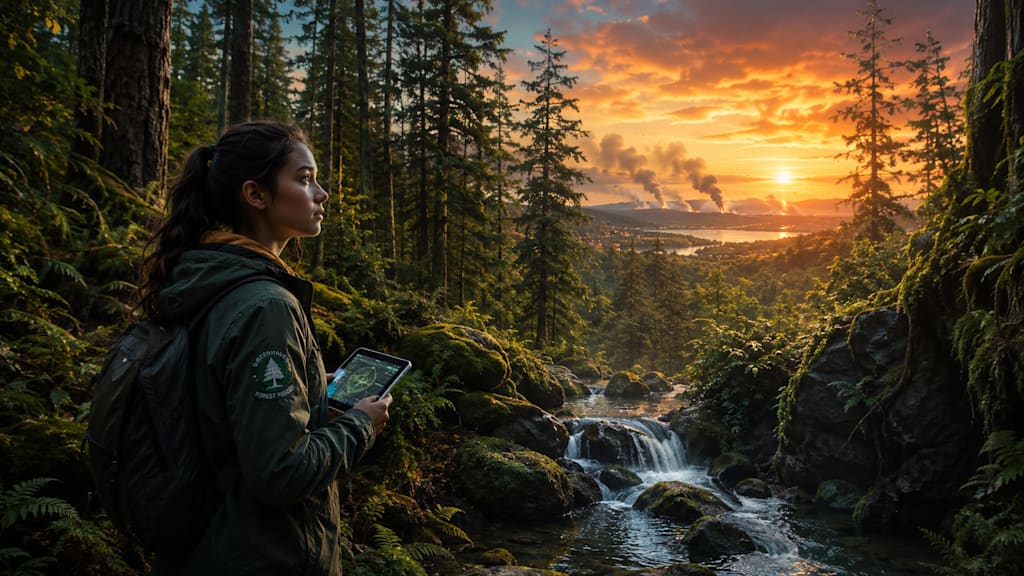
In the year 2085, the world was very different from what it had been decades before. Summers were longer and hotter. Many rivers had dried up, and several coastal cities had disappeared beneath rising seas. Giant storms crossed continents, leaving destruction in their wake. Climate change, once considered a distant threat, had become the defining challenge of humanity.
In a small settlement called Greenhaven, nestled among the last surviving forests of northern Canada, lived a sixteen-year-old girl named Maya. She was known throughout the region as the "Forest Keeper."
Maya had inherited the title from her grandfather, Elias, who had spent his life protecting trees and teaching people about nature. Before he passed away, he told her, “The forest is more than wood and leaves. It is our memory, our protector, and our future.”
Every morning, Maya walked through the ancient woodland carrying a digital tablet that monitored soil moisture, tree health, and wildlife activity. The forest was one of the few ecosystems left largely untouched by climate disasters. Scientists from around the world studied it, hoping to understand how it had survived.
One afternoon, while examining a group of towering pine trees, Maya noticed something unusual. Several sensors were flashing red. The soil temperature was rising rapidly, and moisture levels had fallen to dangerous lows.
She immediately sent a report to the Greenhaven Council.
“This doesn’t make sense,” she said during an emergency meeting. “The forest has its own water systems. It has survived droughts before.”
The council members exchanged worried glances.
An elderly scientist named Dr. Chen stood up.
“We have received satellite images,” he said. “A massive heat dome is moving toward the region. Temperatures may exceed anything we've ever recorded.”
Silence filled the room.
Heat domes had become more common due to climate change. They trapped hot air over large areas for weeks, causing wildfires, crop failures, and water shortages.
“How long do we have?” Maya asked.
“Perhaps ten days,” Dr. Chen replied.
The community immediately began preparing. Water reserves were protected. Fire barriers were strengthened. Drones were deployed to monitor vulnerable areas.
Despite everyone's efforts, Maya felt uneasy. She remembered stories from her grandfather about forests that vanished in a single season.
That night, she couldn't sleep.
As moonlight filtered through her window, she opened an old journal that had belonged to Elias. Between its weathered pages were notes about ecosystems, climate patterns, and restoration projects.
One passage caught her attention:
"The forest survives because of the Hidden Spring. If the spring ever fails, the forest will weaken."
Maya had never heard of a Hidden Spring.
The next morning, she packed supplies and set off into the deepest part of the forest.
For hours she followed faded maps from the journal. Eventually, she reached a narrow canyon overgrown with moss and vines.
At its center was a crystal-clear pool fed by underground water.
The Hidden Spring.
But something was wrong.
The water level was much lower than expected.
Maya activated her scanner and discovered that a landslide several kilometers away had partially blocked the underground channels feeding the spring.
If the blockage wasn't removed, the forest would lose its primary water source just as the heat dome arrived.
She raced back to Greenhaven.
The council listened carefully as she explained her discovery.
“We have to clear the blockage,” Maya insisted.
Dr. Chen shook his head.
“The landslide zone is unstable. Sending people there would be extremely dangerous.”
“But if we do nothing,” Maya replied, “the forest may not survive.”
After hours of discussion, the council approved a rescue mission.
The next day, Maya joined a team of engineers, scientists, and drone operators. They traveled across rough terrain to reach the landslide site.
The scene was alarming.
Thousands of tons of rock and soil had collapsed into a narrow valley, blocking underground waterways.
Using advanced mapping technology, the team identified the safest areas to work. Heavy machines could not access the location, so they relied on robotic excavation units.
For three days, they worked tirelessly.
Meanwhile, temperatures continued rising.
News reports from other regions painted a grim picture. Crops were failing across continents. Millions faced water shortages. Wildfires raged in several countries.
The climate crisis was no longer an environmental issue alone—it affected food, health, economies, and entire societies.
On the fourth day, disaster struck.
A sudden tremor triggered another landslide.
One of the excavation robots was destroyed, and the remaining units became trapped.
The mission leader ordered an evacuation.
“We're pulling out,” he announced.
Maya stared at the blocked valley.
“If we leave now, all this work will be wasted.”
“The area is too dangerous,” he replied.
Frustrated but determined, Maya studied the geological scans.
Then she noticed something.
A smaller channel on the eastern side remained partially open. If they could widen it, water might begin flowing again without removing the entire blockage.
She presented her idea.
At first, the engineers were skeptical.
But after reviewing the data, they agreed it could work.
Using precision drones equipped with laser cutters and drilling tools, they carefully expanded the secondary channel.
Hours passed.
Nothing happened.
Then, just before sunset, a faint rumbling echoed through the valley.
Water burst through the opening.
Cheers erupted across the site.
The underground system was flowing again.
When Maya returned to the Hidden Spring two days later, the water level had already begun rising.
The forest had been saved—for now.
But the heat dome was still coming.
Over the next week, temperatures shattered previous records. Several nearby regions suffered devastating wildfires.
Yet Greenhaven's forest endured.
The restored water system helped trees withstand the extreme heat. Moist soil reduced fire risk, and healthy vegetation cooled the surrounding environment.
Scientists worldwide were amazed.
Their studies revealed an important lesson: ecosystems with strong biodiversity and healthy water systems were far more resilient to climate change.
The forest became a symbol of hope.
International leaders visited Greenhaven to learn from its conservation strategies. New projects were launched to restore wetlands, plant diverse forests, and protect natural water sources.
For the first time in years, global cooperation on climate action began accelerating.
Maya often spoke at conferences.
During one event, a journalist asked her, “Do you think we can still solve the climate crisis?”
She paused before answering.
“We can't undo everything that has happened,” she said. “But we can decide what happens next. Climate change was created by human choices, and it can be fought through human choices too.”
Her words spread around the world.
Years later, many regions began recovering. Renewable energy replaced fossil fuels. Massive reforestation programs restored damaged landscapes. Cities were redesigned to be greener and more sustainable.
The challenges remained enormous, but progress was real.
On her twenty-fifth birthday, Maya returned to the Hidden Spring.
The forest stood tall around her.
Birds filled the air with song.
Young trees grew where bare ground had once existed.
She smiled as she remembered her grandfather's words.
“The forest is our memory, our protector, and our future.”
Looking across the thriving woodland, Maya understood their meaning completely.
The fight against climate change was not merely about preventing disaster. It was about protecting the living world that connected every generation.
And as long as people were willing to act, there was still hope for the future.
About the Creator
Enjoyed the story? Support the Creator.
Subscribe for free to receive all their stories in your feed.
Comments
There are no comments for this story
Be the first to respond and start the conversation.