
The Great Stages of Evolutionary Development
Part 25 of the Elucidation series. Previously: The Leap: When Gradual Change Is No Longer Enough

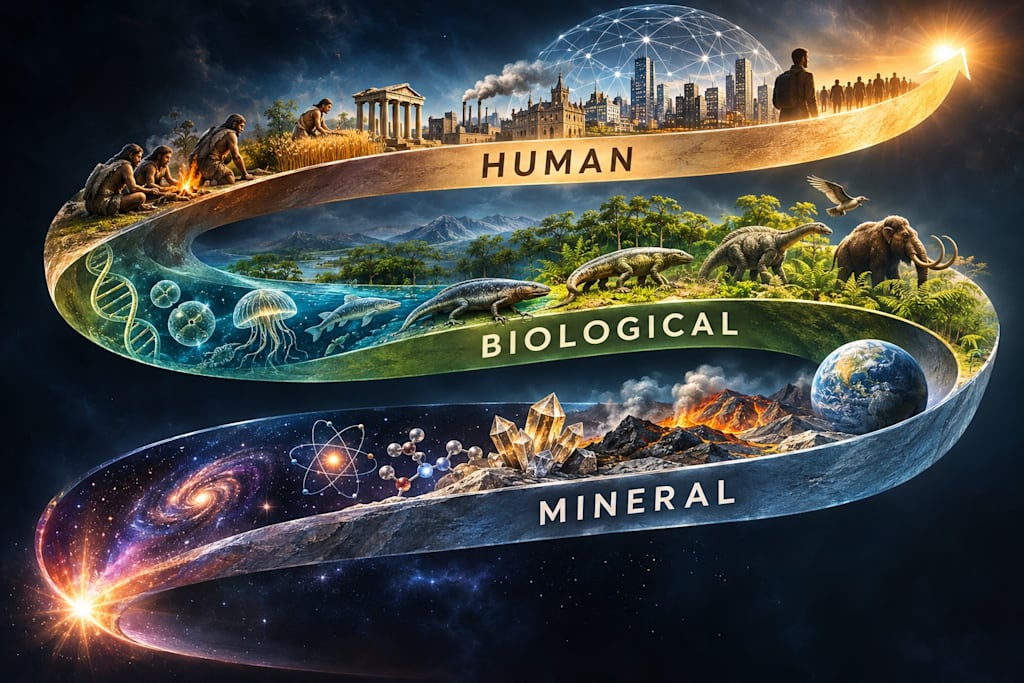
The Great Stages of Evolutionary Development
Part 25 of the Elucidation series. Previously: The Leap: When Gradual Change Is No Longer Enough
• • •
If we stand back and look at the full sweep of nearly 14 billion years, evolutionary development appears as a series of great qualitative stages. Each stage grows out of the one before it, but at a certain point something new emerges. New forms of organization appear, new possibilities open up, and new laws become increasingly important.
Seen in this way, we can distinguish three great stages of evolutionary development.
1. The Mineral Stage
The first stage begins with the early universe and the formation of the simplest elements. Over immense periods of time, stars formed, heavier elements were produced, planets appeared, and increasingly complex chemical compounds became possible.
At this level, evolutionary development takes place through the laws of physics and chemistry. Matter combines and reorganizes, gradually producing structures of greater complexity.
Eventually, this physical and chemical development creates the conditions for a qualitative leap: the appearance of life.
2. The Biological Stage
With the emergence of life, something qualitatively new appears.
Matter is no longer simply combining according to physical and chemical processes. Living systems can maintain themselves, reproduce, adapt, and gradually develop more complex forms.
The biological stage extends from the earliest forms of life through single-celled organisms, multicellular organisms, plants, animals, and increasingly complex organs and nervous systems.
Physics and chemistry still operate within every living organism, but they are no longer enough by themselves to explain what is happening. Biology, heredity, natural selection, and adaptation now become essential.
Over time, living organisms become increasingly complex. Nervous systems develop. Behavior becomes more flexible. Eventually, this process gives rise to the human being.
3. The Human Stage
Human beings remain biological organisms. We still have instincts, physical needs, and inherited biological characteristics. But we are no longer governed by instinct alone.
The development of the human brain creates the capacity for conscious thought, choice, learning, planning, and deliberate action. Human beings can increasingly change their environment instead of merely adapting themselves to it.
This marks the beginning of a new stage.
Human evolutionary development now takes place primarily through social life. Language, cooperation, production, knowledge, institutions, culture, science, economics, and politics become major forces of development.
A biological change may require thousands or millions of years. Human beings, however, can pass knowledge from one generation to another and transform their conditions without waiting for their bodies to evolve biologically.
Organized agriculture and settled societies appear only within the last several thousand years. Recorded history covers only about five thousand years. Modern industrial development occupies only the last few centuries. And today, some major social and technological changes can take place within a single generation.
Each Stage Builds on the Previous One
Biology does not abolish physics or chemistry. Every living organism still depends on them. Human beings do not stop being biological organisms simply because conscious and social development has become possible.
The earlier levels remain present, but something new is added.
A human being is therefore physical, chemical, biological, and at the same time conscious and social. The important point is that once a new level appears, we cannot fully understand it only through the laws of the lower level.
A living organism cannot be understood simply as a collection of chemicals. In the same way, human society cannot be explained simply by animal instinct or biology. Each new stage introduces new relationships and new laws that must also be understood.
The Shrinking Timeline
One of the most striking features of this history is how dramatically the timescale contracts.
Mineral / physical-chemical stage: roughly 10 billion years
Biological stage: more than 3 billion years
Complex animal development: roughly 600 million years
Human stage: roughly 300,000 years
Recorded history: roughly 5,000 years
Modern industrial development: roughly 300 years
The timeline is shrinking at an extraordinary rate. What took billions of years in the mineral stage now takes decades or even years in the social stage. The process is not slowing down. It is speeding up, which is the subject of the second law of evolutionary development.
But before we turn to acceleration, there is one more critical implication of the stage-based nature of development that must be addressed in the next article: the danger of applying the wrong laws to the wrong stage.
• • •
Next: Evolutionary Development: Why Each Stage Has Its Own Laws**
Elucidation is a series of articles inspired by philosophical lectures given around 50 years ago. New articles are published weekly.
About the Creator
Han Elucidation
Why do we exist? A searcher. Exploring existence, meaning, and what it means to be human through the Elucidation series.
Enjoyed the story? Support the Creator.
Subscribe for free to receive all their stories in your feed.
Comments (1)
The shrinking timeline really put things in perspective for me — billions of years for the mineral stage, then just a few centuries for industrial change. I especially liked the point that each stage needs its own laws, since biology cannot be reduced to chemistry alone. I am curious how you will apply that warning about using the wrong laws in the next part.