
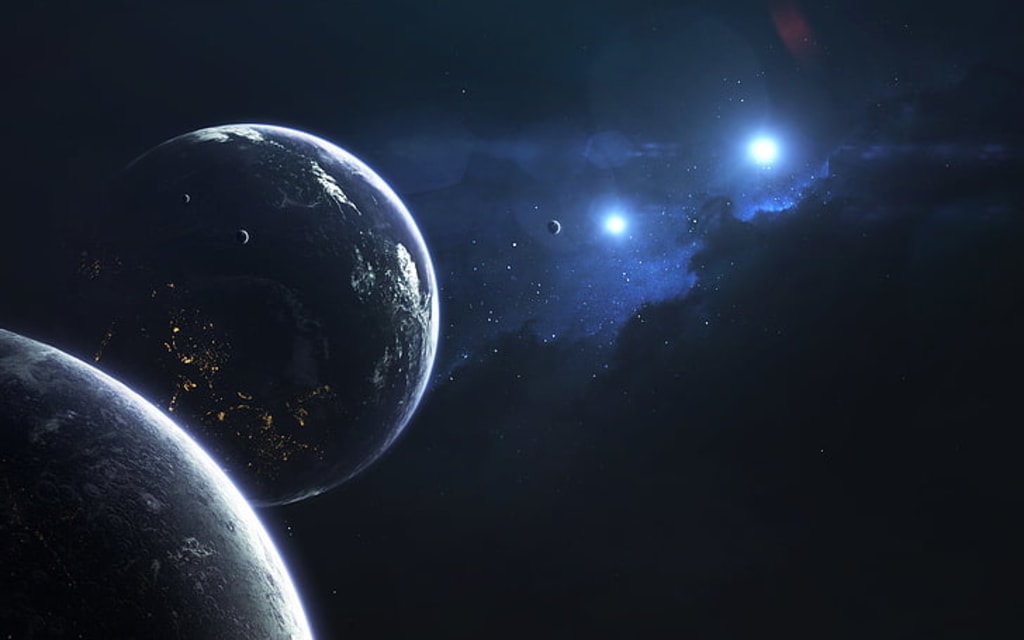
This is Earth, the planet on which you reside, situated within your local neighborhood, the solar system.
Consider the distance between Earth and the moon, which may not appear significant at first glance. However, upon closer examination, it becomes apparent that they are separated by a distance of two hundred
and fifty-two thousand and eighty-eight miles. To put this into perspective, this distance is sufficient to accommodate all the planets within our solar system. Let us now delve into the characteristics of
certain planets, such as Jupiter's Great Red Spot, which is approximately twice the size of Earth, and Saturn, which is nine times wider than Earth. The rings of Saturn are of such magnitude that some
fragments within them rival the size of mountains. However, these dimensions pale in comparison to our Sun.
It is crucial to bear in mind that this is Earth, as observed from various vantage points, including the moon, Mars, just behind Saturn's rings, and even from a distance of four billion miles beyond Neptune.
The enormity of a billion can be better comprehended when considering that one million seconds equates to approximately eleven and a half days, whereas one billion seconds surpasses thirty-one years.
Now, let us take a step back and contemplate the size of Earth in relation to our Sun, a comparison that evokes a sense of awe. Furthermore, we can envision the same Sun from the surface of Mars,
as once pondered by Carl Sagan.
The total number of stars in the universe surpasses the quantity of grains of sand found on all the beaches of Earth. Moreover, there exist stars that far exceed the magnitude of our Sun, such
as VY Canis Majoris, which boasts a diameter approximately 2,000 times larger. Nevertheless, none of these stars can rival the vastness of a galaxy. In fact, if we were to shrink our solar system
down to the size of a quarter and proportionally reduce the Milky Way galaxy, its diameter would roughly equate to that of the United States.
This is due to the immense scale of the Milky Way, which spans approximately 100,000 light-years in width, equivalent to roughly 621 quadrillion, 371 trillion, 192 billion, 237 million, and
333,890 miles. Within this vast expanse lies an unimaginable number of celestial bodies.
Earth has never been perfectly round. The planet bulges around the equator by an extra 0.3 percent as a result of the fact that it rotates about its axis. Earth's diameter from North to South Pole is 12,714 kilometers (7,900 miles), while through the equator it is 12,756 kilometers (7,926 miles). The difference — 42.78 kilometers (26.58 miles) — is about 1/300th the diameter of Earth. This variation is too tiny to be seen in pictures of Earth from space, so the planet appears round to the human eye.
The surface of Earth is rocky and bumpy, so it can't have an even gravitational field. It would, however, if it was perfectly spherical. Instead, Earth has lots of gravity anomalies—both positive and negative.
It's also known as a telluric or rocky planet. A terrestrial planet simply refers to a planet that's mostly composed of silicate rocks or metals. Other terrestrial planets in the Solar System include Mercury, Venus, and Mars.
It may be hard to wrap your brain around, but here on Earth, we're constantly spinning. According to Space.com, Earth spins as fast as 1,000 miles per hour but it depends where you're standing on the planet. At the equator, you'd be moving the fastest; at either the North or the South Pole, you would—surprisingly—not be moving at all.
About the Creator
Enjoyed the story? Support the Creator.
Subscribe for free to receive all their stories in your feed.
Comments
There are no comments for this story
Be the first to respond and start the conversation.