
The Future: Is AI Dangerous for Humans?
Understanding AI Types, Risks, and Opportunities

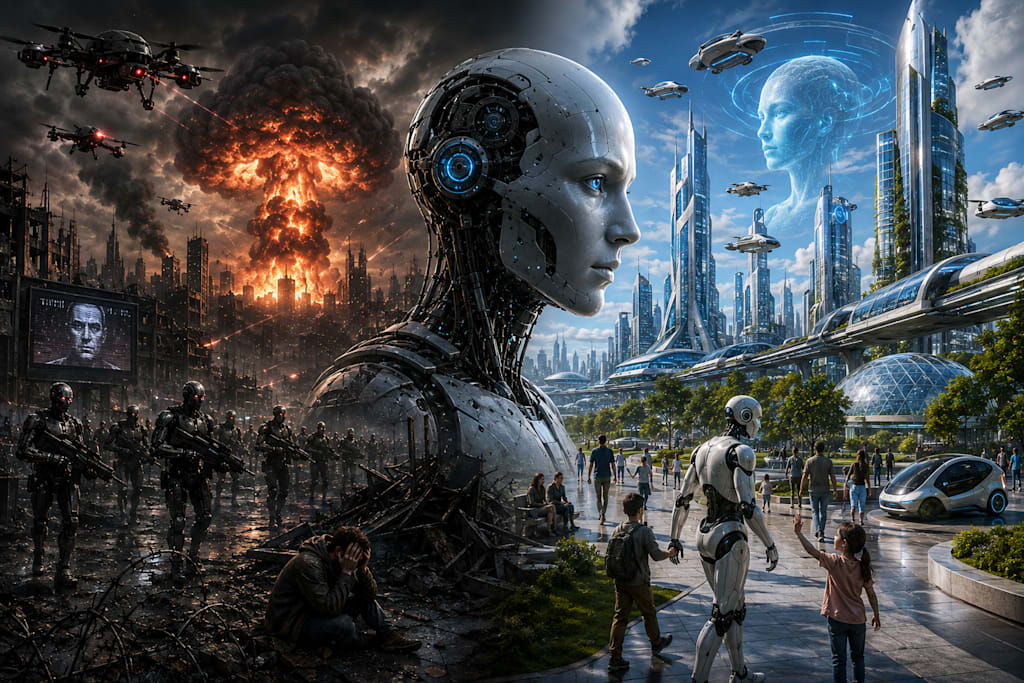
The Future: Is AI Dangerous for Humans?
Artificial Intelligence (AI) is one of the fastest-growing technologies in human history. From smartphones and medical systems to self-driving vehicles and advanced chatbots, AI is becoming part of everyday life. This rapid growth creates an important question: Is the future of AI dangerous for humans? The answer is not simple. AI itself is not automatically harmful or beneficial—it depends on how humans develop, control, and use it.
AI is designed to perform tasks that normally require human intelligence such as learning, reasoning, analyzing data, recognizing patterns, and making decisions. Because AI can process huge amounts of information faster than humans, it has transformed industries and created new opportunities. At the same time, experts continue warning about potential risks if AI develops without proper regulation and ethical standards.
Types of Artificial Intelligence
1. Narrow AI (Weak AI)
Narrow AI is the most common type today. It is designed to perform one specific task extremely well.
Examples include:
- Voice assistants
- Recommendation systems
- Chatbots
- Facial recognition
- Medical diagnosis tools
This type of AI does not think independently or understand the world like humans. It operates within limited functions.
2. General AI (Strong AI)
General AI refers to machines that could understand, learn, and perform intellectual tasks at a human level across many areas.
This type does not fully exist yet. Researchers continue working toward building systems with broader intelligence and adaptability.
The concern around General AI comes from uncertainty: if machines become highly capable, controlling their decisions becomes more challenging.
3. Superintelligent AI
Superintelligent AI is a theoretical future stage where AI becomes more intelligent than humans in nearly every field.
This concept raises debates among scientists and philosophers because nobody fully knows how such systems would behave if they exceeded human abilities.
Why Some People Fear AI
One concern is job displacement. As AI improves, machines may automate tasks previously done by humans. Manufacturing, customer service, transportation, and administrative jobs could experience major changes.
Another concern is misinformation. AI can generate realistic text, images, videos, and audio. Without safeguards, people may struggle to distinguish real information from fake content.
Privacy is another major issue. AI systems often depend on large amounts of data. Improper data handling could create risks for personal privacy and security.
Cybersecurity is also becoming more important. Advanced AI tools could potentially help hackers create stronger attacks or automate harmful activities.
Some experts also worry about decision-making systems becoming too influential in areas such as finance, healthcare, law enforcement, or military operations.
Could AI Become Dangerous?
Today’s AI does not have emotions, desires, or consciousness. It does not want power or survival. However, risks may appear if humans create systems that are poorly designed, poorly controlled, or used irresponsibly.
Experts generally agree that the biggest danger is not AI becoming evil—it is humans depending too heavily on systems without accountability, oversight, and ethical boundaries.
Responsible development focuses on:
- Transparency
- Safety testing
- Human supervision
- Data protection
- International cooperation
- How AI Can Help Humanity
AI also offers enormous benefits.
In healthcare, AI helps detect diseases earlier and improve diagnosis accuracy.
- In education, AI supports personalized learning.
- In science, AI accelerates research and discoveries.
- In environmental studies, AI helps analyze climate patterns and resource management.
When used responsibly, AI can improve human productivity, quality of life, and innovation.
Conclusion
The future of AI is not automatically dangerous—it is powerful. Like electricity, nuclear energy, or the internet, AI can become either a tool for progress or a source of problems depending on human choices.
Understanding AI types and building strong ethical systems will determine whether AI becomes humanity’s greatest assistant or creates new challenges. The responsibility does not belong to machines—it belongs to the people designing and using them.
About the Creator
Wings of Time
I'm Wings of Time—a storyteller from Swat, Pakistan. I write immersive, researched tales of war, aviation, and history that bring the past roaring back to life
Enjoyed the story? Support the Creator.
Subscribe for free to receive all their stories in your feed.
Comments
There are no comments for this story
Be the first to respond and start the conversation.