
The Evergreen Illusion: Understanding Broadleaf Mistletoe in Winter Canopies
Why those vibrant green patches in bare shade trees aren't holiday cheer—and why snapping off visible growth fails.

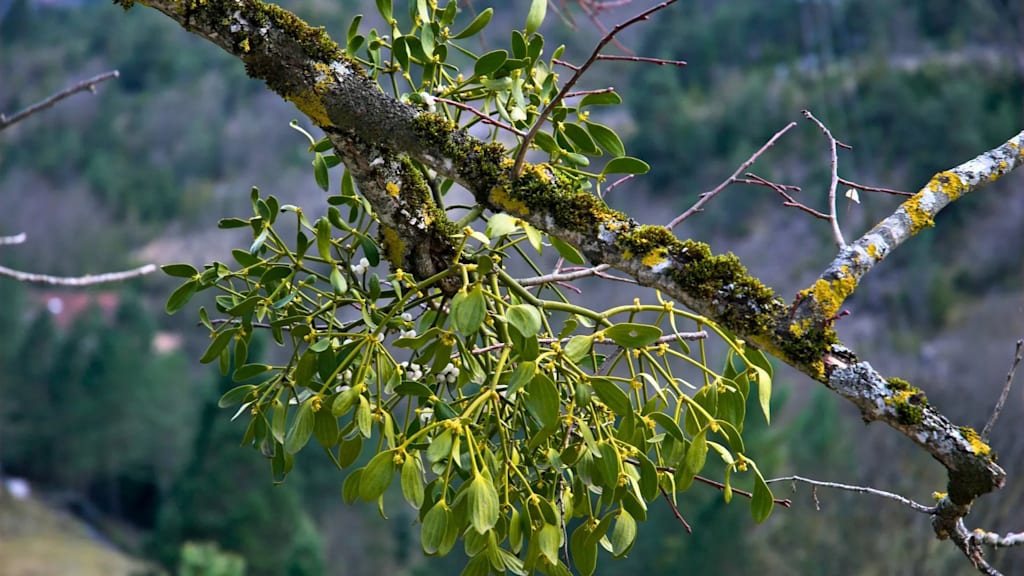
When autumn leaves drop, property owners get their first clear look at the upper canopy of mature trees. Without summer foliage blocking the view, one particular sight frequently triggers alarm: dense, spherical patches of green foliage clinging to completely bare branches.
To most people, mistletoe brings to mind holiday traditions. High up in a mature oak, walnut, or ash, however, broadleaf mistletoe represents an intriguing ecological puzzle. Many assume it signals immediate tree failure, prompting hasty decisions or misguided removal efforts. The reality of how this plant survives is far more nuanced.
The Biology of a Hemiparasite
Broadleaf mistletoe (Phoradendron species) is a native member of the sandalwood family, Santalaceae. While commonly labeled a parasite, botanists classify it more specifically as an obligate hemiparasite.
Unlike total parasites that rely entirely on a host for all sustenance, broadleaf mistletoe has green leaves filled with chlorophyll and manufactures its own food through photosynthesis. What it cannot do is draw water or mineral nutrients directly from the soil.
Instead of growing conventional ground roots, mistletoe extends specialized biological anchors known as haustoria through the outer bark. These structures penetrate into the tree's water-conducting xylem tissues, siphoning off moisture and dissolved minerals. Because it continues photosynthesizing year-round, it stays vibrant green even while the host tree sits dormant through winter.
Why Snapping Off Visible Growth Fails
When property owners spot a green cluster in a tree, their immediate reaction is often to grab a pole saw and break off the visible foliage. Unfortunately, this surface fix provides only a temporary illusion of control.
Because the haustoria extend deep inside the branch, breaking off external stems leaves the primary survival mechanism intact beneath the bark. Within a season or two, those embedded internal structures simply push out fresh photosynthetic shoots.
Managing mistletoe growth requires addressing the wood itself. Arborists typically prune the infected limb at least one foot below the attachment point or back to a major lateral branch. When mistletoe attaches to a main trunk or scaffold limb that cannot be safely pruned, workers trim the greenery flush with the bark and securely wrap the site with dark polyethylene sheeting to block light and suppress regrowth over time.
Avian Dispersal and Spread
Mistletoe infestations rarely stay confined to a single branch. The plant relies primarily on birds for dispersal across local tree canopies.
In late autumn, female mistletoe plants produce sticky white berries. Birds such as cedar waxwings and robins feed on these berries and deposit seeds onto high perches. The name mistletoe itself reflects this dynamic, deriving from ancient Anglo-Saxon words translating to "dung on a twig."
Because birds favor high perches in dominant canopy trees, mature specimens are usually infected first. Falling seeds and bird activity then spread new infestations to lower branches and nearby susceptible trees.
Evaluating Tree Risk and Host Health
Finding a few green clusters in a mature shade tree does not mean the tree is doomed. Healthy trees can often tolerate light mistletoe loads for decades without significant loss of structural integrity.
Problems arise when heavy infestations combine with secondary stresses like drought, soil compaction, or root disease. These factors weaken the host's defenses, turning a manageable strain into branch dieback or swelling.
Certain species are far more susceptible than others. Trees such as Modesto ash, alder, birch, and walnut frequently harbor heavy growth, whereas ginkgo, Chinese pistache, eucalyptus, and redwood are rarely affected.
A Balanced Approach to Canopy Stewardship
Winter provides a valuable window to observe canopy structure, assess host vigor, and spot potential branch dieback before spring growth begins. Rather than reacting with hasty removals, evaluating soil health, irrigation, and structural balance offers a far better path forward. Understanding the biology of hemiparasitic plants allows property owners to manage mature trees with patience and clarity.
About the Creator
ORB Tree Service Marketing
ORB Tree Service Marketing provides SEO and local search strategies for the tree care and roofing industries. Follow us for insights on search optimization and lead generation for home services.
Enjoyed the story? Support the Creator.
Subscribe for free to receive all their stories in your feed.
Comments
There are no comments for this story
Be the first to respond and start the conversation.