
The Eclipse That Will Stop Europe: Everything You Need to Know About August 12, 2026
Right in the middle of summer, the sun, moon, and Earth are about to line up in a perfect row once again — for the first time in over a century in this exact spot.

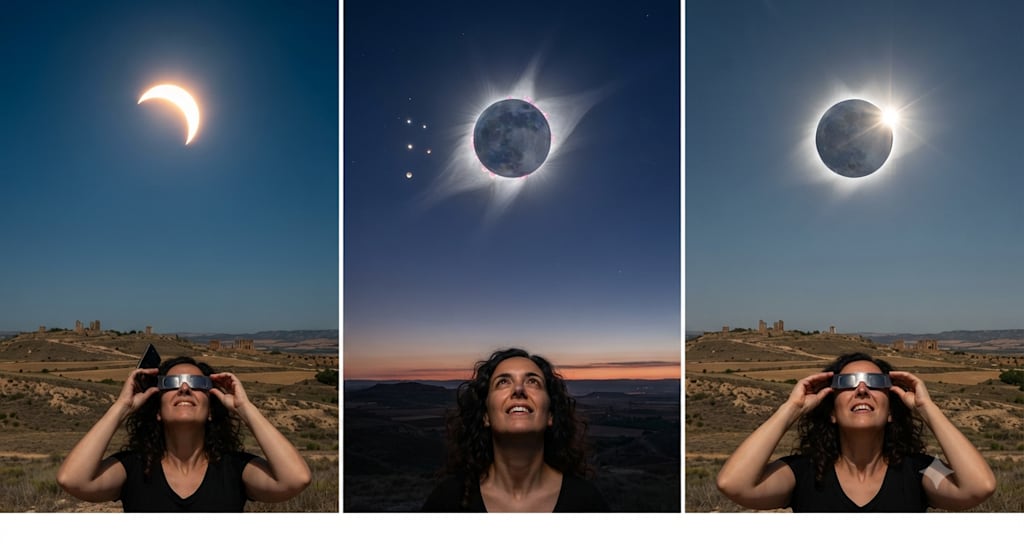
Picture yourself standing outside on an ordinary afternoon. The birds go quiet. The temperature drops a few degrees. The light turns strange, metallic, almost unreal — as if someone were slowly dimming a switch on the whole world. And then, in the middle of the day: darkness. A black disc where the sun used to be, ringed by a shimmering, silvery halo that no camera ever quite manages to capture.
That's what millions of people will experience on Wednesday, August 12, 2026, when the moon slides directly in front of the sun and produces a total solar eclipse — the first visible from mainland Europe since 1999. Whether you're planning to travel to see it up close, or you just want to understand what's happening in the sky wherever you are, this is one of the most spectacular natural events you can witness in a lifetime. Here's everything you need to know.
Why is this such a big deal?
Total solar eclipses aren't rare in themselves — somewhere on Earth, one happens roughly every 18 months. What makes them hard to actually witness is that the shadow they cast is extremely narrow, often just a few hundred kilometers wide, and it usually sweeps across oceans, deserts, or empty wilderness.
This time is different. The August 12, 2026 eclipse draws a band of total darkness across eastern Greenland, western Iceland, and northern Spain, with a small sliver reaching into northwestern Portugal. It's the first time since 1999 that mainland Europeans can experience totality without leaving the continent — which is why hundreds of thousands, possibly millions, of travelers are expected to flock to Spain and Iceland to see it.
Where and when is it best seen?
The path of totality is only about 290 kilometers (180 miles) wide, so exact location matters a lot:
Greenland and Iceland: The eclipse happens here in the late afternoon or early evening, local time. Over the Atlantic between the two islands, near the centerline, totality lasts the longest — around 2 minutes and 18 seconds.
Northern Spain: Here the eclipse occurs just before sunset, with the sun only a few degrees above the horizon. Totality is shorter, up to about 1 minute and 50 seconds — but the effect is even more dramatic, with a darkened sun sinking toward a glowing, colorful horizon. It's the first time totality has touched mainland Spain since 1905.
The rest of Europe (including Sweden): Here you'll see "only" a partial eclipse, with the moon covering part of the sun's disc. Depending on where you are, more than 90% of the sun can be obscured in parts of Europe — still an impressive sight, even without full darkness.
As an extra bonus, the eclipse coincides with the peak of the annual Perseid meteor shower, which crests right around August 12–13. If you're lucky, you might catch a shooting star streak by during totality itself.
What's actually happening up there?
A solar eclipse occurs when the moon, in its orbit, lines up exactly between Earth and the sun. That sounds simple, but it's actually a remarkable cosmic coincidence: the sun is about 400 times larger than the moon, but it also happens to be roughly 400 times farther away — which makes the two appear almost exactly the same size in our sky. No other planet in our solar system has that combination. It's why Earth, uniquely, gets to experience this kind of perfect, breathtaking blackout.
In the final seconds before totality, you can sometimes see the so-called "diamond ring" effect, when one last, intense burst of sunlight peeks through a valley on the moon's edge, along with "Baily's beads" — a string of tiny points of light glinting along the lunar rim. And once the sun is fully hidden, something we normally never see with the naked eye is revealed: the corona, the sun's outer atmosphere, which stretches millions of kilometers into space but is usually far too faint to see against the sun's blinding glare.
Is it dangerous for your eyes? (Short answer: yes, if you don't protect them)
This is the single most important piece of information in this whole article, so let's be blunt: looking directly at the sun during the partial phases of an eclipse can cause permanent eye damage. The tricky part is that it doesn't hurt while it's happening — the retina has no pain receptors — so people often don't realize the damage is being done until it's too late.
Here's how to protect yourself:
Always use certified eclipse glasses that meet the international safety standard ISO 12312-2. Regular sunglasses, no matter how dark, are nowhere near enough.
Check that your glasses are undamaged before using them — even a tiny scratch or pinhole can let through harmful light.
If you want to photograph the sun, your camera needs an approved solar filter over the lens too — otherwise you risk both your eyesight (if you look through the viewfinder) and your camera's sensor.
The only moment you can look directly at the sun without protection is during totality itself — the brief minutes when the sun is completely covered. The instant any sliver of sunlight reappears (like the "diamond ring"), protection needs to go back on immediately.
If you're outside the path of totality (as in Sweden), eye protection is required for the entire eclipse, since the sun is never fully covered.
A simple, completely safe alternative if you don't have glasses: poke a small hole (1–2 mm) in a piece of cardboard and hold it up so the light projects onto a sheet of paper in the shade. You'll see a safe image of the partially covered sun without looking at the sky at all.
Want to photograph it? Here's what the pros do
Experienced eclipse photographers agree on one thing: prepare well in advance, and put safety first. A few concrete tips:
Practice your camera settings and manual focus before the day itself — during totality you'll have only a couple of minutes, with no time to troubleshoot.
Use a tripod for stability, and keep an approved solar filter mounted on the lens throughout all the partial phases.
Remove the filter only during totality to capture the corona — and put it back on the instant the sun starts to reappear.
Don't forget wide-angle shots too: the darkened sky, the shifting light, and the people around you tell just as much of the story as a close-up of the sun.
Only have a phone? It can still capture the atmosphere — especially during totality — even if it won't give you a close-up of the solar disc.
Seasoned eclipse chasers almost universally give the same advice: practice enough beforehand that you can put the camera down during totality itself and just experience it. Those two minutes never come back.
A sky event that has always fascinated humanity
Long before we understood the orbital mechanics behind eclipses, they were seen as powerful, often terrifying omens. In Old Norse mythology, the sun is perpetually chased across the sky by the wolf Sköll, and an eclipse was read as the moment he nearly caught his prey. In ancient Chinese tradition, people believed a celestial dragon was devouring the sun, and they banged drums and pots to scare it away. Across many cultures — from Viking-age Scandinavia to Indigenous peoples of North and South America — eclipses were met with everything from battle cries and clashing weapons to silence, fasting, and ceremonies of respect for nature's power.
What's striking is that so many cultures, entirely independently of each other, arrived at the same basic story: something was eating or stealing the sun, and it could be won back through noise, ritual, or attention. Today, of course, we know it's simply our own moon briefly blocking our own star. But the sense of awe it inspires is oddly the same, whether you're standing in a modern crowd in northern Spain or were a Viking warrior a thousand years ago.
So — should you go see it?
If you have the chance to travel into the path of totality, it's hard not to recommend it. There's a reason experienced "eclipse chasers" travel the globe again and again to witness the same thing: a total solar eclipse is, according to most people who've seen one, completely different from what photos and videos convey. The light, the sudden drop in temperature, the silence from wildlife, and the abrupt night sky in the middle of the day combine into an experience that's hard to put into words.
Can't travel? No problem — most of Europe, including Sweden, will still get an impressive partial eclipse to watch (with proper eye protection, of course). And if you miss this one entirely, the next chance is already on the calendar: a new total solar eclipse sweeps across Spain, North Africa, and the Middle East on August 2, 2027, followed by an annular eclipse over Portugal and Spain on January 26, 2028.
But on August 12, 2026, right in the middle of summer, the sun, moon, and Earth are about to line up in a perfect row once again — for the first time in over a century in this exact spot. A spectacle that's been playing out for millions of years, that humanity has explained with wolves and dragons throughout its history, and that you can now watch with your own (protected) eyes.
Mark August 12 on your calendar. Get your certified eclipse glasses in time. And look up.
About the Creator
zenGaze
A person with a new idea is a crank until the idea succe!eds
Enjoyed the story? Support the Creator.
Subscribe for free to receive all their stories in your feed. You could also become a paid subscriber, letting them know you appreciate their work.
Comments
There are no comments for this story
Be the first to respond and start the conversation.