
The Coldest Place in the Solar System Is Also the Best Place to Build a Moon Base
It is not the Moon’s dark side. It is a crater floor colder than Pluto, and the ice inside could fuel the next era of spaceflight.
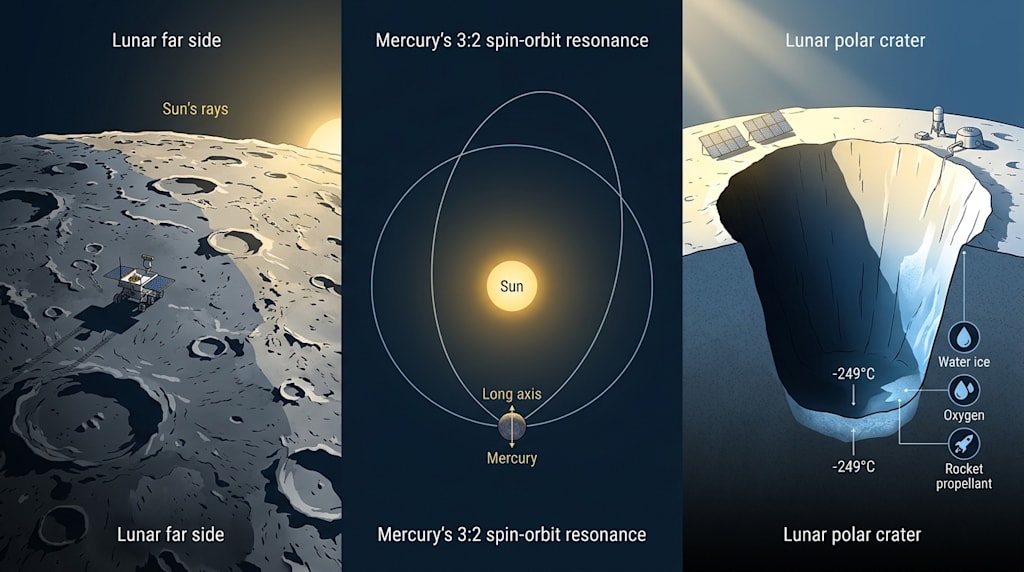
Start with a photograph. The lunar far side is packed with craters, pocked and pitted like iron hammered over and over. Many people seeing it for the first time say this must be the side that never sees light. That is half wrong. The far side is never visible from Earth, but it still has sunrises and sunsets. The Sun lights the half of the Moon facing it. As the Moon orbits Earth, that lit half changes orientation relative to the lunar surface, so every point on the Moon cycles through day and night.
One synodic month lasts about 29.53 Earth days. That gives about 14.75 Earth days of daylight and about 14.75 Earth days of night. Yutu rover’s work rhythm followed this number. It woke during lunar day, did its job, shut down for lunar night, and powered back on at the next sunrise. Its design life was three months. It lasted 972 days on the surface. For 972 days it repeated the same sequence. Sun rises to a certain height. Solar panels supply power. Wheels turn. Cameras switch on. Sun goes down. Heaters take over. Most instruments power off. The body tucks into thermal protection. The sequence is not glamorous, but it is the only workable rhythm for surface exploration on the Moon.
Mercury often comes up as a second example. Closest to the Sun, so the Sun must have locked it down completely. Before 1965, astronomers thought exactly that. Mercury, like the Moon, rotated synchronously at 1:1, one face forever toward the Sun, the other forever away. Radar measurements overturned the assumption. Mercury’s rotation period is about 58.6 Earth days. Its orbital period is about 88 Earth days. The ratio is 2:3. For every two orbits around the Sun, it rotates three times. One Mercury solar day is about 176 Earth days. Day and night are long, but they alternate. Mercury was not locked into a fixed face. Its eccentric orbit nudged it into a rhythm of three rotations per two orbits. Tidal forces peak near perihelion. Each time Mercury passes that point, it roughly presents the same long axis to the Sun. That is how the 3:2 resonance stabilizes.
The Moon has day and night. Mercury has day and night. Does the Solar System contain any place that never sees sunlight all year? Yes. These places are not on a celestial body’s backside. They sit at the bottom of impact craters deep enough, near the poles. They are called permanently shadowed regions, or PSRs. The conditions are simple. The body’s axial tilt is tiny. The Sun’s elevation in the polar sky stays very low all year. Light grazes almost along the horizon. If the crater rim rises even slightly above the floor, it can keep part of that floor in shadow forever. The Moon’s axial tilt is about 1.5 degrees. Mercury’s is about 0.03 degrees. Ceres’ is about 4 degrees. All three bodies qualify.
The Moon has 324 confirmed PSRs. They cover about 31,000 square kilometers. More than half are in the southern hemisphere. They do not cluster at the exact poles. They can appear as low as 58 degrees latitude. Temperature is where these crater floors get extreme. Inside a PSR there is no solar radiation year-round. Temperatures can drop to about 40 K, or roughly minus 233 degrees Celsius. In 2009, NASA’s Diviner instrument measured minus 249 degrees Celsius inside Hermite crater at the lunar north pole. That is only 24 K above absolute zero. The number is colder than the surface of Pluto. Volatiles such as water, carbon dioxide, and mercury, once they fall to the crater floor, have a hard time escaping. They can stay sealed there for millions or billions of years.
Cold here is not scenery. It is a preservation mechanism. In 2009, LCROSS impacted Cabeus crater near the lunar south pole. The ejecta plume contained water at a mass fraction of about 5.6 percent, with an uncertainty of plus or minus 2.9 percent. That is a local, direct impact measurement. It is not an average abundance for the entire polar region. Multi-source remote sensing estimates suggest Cabeus may hold about 11 million tonnes of water ice. Shoemaker may hold about 5 million tonnes. Faustini may hold about 4 million tonnes. Some PSRs near the lunar north pole may hold water ice on the scale of hundreds of millions of tonnes. Water ice can be drunk. It can be electrolyzed into oxygen. It can be split into liquid hydrogen and liquid oxygen for rocket propellant. If these materials can be extracted on the Moon, the economics of the Moon as a deep-space transfer station change.
Helium-3 needs separate treatment. Its main source is solar wind implanted into lunar regolith. Helium-3 from the solar wind strikes regolith grains and lodges in mineral lattices. Its baseline distribution is not limited to PSRs. PSR temperatures are extremely low. They may concentrate and preserve solar-wind-implanted helium-3. One conservative estimate puts it at 50 ppb or more. Calling helium-3 a resource unique to permanently shadowed craters is wrong. Its source is the solar wind. Its distribution is mainly in the regolith. PSRs are a special environment that may improve preservation efficiency.
A future lunar base will probably not be built inside a PSR. A more plausible layout is on the crater rim. One side faces the Sun. Solar panels there can work almost continuously. The other side faces the crater floor. Ice waits there to be extracted. The drop from rim to floor may be only a few hundred meters. One side has persistent sunlight. The other has billions of years of darkness. The coldest, darkest corner of the Solar System may become the busiest place. It preserves what everywhere else has lost. Water sits as ice on the crater floor. Sunlight falls on panels along the rim. On the slope between them, someone may someday push equipment down and carry water ice back up.
About the Creator
Jin
Writer of reamstories
https://reamstories.com/jin
Enjoyed the story? Support the Creator.
Subscribe for free to receive all their stories in your feed. You could also become a paid subscriber, letting them know you appreciate their work.
Comments
There are no comments for this story
Be the first to respond and start the conversation.