
The Blue Ghosts of Appalachia: The Forest That Glows After Dark
The Iron Lighthouse

There are places in America where the extraordinary doesn’t announce itself with a thunderclap, an earthquake, or some enormous geological spectacle. Sometimes, it arrives without making a sound.
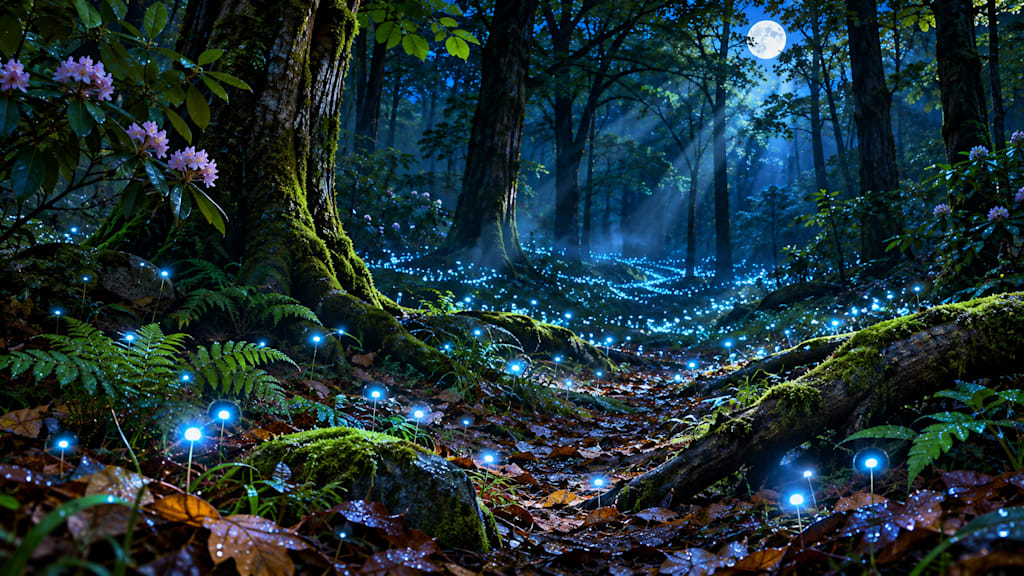
Deep in the forests of western North Carolina, a brief period each spring arrives when the darkness begins to move. Not the trees, nor the shadows. The darkness itself seems to come alive with tiny, wandering lights. They drift inches above the forest floor, gliding between fallen leaves and beneath the branches of ancient hardwoods. Unlike the familiar fireflies of summer, these lights do not blink in and out with cheerful, rhythmic flashes. They linger. For seconds at a time, sometimes for more than a minute, they burn with a delicate, ghostly radiance before disappearing into the blackness. And when enough of them gather, an ordinary Appalachian woodland can appear to have been transformed into something from another world.
It looks like the sort of place where an ancient legend ought to begin. But the remarkable truth is that these mysterious lights require no supernatural explanation whatsoever. A tiny living creature produces them. And its story is considerably more extraordinary than its appearance might suggest.
A Forest with a Secret
In the mountains surrounding Brevard, North Carolina, lies DuPont State Recreational Forest, a landscape known for its waterfalls, wooded trails, and spectacular natural scenery. During daylight hours, visitors come to explore its streams and forests. But beneath the dense canopy, another world exists. A world of damp leaves, moss, fallen branches, and countless small creatures whose lives unfold largely unnoticed by the people walking above them.
Among those creatures is 'Phausis reticulata'. Its common name is considerably more memorable: The Blue Ghost Firefly.
At first glance, it seems an unlikely candidate for one of America’s most enchanting natural spectacles. The males are tiny beetles, roughly a quarter of an inch long, with dark wing covers and delicate wings. Their appearance is so unremarkable that someone who encounters one in daylight might never give it a second thought. But when darkness falls during their mating season, these little insects become something extraordinary.
Male blue ghosts take flight beneath the forest canopy, moving slowly over the ground while producing a prolonged glow. Unlike the more familiar fireflies, which flash their lights in distinct patterns, blue ghosts seem to carry tiny lanterns through the darkness. Their light is often described as bluish-white, although its apparent color can vary with viewing conditions. And because they fly so low, the spectacle can resemble a field of miniature spirits drifting through the undergrowth. The name suddenly makes perfect sense.
The Science Behind the Apparition
The blue ghost’s mysterious light is an example of bioluminescence: the production of visible light through a chemical reaction inside a living organism. Fireflies generate light using specialized biological machinery involving luciferin, an enzyme called luciferase, oxygen, and cellular energy. The result is an astonishingly efficient form of illumination that produces relatively little heat.
But what makes the blue ghost especially fascinating isn’t simply that it glows. It’s how it uses that glow. Many familiar North American fireflies communicate through carefully timed flashes. A male produces a particular signal, and a receptive female may respond with her own. The blue ghost follows a different approach. Instead of flashing repeatedly, the male produces a long-lasting glow while searching the forest floor for a mate.
And that brings us to one of the strangest aspects of the species. The females cannot fly. While the males possess wings and patrol the forest, adult females remain on or among the leaf litter. They retain a remarkably larval appearance, lacking the fully developed wings and hardened wing covers typical of adult beetles. They also glow. But their lights are faint, small, and easy to overlook.
Imagine the challenge. A male must locate a tiny, flightless female concealed among countless leaves, roots, and fragments of vegetation, in a forest that becomes almost completely dark after sunset. Researchers have investigated how visual signals and chemical cues contribute to this unusual courtship. What appears to human observers as an ethereal procession of wandering lights is actually part of an intricate reproductive system shaped by evolution. The forest isn’t haunted. It’s hosting a remarkable biological search party. And every little blue-white glow represents a creature trying to find another creature in the darkness. Somehow, knowing that makes the spectacle even more beautiful.
The Scientists Who Followed the Lights
For many years, the blue ghost was less thoroughly understood than some of its more conspicuous relatives. Its small size, limited seasonal activity, and preference for dark forest habitats made detailed observation challenging. But researchers were determined to understand it.
Among them were Jennifer E. Frick-Ruppert and Joshua J. Rosen of Brevard College. Their work, published in 2008 in the Journal of the North Carolina Academy of Science, examined the morphology and behavior of blue ghost fireflies across several locations in the southern Appalachians. The observations spanned years, with particularly intensive research during 2006 and 2007. Their study clarified the anatomy of both sexes, including previously under-described features of the unusual flightless females.
The researchers also documented the habitats these insects favored. Blue ghosts were associated with mature forests, closed tree canopies, moist soil, and substantial layers of fallen leaves. Small streams and seepage areas were common features of the locations they studied. At DuPont, rhododendron formed part of the dense understory.
These details might sound unremarkable. After all, damp leaves and shaded woodland hardly seem like the ingredients for a great scientific mystery. But for the blue ghost, those ordinary features are essential parts of its world. The fallen leaves aren’t simply debris. They provide habitat for the insects and the small organisms associated with the forest floor. The darkness isn’t merely an absence of sunlight. It’s the environment in which their delicate signals can be detected. The trees overhead also help create the conditions that allow this unusual spectacle to unfold. The researchers weren’t merely studying glowing insects. They were revealing the extraordinary complexity of a habitat most people would walk through without ever noticing.
A Brief Appointment with the Darkness
One reason the blue ghost seems so elusive is that its display is seasonal. In western North Carolina, the most familiar viewing period generally falls during May and early June, although activity varies with location, weather, and year. There may be only a relatively short opportunity to witness large numbers of males flying through the forest. Even arriving during the right season doesn't guarantee anything.
You can observe the insects most easily when darkness has settled over suitable habitat. Artificial lights can overwhelm their faint glow. Moonlight, weather, and local environmental conditions can also affect the viewing experience. Visitors accustomed to bright, flashing fireflies may initially wonder whether anything is happening. Then their eyes adjust. A small point of light appears beneath a shrub. Another drifts between two trees. Then another. What seemed like an empty forest begins to reveal movement.
The lights don’t necessarily form the dazzling blue carpet that some heavily edited photographs might suggest. Their glow is subtle, and the most spectacular images often rely on long exposures that accumulate light over time. But that subtlety is part of the experience. These aren’t fireworks. They aren’t a laser show. They are tiny living lanterns moving through one of America’s oldest mountain landscapes. And they have been doing so without an audience for generations beyond counting.
The Danger of Loving Something Too Much
Unfortunately, the growing fascination with blue ghost fireflies presents a difficult problem. The very attention that encourages people to appreciate these insects can also threaten the habitats they depend upon.
Consider the female blue ghost. She cannot fly away when someone approaches. She lives close to the ground, among the leaves that hikers may casually disturb or trample. An enthusiastic visitor stepping off a trail to get a better photograph may never realize how much damage a single misplaced footstep can cause. Bright flashlights and other artificial lighting can interfere with the darkness needed to observe fireflies and may disrupt their natural behavior. Habitat disturbance, development, and the loss of suitable woodland conditions create additional concerns.
In 2026, conservation reporting highlighted researchers' warnings that blue ghost populations and the areas where they occur have declined in parts of the southern Appalachians. That is a sobering thought. A creature capable of producing one of nature’s most extraordinary nighttime displays may be vulnerable to something as ordinary as the destruction of its habitat. And unlike an ancient building, a battlefield monument, or a historic lighthouse, this natural treasure cannot simply be reconstructed from photographs and architectural plans. Its existence depends on living ecological relationships.
So responsible viewing matters. Staying on designated paths, respecting forest access rules, avoiding unnecessary artificial light, and observing without disturbing the leaf litter are all ways to appreciate these insects without adding pressure. Sometimes the greatest act of admiration is simply to leave something undisturbed.
The Light We Almost Never See
There is something wonderfully humbling about the blue ghost firefly. We live in an age of extraordinary technological achievements. We send spacecraft beyond the planets. We construct machines capable of studying distant galaxies. We illuminate our cities so thoroughly that millions of people can no longer see the stars that once filled the night sky.
Yet in a quiet North Carolina forest, a beetle barely larger than a grain of rice can produce a spectacle that seems almost impossible. No electrical grid. No batteries. No human engineering. Just chemistry, evolution, and a living creature searching for a mate.
And perhaps that’s the most remarkable part of the story. The blue ghosts aren’t performing for us. They aren’t trying to inspire wonder. They don’t know that people travel to the mountains hoping to catch a glimpse of their extraordinary lights. They are simply living. Doing what their ancestors did long before DuPont became a recreational forest, long before tourists carried cameras into the mountains, and long before anyone thought to give them such an evocative name. Their beauty is incidental. A magnificent accident of nature.
And somewhere in the Appalachian darkness, as another spring evening settles over the trees, the first tiny light begins to move. Then another. Then another. The forest floor slowly awakens with a quiet, ghostly radiance. For a few fleeting weeks, a hidden world reveals itself to anyone patient enough to watch. And then, as the season passes, the lights fade. The forest returns to darkness. The leaves remain. The streams continue flowing. And beneath the canopy, life carries on, waiting for another spring.
Not every ghost is a haunting. Sometimes, it’s simply nature reminding us how much magic still exists in the world.
The Iron Lighthouse - Illuminating the extraordinary stories hiding in America’s past and present.
About the Creator
The Iron Lighthouse
Where folklore meets freeway. A guide to the strange heart of the American backroads...
Enjoyed the story? Support the Creator.
Subscribe for free to receive all their stories in your feed.
Comments
There are no comments for this story
Be the first to respond and start the conversation.