
The 2026 Strawberry Moon
Peak Times, Celestial Mechanics, and the Low-Hanging Illusion
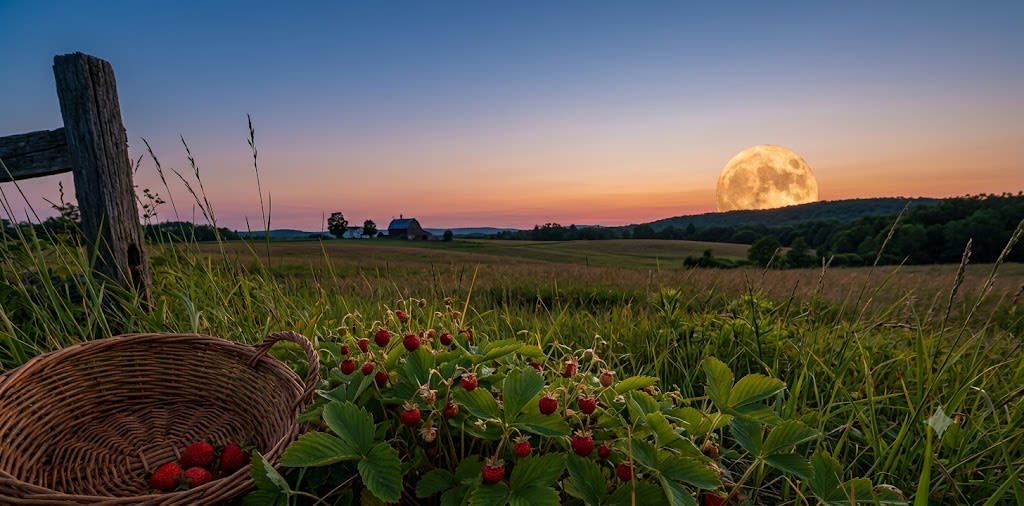
June 29, 2026, brings a lunar event that is equal parts astronomical spectacle and cultural touchstone: the Strawberry Moon. But step outside expecting a crimson orb, and you will be disappointed. The magic of this particular full moon lies not in its pigment. Instead, its draw comes from a profound seasonal alignment and an unusually extreme trajectory across the summer night sky.
Key Takeaways: The 2026 Strawberry Moon
- Peak Illumination Date: Monday, June 29, 2026.
- Exact Time: 7:57 p.m. Eastern Daylight Time (EDT).
- Astronomical Position: The Moon will peak at 28 degrees in Capricorn, sitting directly opposite the Sun in Cancer.
- Visual Phenomenon: In the Northern Hemisphere, it traces the lowest, most southerly path of any full moon of the year, creating a unique "horizon-hugging" effect.
The defining characteristic of June's full moon is its extreme behavior on the horizon. Because a full moon always sits opposite the sun in the sky, they act as cosmic counterweights. In June, the sun takes its highest, northernmost path of the year in the Northern Hemisphere (the summer solstice). Consequently, the Strawberry Moon does the exact reverse. It follows a shallow, sluggish arc. It rises late in the extreme southeast, hugs the horizon, and sets early in the southwest.
This creates the famous "low-hanging fruit" effect. When the moon is pinned close to the horizon, you view it through the thickest, densest layer of Earth's atmosphere. This atmospheric filter scatters shorter wavelengths of light (like blues and greens) while allowing longer wavelengths (reds, oranges, and yellows) to pass straight through to your eyes. This scattering is the true—and only—reason the moon might temporarily take on a rich, amber hue shortly after moonrise. Once it climbs higher, it rapidly reverts to a brilliant, standard white.
Why is it called the Strawberry Moon if it isn't red?
The name is botanical, not visual. It originates from Native American tribes—specifically the Algonquian, Ojibwe, Dakota, and Lakota peoples of the northeastern United States. They used this specific lunar cycle as an ecological calendar to mark the ripening of "June-bearing" wild strawberries. It signaled that the fruit was ready to be gathered.
Other Indigenous groups applied names reflecting their own localized ecosystems. The Haida refer to it as the Berries Ripen Moon. The Tlingit of the Pacific Northwest call it the Birth Moon, noting it as the season when specific regional animals are born. Meanwhile, European historical texts often refer to it as the Mead Moon or Honey Moon, aligning with the late-June tradition of mowing meadows and the high season for summer marriages.
Astrological and Cultural Significance
Astrologically, the 2026 Strawberry Moon anchors a moment of structural reflection. According to general planning notes curated by world-renowned astrologer Kyle Thomas for the Farmers' Almanac, this full moon reaches its peak in Capricorn—a cardinal earth sign associated with leadership, work, and structure. With the Sun sitting in Cancer (the axis of home and family), this celestial alignment creates a stark juxtaposition between domestic life and outward, public responsibilities.
Whether you are tracking its trajectory for a landscape photograph or marking the agricultural shift of the season, the viewing window is clear. The absolute best time to experience the 2026 Strawberry Moon is during dusk, precisely around your local moonrise time on the evening of June 29.
About the Creator
Enjoyed the story? Support the Creator.
Subscribe for free to receive all their stories in your feed.
Comments
There are no comments for this story
Be the first to respond and start the conversation.