
The "100-Hour Battery" That Can Ride Out Storms
Long-Duration Energy Storage

by Futoshi Tachino
Iron–air storage is built for the multi-day renewable gaps lithium-ion can’t cover.
Clean electricity has a new problem: sometimes it arrives all at once.
On a windy spring night, turbines can flood the grid with power when demand is low. On a bright weekend, solar can do the same. Then the weather shifts—clouds settle in, wind drops—and the grid suddenly needs firm power again.
Lithium-ion batteries are excellent at smoothing the daily bump: shifting midday solar into the evening peak, responding fast to frequency events, and backing up a substation for a few hours. But they aren’t designed for the multi-day gaps that show up once you try to run a whole region mostly on wind and solar.
That’s where long-duration energy storage (LDES) is starting to step out of the “interesting someday” category—systems designed to discharge for days, not hours.
One of the most watched approaches right now: the iron–air battery, sometimes nicknamed the “rust battery.”
What is an iron–air battery?
The core idea: store energy by rusting iron—and un-rusting it later
An iron–air battery uses a simple, abundant ingredient list: iron, air (oxygen), and water. The operating concept is reversible rusting: during discharge, iron reacts with oxygen; during charging, electricity pushes the reaction backward, turning rust back into iron. (Google Blog, Feb 24, 2026)
This isn’t “magic new materials.” The promise is practical: cheap, widely available active materials could make it economical to build storage big enough for multi-day reliability.
Why the grid suddenly needs 100-hour storage
The problem is shifting from “enough energy” to “weather coverage”
As renewables rise, the limiting factor becomes less “Can we generate enough clean electricity?” and more:
Can we keep the lights on through a bad renewable stretch?
The U.S. Department of Energy has been explicit that long-duration storage adds flexibility and reliability for a low-carbon grid—but cost is the major barrier. DOE’s Long Duration Storage Shot targets a 90% cost reduction by 2030 (relative to a 2020 lithium-ion baseline) for technologies providing 10+ hours, with a stated LCOS target of $0.05/kWh by 2030. (Energy.gov PDF, Aug 2024)
Iron–air systems aim directly at what daily batteries don’t solve: multi-day “gaps” driven by weather patterns.
Proof it’s moving from pilots to grid-scale commitments
A few years ago, iron–air was mostly slides and prototypes. What’s changed is a growing set of utility deployments and manufacturing investments that look like a real commercialization curve.
1) Utilities are building first-of-a-kind projects
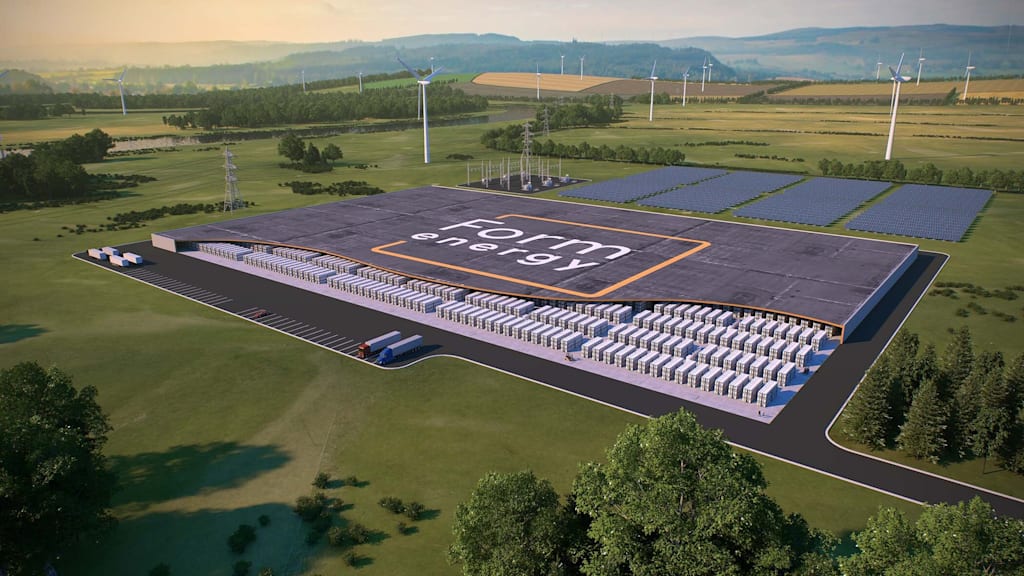
Form Energy and Great River Energy broke ground on a multi-day storage project designed to deliver up to 100 hours of discharge—positioned as a way to store surplus renewable generation and release it when demand is high or renewable output is low. (Form Energy, Aug 15, 2024)
Earlier, Xcel Energy received approval to build a demonstration-scale iron–air system at its Sherco site, with construction slated to begin in 2024 and an as-early-as-2025 online target (per the company announcement). (Form Energy, Jul 6, 2023)
2) Manufacturing is scaling beyond “hand-built”
Form Energy’s Form Factory 1 in Weirton, West Virginia is presented as a high-volume manufacturing facility for iron–air batteries. (Form Energy)
The company also announced an expansion intended to increase manufacturing capacity, with a completion timeline described as “by the end of 2025.” (Form Energy, Oct 14, 2024)
3) A headline deal ties multi-day storage to data centers
A major recent signal came from Minnesota: Google announced an agreement with Xcel Energy to add new clean supply—1,400 MW of wind, 200 MW of solar, and 300 MW of iron–air battery storage from Form Energy. (Google Blog; Xcel Energy, Feb 24, 2026)
Multiple outlets describe the storage component as 300 MW / 30 GWh—the kind of “GWh-scale” number that matters because energy (not just power) is what makes storage multi-day. (Energy-Storage.news, Feb 2026; plus coverage from Canary Media and pv magazine)
What iron–air is—and what it isn’t
It helps to think of storage as two different jobs:
Fast, frequent, short (milliseconds to hours): stabilize the grid, shave peaks, respond instantly. Lithium-ion shines here.
Slow, huge, long (many hours to days): cover extended lulls, ride through storms, bridge multi-day renewable droughts. That’s the iron–air pitch.
Even proponents often frame iron–air as complementary, not a replacement: pair short-duration batteries with long-duration systems so you aren’t forcing one technology to do everything. (Canary Media, Feb 24, 2026)
The tradeoffs that will decide whether iron–air goes mainstream
Iron–air’s appeal is “cheap ingredients + long discharge.” But becoming routine infrastructure means clearing hurdles that don’t show up in a chemistry diagram.
Efficiency and cycling behavior
Long-duration systems can tolerate lower efficiency if the cost per stored kWh is low enough, but utilities still care about losses and operating patterns. Commentary around the Google/Xcel/Form deal notes iron–air’s efficiency is typically lower than lithium-ion, even if it may win on cost and duration. (TechCrunch coverage referenced in your draft)
Durability and electrode challenges
Academic reviews highlight technical pain points—corrosion, hydrogen evolution during charging, passivation on the iron anode, and sluggish kinetics/stability at the air cathode. These issues can determine lifetime, maintenance, and real-world reliability at grid scale. (Bogomolov & Ein-Eli, 2025 via PMC; McKerracher et al., ChemPlusChem)
Footprint and siting
This is grid infrastructure, not a phone battery. Projects succeed when they can be sited where land is available, interconnection is feasible, and permitting is manageable.
What “success” should look like next
If iron–air is truly becoming a major grid resource, expect to see:
Repeat orders after first pilots (second and third projects, not just demos)
Bankable performance: warranties, degradation data, and operating track records financiers accept
Industrial manufacturing cadence, not bespoke builds
Clear grid planning “stacking”: lithium-ion for fast services, iron–air for multi-day reliability
The punchline
Some of the most valuable clean-energy innovations right now aren’t new generation sources—they’re reliability unlocks that make wind and solar behave like dependable power through messy real weather.
Iron–air batteries are one of the first storage approaches that seriously targets the scale and price implied by “mostly-renewables grids.” The chemistry is old enough to be understandable. The deployments are new enough to be exciting. And the size of the Minnesota commitments suggests the grid is starting to treat multi-day as a real category, not a footnote. (Google Blog, Feb 24, 2026)
FAQ
How long can an iron–air battery discharge?
Some grid projects are designed around multi-day duration, commonly described as up to ~100 hours. (Form Energy project announcements)
Why not just use lithium-ion batteries for everything?
Lithium-ion is excellent for fast response and short duration, but multi-day renewable lulls can require storage designed for much longer discharge.
Why is it called a “rust battery”?
Because it stores energy through reversible rusting: iron reacts with oxygen during discharge, then charging reverses the reaction. (Google Blog)
What’s the big Minnesota deal about?
Google and Xcel announced a clean supply agreement that includes wind, solar, and iron–air storage—reported by several outlets as 300 MW / 30 GWh of multi-day storage. (Google Blog; Xcel; Energy-Storage.news)
References
U.S. Department of Energy, Office of Electricity. Achieving the Promise of Low-Cost Long Duration Energy Storage. August 2024. PDF. https://www.energy.gov/sites/default/files/2024-08/Achieving%20the%20Promise%20of%20Low-Cost%20Long%20Duration%20Energy%20Storage_FINAL_08052024.pdf
Google. “Google’s new data center in Pine Island, Minnesota.” Google Blog, February 24, 2026. https://blog.google/innovation-and-ai/infrastructure-and-cloud/global-network/data-center-pine-island/
Xcel Energy. “Xcel Energy to power new Google data center in Minnesota.” Xcel Energy Newsroom, February 24, 2026. https://newsroom.xcelenergy.com/news/xcel-energy-to-power-new-google-data-center-in-minnesota
Reuters. “Google signs AES, Xcel supply deals to meet data-center energy needs.” February 24, 2026. https://www.reuters.com/business/energy/xcel-energy-power-new-google-data-center-minnesota-2026-02-24/
Energy-Storage.news. “Google Minnesota data centre energy deal includes 30GWh multi-day iron-air batteries from Form Energy.” February 2026. https://www.energy-storage.news/google-minnesota-data-centre-energy-deal-includes-30gwh-multi-day-iron-air-batteries-from-form-energy/
Canary Media (Julian Spector). “Gigantic Form Energy battery to power Google data center in Minnesota.” February 24, 2026. https://www.canarymedia.com/articles/batteries/gigantic-form-energy-battery-google-minnesota
pv magazine USA. “Google to deploy world’s largest iron-air battery for US data center.” February 25, 2026. https://www.pv-magazine.com/2026/02/25/google-to-deploy-worlds-largest-iron-air-battery-for-us-data-center/
Form Energy. “Great River Energy and Form Energy break ground on first-of-its-kind multi-day energy storage project.” August 15, 2024. https://formenergy.com/great-river-energy-and-form-energy-break-ground-on-first-of-its-kind-multi-day-energy-storage-project/
Form Energy. “Xcel Energy receives approval to build multi-day battery storage at Sherco site.” July 6, 2023. https://formenergy.com/xcel-energy-receives-approval-to-build-multi-day-battery-storage-at-sherco-site/
Form Energy. “Form Factory 1.” (Facility page.) https://formenergy.com/form-factory-1/
Form Energy. “Form Energy Begins Expansion of Form Factory 1 to Increase Manufacturing Capacity.” October 14, 2024. https://formenergy.com/form-energy-begins-expansion-of-form-factory-1-to-increase-manufacturing-capacity/
Bogomolov, Katerina; Ein-Eli, Yair. “Will Iron Forge the Future of Metal‐Air Batteries in Grid Scale Energy Storage?” ChemSusChem (open access via PubMed Central), revised January 31, 2025; issue date May 19, 2025. https://pmc.ncbi.nlm.nih.gov/articles/PMC12094147/
McKerracher, R. D.; Ponce de León, C.; Wills, R. G. A.; Shah, A. A.; Walsh, F. C. “A Review of the Iron–Air Secondary Battery for Energy Storage.” ChemPlusChem, 80(2), 323–335 (published online 2014; issue 2015). DOI: 10.1002/cplu.201402238. https://chemistry-europe.onlinelibrary.wiley.com/doi/abs/10.1002/cplu.201402238
About the Creator
Futoshi Tachino
Futoshi Tachino is an environmental writer who believes in the power of small, positive actions to protect the planet. He writes about the beauty of nature and offers practical tips for everyday sustainability.
Enjoyed the story? Support the Creator.
Subscribe for free to receive all their stories in your feed.
Comments
There are no comments for this story
Be the first to respond and start the conversation.