Sustainability
King Protea
The King Protea (Protea cynaroides) a flower that represents resilience, beauty, and strength. It is also known for its vibrant and lovely yet deep-rooted meaning as South Africa's national flower. Renowned for resilience in the harshest of places, the King Protea registers as one of earth's oldest flowering plants, a bit of clank of time older than two million years. Because of its uniqueness and cultural importance, it's a fascinating thing to study and appreciate.
By Rohitha Lanka2 years ago in Earth
Concerns Rise Over Big Bear Valley Bald Eagles' Eaglet. AI-Generated.
Key Highlights One of the three eaglets belonging to Big Bear Valley's famed bald eagle pair, Jackie and Shadow, has been reported missing.The disappearance coincided with a recent snowfall in the area, obscuring the view of the nest bowl on the live webcam feed.Friends of Big Bear Valley, the organization responsible for the eagle cam, remains hopeful, stating that a portion of the nest remains obscured.The community and online audiences have mobilized, expressing concern and looking for updates on the missing eaglet.This incident underscores the delicate balance of nature and the challenges faced by Bald Eagles, even in protected environments.
By Nur Jahan Begum2 years ago in Earth
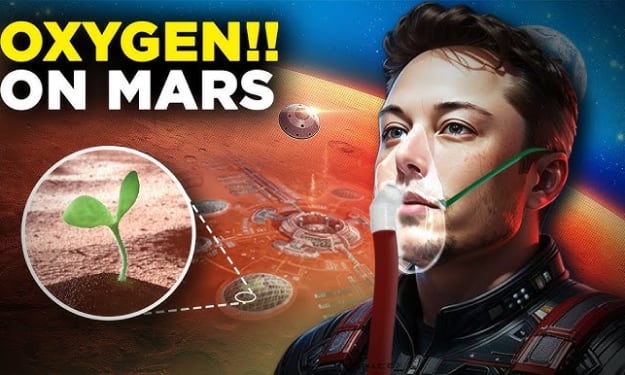
How Humans Will Get Oxygen on Mars
How Humans Will Get Oxygen on Mars. Mars often called the Red Planet has long been a subject of fascination for scientists space agencies and visionaries. With ambitious plans from organizations like NASA SpaceX and other space agencies human colonization of Mars is no longer just science fiction it is becoming an achievable goal. However one of the greatest challenges for sustaining human life on Mars is the availability of oxygen. Unlike Earth Mars has a very thin atmosphere composed mainly of carbon dioxide about 95% with only trace amounts of oxygen. This makes survival on the planet impossible without external sources of breathable air. To establish a human presence on Mars scientists and engineers are exploring various methods to generate oxygen ensuring that future astronauts and colonists have a reliable supply for breathing fuel production and other essential activities. One of the most promising solutions for oxygen production on Mars is the Mars Oxygen In Situ Resource Utilization Experiment (MOXIE). This experimental technology developed by NASA has already demonstrated success aboard the Perseverance rover. MOXIE works by extracting carbon dioxide from the Martian atmosphere and using a process called solid oxide electrolysis to separate oxygen atoms. This method requires electricity which can be generated from solar panels or nuclear power sources. The extracted oxygen can then be stored for human consumption or used as rocket fuel for return missions. MOXIE’s small scale experiments have proven that oxygen production on Mars is feasible and future missions will aim to scale up this technology to support human settlements.
By Adnan Rasheed2 years ago in Earth
New map shows Antarctica without its ice.
New map shows Antarctica without its ice. Antarctica the southernmost continent on Earth has long remained one of the most mysterious and least explored regions of our planet. Covered by a thick layer of ice for millions of years it has been a challenge for scientists to map what truly lies beneath. However a groundbreaking new map released by the British Antarctic Survey (BAS) has provided the most detailed look yet at Antarctica’s hidden landscape, showing what the continent would look like if all its ice were stripped away. This new data compiled from over 60 years of research is expected to play a crucial role in understanding ice flows climate change and the geological history of the region. The significance of this map cannot be overstated. Antarctica holds about 70% of the world’s fresh water in its vast ice sheets, which have an average thickness of approximately 1.2 miles (1.9 km). Underneath this ice lies a rugged and complex landscape complete with towering mountains deep valleys and vast plains. The newly released map provides a clearer picture of this hidden world allowing scientists to analyze the topography of the land in unprecedented detail.
By Adnan Rasheed2 years ago in Earth
Exploring the Versatility of Plastic Pyrolysis Fuel
The global issue of plastic waste management has led to innovative technologies that transform discarded plastic materials into valuable resources. One such method is plastic pyrolysis, a process that breaks down plastics at high temperatures in the absence of oxygen to produce a range of by-products, including plastic pyrolysis fuel. This fuel has emerged as a viable alternative to conventional energy sources, offering diverse applications across various industries. The potential of plastic pyrolysis fuel extends far beyond waste management, presenting economic and environmental advantages in energy production and industrial processes.
By Wayne Shen2 years ago in Earth
The Last Roar of the Jungle
Chapter 1: The Echoes of a Dying Jungle In the heart of a sprawling jungle, where the emerald canopy kissed the azure sky, lived Tarak, a majestic tiger burdened by a life of hardship. The jungle, once vibrant and teeming with life, had dwindled under the pressure of human encroachment. Trees that had stood for centuries were felled, rivers were dammed, and the balance of nature was slowly tipping toward chaos. Tarak, with his vibrant orange coat marred by the scars of survival, roamed the territory that was once his ancestral home, now reduced to a mere shadow of its former glory.
By MOHAMMED NAZIM HOSSAIN2 years ago in Earth