short story
Golden Fields. AI-Generated.
Aarav stood at the edge of the village road, staring at the endless yellow ocean before him. The mustard flowers were in full bloom, stretching far as his eyes could see. It was early morning, and the sun, soft and golden, touched the tops of the flowers, turning the entire field into a shimmering blanket of gold.
By Bilal Mohammadiabout a year ago in Earth
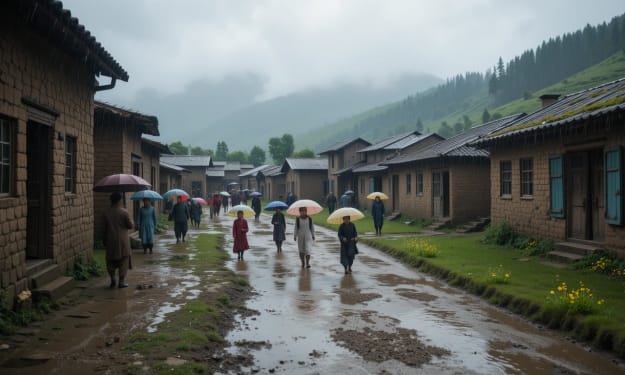
Raindrops Embracing the Village. AI-Generated.
Soft grey clouds hung over the little village like a cozy blanket. It was early afternoon when the first raindrops began to fall, slowly tapping on the clay rooftops. The air smelled fresh, like wet earth and blooming grass. People paused whatever they were doing and looked up at the sky, smiling. Rain in the village was always a special moment.
By Bilal Mohammadiabout a year ago in Earth
Cool Wheels in a Hot Land: Afghan Taxi Drivers Innovate with Homemade Air Coolers
Cool Wheels in a Hot Land: Afghan Taxi Drivers Innovate with Homemade Air Coolers In the scorching heat of Afghanistan, especially in the southern city of Kandahar, temperatures often exceed 40°C (104°F). Amid such extreme weather, taxi drivers are turning to innovative solutions to keep their vehicles—and their passengers—cool. Their unique invention? Handmade air coolers installed on the roofs of their taxis, complete with large pipes that run inside the car. These DIY cooling systems are gaining popularity as traditional car air-conditioners often fail in Afghanistan’s searing summer temperatures. Drivers in Kandahar claim that not only are these homemade coolers more effective, but they also circulate air throughout the entire vehicle, unlike factory-fitted AC units that typically only cool the front. One of the taxi drivers, Abdul Bari, explained to AFP (Agence France-Presse), “These handmade air coolers work better than the AC. The AC only cools the front of the car, but this cooler spreads air throughout the vehicle.” Videos shared by news agencies show Abdul Bari securing a large pipe through the window of his taxi while another man fastens the cooler unit on top of the roof. Despite being homemade, these coolers seem to be making a big difference for drivers and passengers alike. The only downside, according to Bari, is that they need to be manually refilled with water twice a day. “But for me,” he added, “it’s working perfectly.” A Low-Cost, High-Impact Innovation Afghanistan is one of the poorest countries in the world and is also facing severe impacts from climate change. According to government warnings, the country is expected to experience even more intense heat in the coming weeks. Amidst economic hardship and a lack of reliable infrastructure, residents are often forced to rely on their ingenuity to cope with harsh environmental conditions. Another taxi driver, Gul Mohammad, shared that he began using this makeshift air-cooling system a few years ago when summer temperatures became unbearable. “The ACs in these cars don’t work,” said the 32-year-old driver. “And repairing them is very expensive. So I went to a local technician and asked him to make this cooler for me.” Gul Mohammad said he spent around 43 US dollars to build the cooler. While that might seem like a modest amount, in a country where poverty is widespread, it’s a significant investment. Still, for these drivers, it's a necessary one. Passengers too are praising the innovation. Noorullah, a 19-year-old commuter, recalled how he fell ill due to extreme heat just a few days ago. “It becomes really hard to travel in vehicles without coolers during the summer,” he said. “I even carry heat-relief tablets in my pocket when I travel.” Record-Breaking Heat and a Country in Crisis Afghanistan experienced its hottest spring on record between April and June this year. The rising temperatures are not just an inconvenience—they pose a serious threat to lives, especially for vulnerable groups such as children, the elderly, and the poor. Last week, the United Nations Food and Agriculture Organization (FAO) warned that drought conditions in Afghanistan were devastating crops and rural livelihoods. Combined with political instability, economic sanctions, and ongoing conflict, climate change is becoming an unbearable burden for the Afghan population. Environmental experts have warned that the humanitarian crisis in Afghanistan is likely to worsen due to the increasing severity of climate-related impacts. As access to international forums has been limited since the Taliban’s return to power in August 2021, the country is largely excluded from global climate discussions. This isolation hampers its ability to secure aid, resources, or strategic partnerships that could help address climate-related challenges. Ingenuity in the Face of Adversity The story of these taxi drivers is a powerful reflection of how ordinary people in Afghanistan are adapting in the face of enormous challenges. While global discussions on climate action continue, people like Abdul Bari and Gul Mohammad are doing what they can with the limited resources available to them. Their homemade air coolers are a testament to local resilience, creativity, and survival. These drivers are not just providing transport—they’re offering their passengers a safer, more comfortable environment in otherwise unbearable conditions. The systems they use are simple but effective: a fan connected to a water tank that blows moist air into the car through a pipe. The principle is basic evaporative cooling—a method well-suited for dry and hot climates like that of southern Afghanistan. While such methods may seem rudimentary compared to modern air-conditioning systems, they are both energy-efficient and affordable, especially in areas where electricity is unreliable and fuel prices are high. More importantly, they are life-saving innovations in a context where heat-related illnesses are on the rise. The Bigger Picture Beyond the streets of Kandahar, these innovations also raise larger questions: What happens when governments and international systems fail to protect people from environmental extremes? What role can local ingenuity play when formal infrastructure is either absent or inaccessible? In a world facing rapid climate change, the story of Afghan taxi drivers reminds us that solutions don’t always have to be high-tech or expensive. Sometimes, it’s the simplest interventions that make the biggest difference. However, such efforts also highlight the urgent need for global climate justice. Afghanistan contributes very little to global carbon emissions, yet it remains among the most affected. Without political recognition and international collaboration, communities like these will continue to suffer silently—even as they invent their own ways to cope. As temperatures continue to rise and the country braces for even hotter days, these homemade air coolers may become a more common sight—not just in taxis but in homes, shops, and other spaces across Afghanistan. Until larger systemic changes are made, the people of Afghanistan will continue to rely on their resourcefulness and resilience to beat the heat, one cooler at a time.
By Ikram Ullahabout a year ago in Earth
We Are Earth, Too. Content Warning.
The Illusion of Separation We often talk about Earth like it’s something “out there.” Something we visit on hikes, see in satellite images, or try to protect from a distance. But that language creates a dangerous illusion: that Earth is something other—and we, somehow, are not part of it. But here’s a radical truth: you are Earth. You are made of the same elements as stars and soil. The iron in your blood came from ancient explosions in space. The calcium in your bones once swam in oceans. The water in your cells is the same water that carved canyons, filled clouds, and danced on leaves a thousand years ago. You don’t live on the Earth. You live as part of it. The Forgotten Bond Somewhere along the way, we forgot this bond. We built walls, cities, and systems that told us we were superior—masters of the land, not students of it. We began to see nature as a tool, a resource, a commodity. We dug it up, paved it over, bottled it, burned it. We called it progress. But real progress doesn’t come at the cost of the very thing that gives us breath. Now, with wildfires in our lungs and oceans rising to our doorsteps, the Earth is whispering again. “Remember me,” she says. Earth Isn’t Just Beautiful—She’s Wise Earth is more than just beautiful. She’s wise. She shows us how to adapt. How to rest. How to grow through darkness and reach toward light. How to shed what no longer serves and begin again each season. Watch a tree and you’ll learn resilience. Watch a river and you’ll understand surrender. Watch a mountain and you’ll feel patience, stillness, and strength. We’re so used to thinking of nature as something to manage, but what if it’s also something to learn from? The Cost of Disconnection When we forget that we are Earth, we forget to care for her. We poison rivers as if we’ll never drink from them. We pollute the air as if we’ll never breathe it. We clear forests as if we don’t need their shade, their oxygen, their quiet wisdom. But the cost of disconnection is not just environmental—it’s personal. We’re more anxious, more isolated, more overstimulated than ever. And part of that comes from being cut off from the rhythms that used to anchor us—the rising sun, the evening winds, the scent of rain, the feel of soil. We replaced nature with notifications. But the body remembers. And it aches for return. The Healing Power of Going Back The good news? It’s not too late to reconnect. Step outside barefoot. Close your eyes. Listen to the birds instead of your phone. Watch a sunset without trying to capture it. Grow something—even just a herb on your windowsill. Nature doesn’t demand anything fancy. She just asks you to show up. To notice. To be humble enough to sit quietly beside her and remember that you're not a visitor here. You’re home. Even five minutes in nature can lower your cortisol, reset your nervous system, and spark creativity. It’s not magic. It’s biology. You’re wired for this. Earth Doesn’t Need Us to Be Perfect You don’t need to live off-grid or give up technology to love the planet. Earth doesn’t need perfection—she needs participation. She needs people who care enough to try. Who pick up litter during their morning walk. Who use their voice to advocate for clean energy. Who support local farms, reduce plastic, vote with the future in mind. You don’t have to do everything. But do something. Because millions of small acts still add up to big change. And when we protect the Earth, we protect ourselves—our air, our food, our mental health, our future. Raising the Next Generation of Earthkeepers We often talk about saving the Earth “for our children.” But perhaps a better question is: Are we raising children who know how to love the Earth? Do they know the names of trees, the sound of owls, the story of how rivers form? Do they understand where their food comes from—or how to listen to the wind? Raising a generation of Earthkeepers doesn’t mean sheltering them from climate truths. It means teaching them to care, to feel empowered, and to remember their place in the natural world—not as owners, but as stewards. A Planet Worth Falling in Love With Again Maybe the real environmental revolution isn’t in facts and figures—it’s in falling back in love with the Earth. Because we protect what we love. And Earth is worth loving. She is lavender fields and red rock canyons. She is whale songs and thunderclouds. She is mushrooms that talk underground and bees that dance directions. She is mystery, miracle, and home. Final Thoughts: We Are Not Alone Here In the quiet places, the truth is clear. We are not rulers of the Earth. We are not separate from her. We are one thread in a much larger tapestry—intricately woven, entirely dependent. And when we begin to live with that awareness—when we treat the Earth not as a background, but as a relative, a teacher, a part of ourselves—everything changes. Our choices become sacred. Our pace becomes slower. Our gratitude becomes louder. And in that shift, something ancient stirs. Not fear. Not guilt. But love. A fierce, gentle love—for the Earth, for each other, and for the life that connects us all.
By GoldenToneabout a year ago in Earth