short story
The Forest Throne
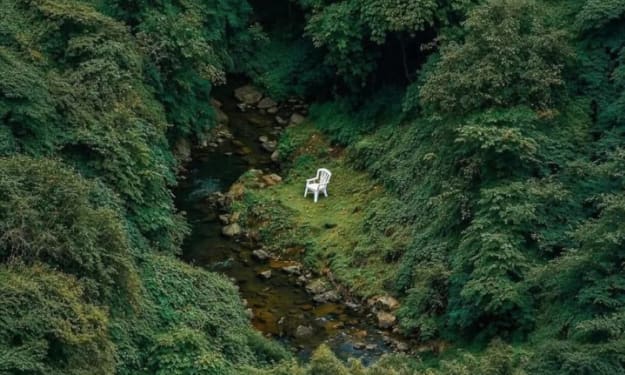
The Forest Throne How One Chair Became a Peaceful Symbol of Rest and Reflection in Nature Deep within the heart of Pineberry Forest, where the trees whisper secrets and the air carries the scent of moss and pine, there stands a single wooden chair. Weathered but sturdy, simple yet striking, the chair has no owner, no plaque, and no obvious reason for being where it is. Yet, over the years, it has quietly become a beloved part of the forest — known by locals and hikers alike as “The Forest Throne.” No one knows exactly who brought the chair there. Some say it appeared after a storm one spring, others believe an old carpenter placed it there as a quiet gift to the woods. The most popular theory is that it was carried in by an elderly woman who used to walk the trails every day with her dog. She was often seen resting on a folding stool, which she once called her “thinking seat.” When she stopped coming, some believe someone honored her memory by placing a sturdier chair in her favorite clearing. Regardless of its origin, the chair now sits peacefully on a small rise overlooking a stream. It faces west, catching the soft golden light of the setting sun through the trees. Birds often perch on its backrest, and squirrels occasionally climb its legs as if inspecting a monument. Wildflowers grow around its feet in the warmer months, and in winter, it wears a soft white coat of snow. More than just a curious object in the woods, the Forest Throne has become a gentle landmark and a destination. Hikers take breaks there, sipping water and listening to the sounds of the forest. Children sit on it like royalty, pretending to hold court with the trees. Artists sketch it, and photographers wait patiently for just the right lighting to capture its quiet charm. Some couples have even gotten engaged next to it, believing it adds a touch of natural magic to the moment. For many, the chair serves a deeper purpose. It invites people to pause — not just physically, but mentally. In a world that moves fast, where even nature walks can become goals to “complete,” the Forest Throne offers permission to stop, sit, and simply be. Local schoolteacher Maya Ellis first discovered the chair during a solo hike in early spring. “I was having a hard time,” she later shared in a community newsletter. “I’d been overwhelmed, anxious, and I wasn’t even sure why I was out there that day. But then I found the chair. I sat down, and everything just… softened. The stillness of the forest, the way the light moved through the trees — it made me breathe differently. I stayed for nearly an hour.” Since then, Maya has returned many times, sometimes with her students. They call it their “story seat,” taking turns to sit in it and tell made-up tales about forest animals and enchanted trees. She’s also helped organize a gentle path-clearing project around the area, ensuring that the chair remains accessible while keeping the surroundings wild and undisturbed. Interestingly, the chair has changed very little over the years. Though it’s been exposed to all kinds of weather, it has held up remarkably well. Some say it’s because it's made of old, seasoned oak. Others suggest it’s the forest itself that protects it — as if the chair, having become part of the ecosystem, now receives its care in return. The Forest Throne has even inspired a local movement called “Sit a While,” encouraging people to create simple resting spots in natural spaces. Wooden benches, upcycled chairs, and stone seats have begun to appear in quiet corners of parks and trails throughout the region, each one marked only by a small carved leaf symbol and the words, “Sit a While.” Despite its fame, the chair has never been vandalized. There is no graffiti, no carvings, and not even trash left nearby. People seem to instinctively respect its presence. Perhaps that’s because the Forest Throne doesn’t ask for anything — it offers. It gives rest to the weary, silence to the busy-minded, and beauty to anyone willing to see it. And so it remains, season after season — a simple chair in a quiet forest, waiting patiently for the next person who needs it. Some come with questions. Others bring sorrow. Many bring nothing at all but themselves. But all who sit in the Forest Throne leave with something: a little more peace, a little more stillness, and a renewed connection with the world around them.
By Muhammad Saad about a year ago in Earth
The Amazon Rainforest: Nature’s best marvel
The Amazon Rainforest is one of the most splendid places on our planet. Regularly known as the “lungs of the Earth” as it produces round 20% of the world’s oxygen, this significant jungle is domestic to top notch biodiversity, particular cultures, and breathtaking natural beauty. But beyond its wonders, the Amazon faces extreme threats that endanger not most effective its survival but additionally the stability of life across the globe. Let’s dive into the fascinating story of this herbal treasure.
By Samiullah Adilabout a year ago in Earth
Hurricane Irene and the Viral “Stadium Effect” (USA)
A Storm That Refused to Be Normal. Hurricanes are nothing new to coastal communities. Every year, residents of the Atlantic Seaboard brace for storms that bring heavy rain, flooding, and destructive winds. But in 2025, Hurricane Irene became more than just a weather event. It became a viral phenomenon — thanks to a mysterious atmospheric display that storm chasers and residents alike have dubbed the “stadium effect.”
By Echoes of Lifeabout a year ago in Earth
A Whole New Underwater World
When we look at the ocean from the shore, it often appears as a vast blue surface stretching endlessly toward the horizon. But beneath those waves lies an entirely different universe, one that most of us rarely get the chance to explore. The underwater world is full of breathtaking beauty, fascinating creatures, and secrets that continue to amaze scientists and divers alike. It truly feels like stepping into another planet—one where life moves differently, where silence speaks volumes, and where every dive uncovers something new.
By aadam khanabout a year ago in Earth
Whispers of the Green Tomorrow
🌿 Whispers of the Green Tomorrow A Heartwarming Journey into a World Where Nature Heals, Hope Grows, and Humanity Thrives In the quiet valley of Aravelle, nestled between mountains painted in emerald hues, a transformation had begun. It wasn’t loud or sudden—no grand announcements or world leaders at podiums. It started with a whisper. A single voice, a single seed, and a spark of hope that spread like morning sunlight over dew-covered grass. Lena Wren, a schoolteacher in her early forties, had returned to her hometown after years in the city. The noise, the rush, the concrete—it had worn her thin. Aravelle was once a place of green hills and clean rivers, but like so many places, it had suffered. Trees had been cut down, the river had shrunk, and the birds had long forgotten the way home. But Lena believed in beginnings. With her savings, she purchased a small piece of neglected farmland on the edge of the village and began to plant—not just crops, but possibilities. She dug her hands into the soil, planted native trees, restored the stream with the help of some old village friends, and opened her land to children who had never seen a butterfly up close. At first, people smiled politely. "How lovely," they’d say, then continue scrolling on their phones or driving past in a hurry. But nature, like kindness, is contagious. One day, 9-year-old Tobi, who was always seen with headphones and a screen, wandered into Lena’s garden during a school field trip. He touched the bark of an old oak she’d planted and whispered, “It feels alive.” It was a small sentence, but for Lena, it was everything. Soon, other children followed. They came to plant, to paint rocks, to build bee hotels and birdhouses. They learned to listen to the wind and read the sky. Slowly, their parents began to join. Then neighbors. Then travelers who heard whispers of something special blooming in Aravelle. The garden became a sanctuary. Flowers danced with bees, and laughter flowed louder than ever. The once-dry river now sparkled, its waters returning with the trees. Birds built nests again, and deer peeked from the woods, curious about the joyful noise. Lena started something called “The Green Tomorrow.” It wasn’t just a garden anymore—it was a movement. People shared seeds and stories, planted hope in pots on balconies, and restored spaces long forgotten. News spread beyond the valley. A young filmmaker named Riya visited Aravelle to document the change. Her short film, Whispers of the Green Tomorrow, went viral. It wasn’t flashy—just moments of real people reconnecting with the earth, a boy’s laughter as a butterfly landed on his nose, a grandmother planting lavender with her granddaughter, Lena smiling with muddy hands. Viewers cried. They shared. They planted. Schools across countries began starting gardens. Cities painted murals of forests and turned rooftops green. People paused in their busy lives to breathe. And amidst all of it, Lena remained in Aravelle, tending her garden with the same quiet dedication. When asked why she did it, she would say, “Because I believe the earth remembers kindness—and gives it back.” Ten years later, Aravelle became a model village for sustainable living. Solar trees lined the paths, food was grown locally, and every child could name more birds than brands. But the real magic wasn’t in the technology or the policies. It was in the people—connected again, not just to nature but to each other. In one of the village’s new community centers, engraved on the wall were the words: “Hope is not a loud promise. It's a quiet seed that grows when someone dares to care.” And so, the whisper became a song. A melody of green tomorrows—sung by rivers, carried by winds, blooming in the hearts of people everywhere.
By Muhammad Saad about a year ago in Earth
Amazon forest
Whispers of the Amazon Deep in the heart of South America, where the canopy stretches high like emerald cathedrals and rivers weave like silver veins, the Amazon Forest whispered ancient stories to those who listened. Twelve-year-old Lina stood at the edge of the Rio Negro, her boots caked in mud, eyes wide with wonder. She had traveled from her city home to visit her grandfather, a retired biologist who had spent his life studying the Amazon. Now, she was about to experience the forest not through textbooks or screens, but with her own senses. “Come, niña,” her grandfather called, adjusting his wide-brimmed hat. “The forest is alive. It’s not something you see—it’s something you feel.” As they ventured deeper, the green closed in around them. Sunlight filtered through the canopy in golden beams. The air was thick and rich with the scent of earth and growing things. Every step brought a new sound—the chirp of a tree frog, the flutter of toucan wings, the rustle of a sloth moving slowly overhead. Lina had never known silence could be so full of life. Her grandfather stopped by a massive tree, its roots spreading like ancient fingers across the ground. “This is a kapok tree,” he said. “One of the giants of the forest. Some of them are over 200 feet tall.” She ran her hand along the bark. “It’s beautiful. Is it important?” “Very,” he nodded. “Kapok trees support hundreds of species. Bats roost in their branches, and their flowers feed bees and birds. Everything in the Amazon is connected, just like this tree to the life it supports.” As they continued, Lina noticed how every part of the forest pulsed with harmony. Bright butterflies danced around blooming orchids. Ants marched in determined lines. Monkeys chattered from high branches, flinging fruit peels to the ground below. They stopped by a quiet stream, where her grandfather knelt and pointed to tiny ripples in the water. “Piranhas,” he whispered with a smile. “Don’t worry, they’re not as fierce as people say.” Lina giggled, crouching beside him. “I thought they’d be bigger.” “Many things in the forest are misunderstood,” he said. “That’s why it’s so important we protect it. People think the Amazon is just trees. But it’s the most biodiverse place on Earth—home to one out of every ten known species. And it helps regulate the climate for the entire planet.” Lina’s expression grew serious. She remembered news stories about fires and deforestation. “Are we doing enough to save it?” Her grandfather sighed. “Some are. Many indigenous communities have lived here for generations, protecting it better than any government. Scientists, activists, even students like you—they’re all part of the fight. But the forest still faces threats. Illegal logging, mining, and farming are eating away at it.” “But if it disappears…” Lina began. “It would be a disaster,” he finished. “Not just for the animals and people here, but for the world. The Amazon stores billions of tons of carbon. It keeps the planet cool. That’s why people call it the ‘lungs of the Earth.’” Lina sat quietly for a moment, listening to the rustle of the trees. “It’s worth saving,” she said firmly. Her grandfather smiled. “Yes, it is.” That night, Lina lay in her hammock at their small research outpost, watching fireflies blink in the dark. Insects buzzed softly around the netting, and somewhere nearby, a jaguar padded through the undergrowth. Despite the darkness, she didn’t feel afraid. The forest didn’t feel like a place of danger. It felt like home. In the days that followed, Lina helped her grandfather with his research. They took samples, tracked animal movements, and talked to local communities. She learned how native plants could heal wounds, how birds signaled changes in weather, and how every leaf and creature had a role. By the end of the week, Lina wasn’t just in awe of the Amazon—she was in love with it. When it was time to leave, she hugged her grandfather tightly. “I’m going to tell everyone about this place. At school, online—everywhere. People need to know what’s here.” He looked proud. “That’s how change starts. With someone who cares.” As the small boat pulled away from the riverbank, Lina waved goodbye, her heart full. Behind her, the Amazon whispered its ancient song—a song of life, of balance, of beauty. And now, she carried that song with her, ready to share it with the world.
By Muhammad Saad about a year ago in Earth