Science
The future life "In Space"
The future of space exploration and colonization is a topic of ongoing research and development by various organizations and countries. The goal of space exploration and colonization is to eventually establish a permanent human presence on other celestial bodies, such as the Moon or Mars.
By 4MECH702 Udhaya Kumar V4 years ago in Earth
Did you know about solar system
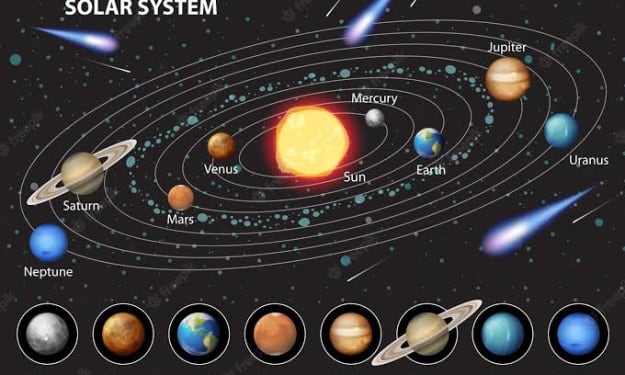
I. Introduction The solar system is the collection of celestial bodies that orbit around the sun. This includes the sun itself, the eight planets and their moons, dwarf planets, comets, asteroids, and other small bodies. The solar system is made up of four types of celestial bodies: the sun, the planets, the dwarf planets, and small bodies (comets, asteroids, and other small bodies). II. The Sun The sun is a star that is located at the center of the solar system. It is a medium-sized star and is primarily composed of hydrogen and helium. It is responsible for providing the energy that sustains life on Earth. The sun plays a crucial role in the formation of the solar system. It is believed that the sun and the solar system formed from a cloud of gas and dust that collapsed under its own gravity. This collapse caused the material to heat up and form the sun, while the remaining material formed the planets and other celestial bodies. III. The Planets The solar system has eight planets: Mercury, Venus, Earth, Mars, Jupiter, Saturn, Uranus, and Neptune. Mercury is the closest planet to the sun and is small and rocky. Venus is the hottest planet and is covered in thick clouds. Earth is the third planet and is the only known planet to support life. Mars is the fourth planet and is known as the "Red Planet" because of its reddish appearance. Jupiter is the largest planet in the solar system and is made mostly of gas. Saturn is the second largest planet and is known for its rings. Uranus is the third largest planet and is tilted on its axis. Neptune is the fourth largest planet and is known for its strong winds. IV. The Dwarf Planets Dwarf planets are celestial bodies that orbit the sun and have enough mass to have a nearly spherical shape, but they have not cleared the neighborhood around their orbit. The five known dwarf planets in the solar system are Ceres, Pluto, Haumea, Makemake, and Eris. Ceres is the largest object in the asteroid belt and is classified as a dwarf planet. Pluto was reclassified as a dwarf planet in 2006. Haumea, Makemake, and Eris are also classified as dwarf planets. V. The Moons The solar system has more than 200 moons, with the most moons orbiting Jupiter and Saturn. The most notable moons include Earth's Moon, Jupiter's four largest moons (Io, Europa, Ganymede, and Callisto), and Saturn's largest moon, Titan. Earth's Moon is the largest relative to the size of its host planet, and it has been studied extensively for its impact on tides and the potential for future colonization. Jupiter's moons are notable for their potential to support life, with the subsurface oceans of Europa and Ganymede being of particular interest. Titan is notable for its dense atmosphere and the potential for similar processes that shaped Earth to have occurred there. VI. The Asteroid Belt The asteroid belt is a region of the solar system that lies between the orbits of Mars and Jupiter. It is composed of a large number of small, irregularly shaped bodies made of rock and metal. The asteroid belt is believed to be the remains of a planet that failed to form due to the gravitational influence of Jupiter. VII. The Kuiper Belt and Oort Cloud The Kuiper Belt is a region of the solar system beyond the orbit of Neptune that is home to many small, icy bodies, including Pluto. The Oort Cloud is a region of the solar system
By Giridharan4 years ago in Earth
The rollout of vaccines and the vaccination drive across the country.
The rollout of vaccines and the vaccination drive across the country. I. Introduction Explanation of the significance of the COVID-19 vaccines Brief overview of the current situation in India regarding the vaccination drive
By Nisha Madeshwaran4 years ago in Earth
Electric Vehicles : Are they really safe for the environment ?
Electric vehicles (EVs) are vehicles that are powered by electric motors and batteries, rather than by internal combustion engines (ICEs) that run on gasoline or diesel. EVs have several advantages over ICE vehicles,
By Arun Ramasamy4 years ago in Earth
New Low-Power Desalination Technology
Water, water everywhere, nor any drop to drink! KISS on a boat Living on a boat as I do, obtaining fresh water is a problem. I try to follow the KISS principle and so I’ve avoided the complexities associated with power-hungry marine desalination systems.
By James Marinero4 years ago in Earth
The Blue Butterfly , Kaitlyn's story and the unknown benefits of the blue butterfly pea flower
A little girl named Kaitlyn used to reside in a small community hidden deep within a verdant tropical forest.She was well-known around the hamlet for her love of the outdoors and her insatiable curiosity.
By Shamil Ahamed4 years ago in Earth
History of Earth
I. Introduction A. Definition of Earth: Earth is the third planet from the sun and the only known planet to support life. It is a terrestrial planet, meaning it is primarily composed of rock or metal. Earth has a diameter of about 12,742 km and is the fifth densest planet in the solar system. B. Importance of Earth: Earth is the only known planet in the universe that can support life. It has a diverse array of ecosystems and biomes that are home to countless species of plants and animals. Additionally, Earth's atmosphere, magnetic field, and distance from the sun all contribute to the planet's ability to support life as we know it. The planet is also an important scientific object of study for understanding the origins of the solar system and the potential for life on other planets. II. Physical Characteristics A. Size and Shape: Earth is the fifth largest planet in the solar system and has an equatorial diameter of 12,742 km and a polar diameter of 12,714 km. It is an oblate spheroid, meaning it is slightly flattened at the poles and bulging at the equator due to its rotation. B. Composition and Structure: Earth's composition is primarily made up of rock, with a small amount of metal in the core. The planet has three main layers: the crust, the mantle, and the core. The crust is the outermost layer and is composed of solid rock. The mantle is the layer beneath the crust and is composed of semi-solid rock. The core is the innermost layer and is primarily composed of iron and nickel. C. Surface features: Earth's surface is covered by 71% water, and the remaining 29% is land. The land is divided into many different landforms such as mountains, valleys, plateaus, and plains. The oceans are also a significant feature of the Earth's surface and are home to a diverse array of marine life. Earth's atmosphere is composed of 78% nitrogen, 21% oxygen, and small amounts of other gases. III. Climate and Weather A. Factors that influence climate: Climate is determined by a variety of factors, including the planet's distance from the sun, the tilt of its axis, and the composition of its atmosphere. The sun's energy drives the Earth's climate, with the amount of solar radiation received by different regions determining temperature and precipitation patterns. Other factors such as ocean currents, topography, and human activity also play a role in shaping Earth's climate. B. Types of climate regions: Earth has a wide variety of climate regions, including tropical, desert, temperate, and polar climates. These regions are determined by factors such as latitude, altitude, and proximity to oceans. C. Weather patterns and phenomena: Weather is the short-term state of the atmosphere, including temperature, humidity, wind, and precipitation. There are many different types of weather phenomena, including thunderstorms, hurricanes, tornadoes, and blizzards. These phenomena are driven by a variety of meteorological processes, such as the movement of air masses and the interaction of warm and cold fronts. IV. Life on Earth A. Diversity of life: Earth is home to a vast array of plant and animal species, including everything from single-celled organisms to complex mammals. The diversity of life on Earth is a result of millions of years of evolution and adaptation to different environments. B. Evolution of life: Life on Earth has evolved over billions of years, with the first simple life forms appearing around 3.5 billion years ago. Over time, these life forms have diversified and become more complex, eventually giving rise to the wide variety of species that exist today.
By Giridharan4 years ago in Earth