Science
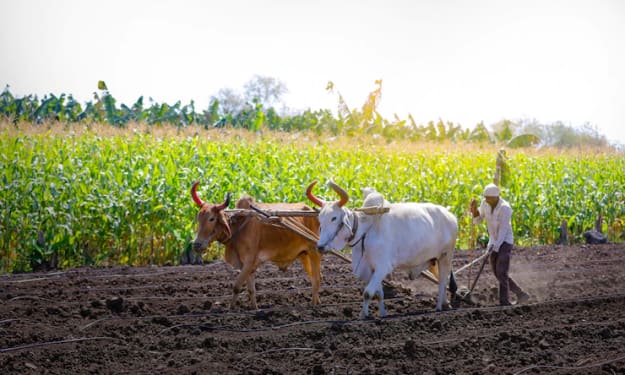
AGRICULTURE TEC
I. Introduction A. Definition of Agriculture: Agriculture is the cultivation of plants, animals, and other life forms for food, fuel, and other products. It is the process of producing food, fiber, and other goods through farming and forestry. Agriculture encompasses a wide range of activities, including planting and harvesting crops, raising livestock, and managing land and natural resources.
By Yuvaraj Murugasan4 years ago in Earth
Nebula
The bright variable star V 372 Orionis takes center stage in this image from the NASA/ESA Hubble Space Telescope, which has also captured a smaller companion star in the upper left of this image. Both stars lie in the Orion Nebula, a colossal region of star formation roughly 1,450 light-years from Earth. V 372 Orionis is a particular type of variable star known as an Orion Variable. These young stars experience some tempestuous moods and growing pains, which are visible to astronomers as irregular variations in luminosity. Orion Variables are often associated with diffuse nebulae, and V 372 Orionis is no exception; the patchy gas and dust of the Orion Nebula pervade this scene. This image overlays data from two of Hubble’s instruments. Data from the Advanced Camera for Surveys and Wide Field Camera 3 at infrared and visible wavelengths were layered to reveal rich details of this corner of the Orion Nebula. Hubble also left its own subtle signature on this astronomical portrait in the form of diffraction spikes that surround the bright stars. The four spikes around the brightest stars in this image form when an intense point source of light, such as starlight, interacts with the four vanes inside Hubble that support the telescope’s secondary mirror. The diffraction spikes of the NASA/ESA/CSA James Webb Space Telescope, on the other hand, are six-pointed due to Webb’s hexagonal mirror segments and 3-legged support structure for the secondary mirror.
By Bijan Mondal4 years ago in Earth
The Critical Need for Rainforest Conservation
The world’s tropical rainforests are an incredible treasure trove of biodiversity, home to millions of unique species of plants, animals, and microorganisms. They act as a vital source of oxygen, absorb carbon dioxide, regulate global climate and hydrological cycles, and provide numerous resources and services to humans and other species. However, through deforestation and overuse, the rainforests have been put in peril, yet the key to their survival lies in the preservation of its biodiversity.
By Mohammad Hammash4 years ago in Earth
Unlocking the potential: A comprehensive analysis of solar panels and their impact on clean energy
Solar energy is a clean, renewable energy source that has gained popularity in recent years as a way to reduce dependence on fossil fuels and decrease carbon emissions. Solar panels, also known as photovoltaic cells, are the primary technology used to convert sunlight into electricity. In this article, we will discuss the history, technology, and current applications of solar panels.
By Geert Verreet4 years ago in Earth
"Galaxies: The Universe's Masterpiece"
WHAT IS GALAXY? A galaxy is a collection of stars, gas, dust, and dark matter bound together by gravity. There are many different types of galaxies, including spiral, elliptical, and irregular. The Milky Way, the galaxy that contains our solar system, is a barred spiral galaxy. It has a flat disk with spiral arms that contain a mixture of young and older stars, and a central bar. The disk is surrounded by a halo of older stars and globular clusters. The Milky Way is estimated to contain between 100 and 400 billion stars and a supermassive black hole at its center. Galaxies can also contain gas, dust, and other types of matter that can be used to form new stars. The study of galaxies is known as galaxy formation and evolution, which is an active area of research in modern astrophysics.
By Vivin Akshay4 years ago in Earth
Navigating the Challenges of Indian Farming: Exploring Solutions for Improving Productivity, Market Access, and Farmer Income
Indian farming is a vital sector of the economy, providing food and livelihoods for millions of people. However, Indian farmers face a number of challenges that impede their productivity and profitability. These challenges include low productivity, lack of access to modern technology and inputs, and poor market access. In order to address these issues and improve the lives of Indian farmers, a variety of solutions must be explored. This essay will examine the challenges facing Indian farmers and explore potential solutions for improving productivity, market access, and farmer income.
By Muthumariselvam mariyappan4 years ago in Earth
THE COW LIFE STORY
Chapter 1: Bessie is Born Bessie was born on a beautiful farm, surrounded by green fields and happy animals. She was a cute little calf, with soft brown fur and big, curious eyes. Bessie's mom was a gentle cow named Daisy, and she was very proud of her new baby. As she looked at her new born calf, Daisy knew that Bessie was going to be a special one, with her inquisitive eyesand playful nature.
By Hustler Withright4 years ago in Earth
The Approaching Green Comet: A Once-in-50,000-Year Event
The universe is a vast and mysterious place, and every once in a while, it reminds us of its wonder and beauty with a celestial event that takes our breath away. One such event is set to occur in the coming months, as a rare green comet is set to make its first approach to Earth in 50,000 years. Dubbed Comet C/2022 P1, this celestial phenomenon is causing excitement among astronomers and stargazers alike, as it provides a unique opportunity to study a green comet and its significance.
By Globe Trotter's Journal4 years ago in Earth