Science
The most brilliant cosmic explosion in years could assist cosmologists with anticipating future star blasts
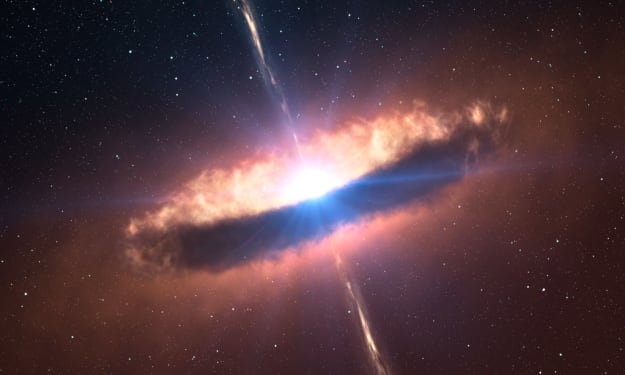
The most brilliant cosmic explosion in years could assist cosmologists with anticipating future star blasts Cosmologists spot more than 20,000 cosmic explosions consistently, yet this one sticks out. Another cosmic explosion has transformed into the most-watched peculiarity in the May night sky. The closeness of the heavenly blast and the tremendous measure of perceptions assembled since the revelation vow to propel space's comprehension experts might interpret heavenly development and really might prompt significant advances in cosmic explosion gauging. Cosmic explosions are strong blasts in which extremely gigantic stars, something multiple times more monstrous than our sun, pass on when they go through all the hydrogen fuel in their centers. The disclosure of this most recent detonating star, referred to formally as 2023ifx, was a fortunate one. At the point when novice space expert Koichi Itagaki got comfortable with his beginner observatory in the mountains close to Yamagata City in northern Japan on the evening of May 19, much to his dismay that his daily output of the close-by cosmic systems would deliver a galactic sensation. Itagaki, a Chief of a food organization, is no beginner in the cosmic explosion business. He is one of the world's most productive novice cosmic explosion trackers and has more than 170 cosmic explosion disclosures added to his repertoire, as indicated by Logical American. That is the reason when Itagaki turned his telescope to the Pinwheel Universe, a famous objective among beginner cosmologists to find nearly 21 million light-years from Earth, it didn't take long for him to understand that he was seeing something critical. Since Itagaki revealed the perception to the Worldwide Galactic Association that evening, the lighting-up star in the Pinwheel System has turned into the most concentrated object in the night sky. Both the world's biggest logical telescopes and beginncomprehensions all over the planet have turned their focal points toward the newly detonated star, which has since been announced as the closest cosmic explosion blast over the most recent five years. The occasion's nearness to Earth is just a single piece of its logical allure. Daniel Perley, an astrophysicist at Liverpool John Moores College, let Space.com know that on account of the huge number of accessible perceptions of the system taken by the two novices and experts, stargazers could nail down the specific snapshot of the blast in practically no time. Typically, when a cosmic explosion is found, it's as of now daily, two days, three days, even seven days after the blast when we first see it," Perley said. "This one was found not long after the real introductory blast of the star, and we might try and have the option to get that down to a couple of moments after we gather a portion of the novice information that individuals have been unexpectedly taking of the cosmic system. So it will be feasible to get incredibly, decent imperatives on the very snapshot of blast. Also, that is surprising. With the present innovation, cosmic explosion locations are not interesting. As indicated by Cardiff College astrophysicist Cosimo Inserra, strong study telescopes track down a few cosmic explosions consistently. Inside a solitary year, more than 22,000 supposed transient occasions, unexpected strong brightening serum in systems, can be found. This number incorporates cosmic explosions, yet in addition, stars are destroyed by dark openings. Overall, the distance of most of these drifters depends on redshift 0.1," Inserra said. "That is between 0.7 to 1.5 Giga light-years [a Giga light year equivalent to a billion light years]. At the point when such a blast goes off in the neighborhood of our world, the Smooth Way, space experts can identify it before it arrives at its most extreme splendor, screen it for a more extended period, yet in addition make estimations that are impractical for the more far off blasts. At the point when it's close by, we can get the whole electromagnetic range of data, which our telescopes as a rule can't distinguish in the distant articles because the sign is so weak," Inserra said. "The full electromagnetic range has just been identified for a couple [supernovas]. What's more, with this one, since it's so brilliant, we as of now have X-beam data, optical and close infrared. The perceptions will likewise work on the comprehension of the development of stars themselves, especially the progressions they go through in the last phases of their lives, added Perley. "The significant thing is to comprehend the idea of the star that detonated," said Perley. "If we can check whether the star had some factor action before the blast, that would be a significant turn of events." As per Inserra, cosmologists can see which stars are in the last phases of their lives yet have no real way to tell whether the star will go corelationssion a long time from now or tomorrow.
By Hassan Saddam3 years ago in Earth
LIFE ON MARS
Once upon a time, in a land far, far away (well, Africa), there lived a group of odd-looking, standy-uppy creatures called homo sapiens. Early humans had been living in Africa for hundreds of thousands of years, chasing gazelles and running away from lions, but homo sapiens was a little bit different.
By Jack Mutinda3 years ago in Earth
The Time Traveler's Quest
In the depths of a hidden laboratory, tucked away from prying eyes, Dr. Amelia Williams toiled tirelessly on her greatest invention—a time machine. For years, she had delved into the mysteries of time travel, driven by an insatiable curiosity to explore the past and shape the future.
By Thomas Writes3 years ago in Earth
The little girl's wet nurse
In the distant animal kingdom, there is a beautiful fox tricked the little pig apple, there are many small animals there to learn. They each have their own skills, some can music, some can swim, and can climb trees... .. ... One day, the principal saw little Ma Feifei crying, so he went up and asked, "Feifei, what's wrong with you?" 'They're all good in their own way, but I can't beat them in anything, I'm not a good student, whoo.' The headmaster said: "Don't be sad, you must have your own ability!" Then the dog said: "We come to the race to run!" The principal said, "Try it, you can do it!" Pony Fifi gathered her courage and began to play. At the start of the race, Pony Fifi took the lead in first place. A whistle, the game is over, pony Fifi won the first, everyone for her thumbs up. Little Ma Feifei said happily." I have a wooden collar and I don't have a bad student anymore!"
By Felicia Early3 years ago in Earth
The Future of Renewable Energy: Trends and Innovations to Watch
Renewable energy is gaining momentum as a crucial component of the global energy transition towards a sustainable and low-carbon future. With the urgent need to mitigate climate change and reduce dependence on fossil fuels, the renewable energy sector is experiencing rapid growth and innovation. In this article, we will explore the trends and innovations shaping the future of renewable energy and their potential to revolutionize the way we generate, store, and consume energy.
By Gokhan Polard3 years ago in Earth
The Impact of Melting Glaciers on Sea Level Rise and Coastal Communities
Glaciers are majestic bodies of ice that have shaped the Earth's landscape for thousands of years. However, in recent decades, the accelerating rate of global warming has led to the rapid melting of glaciers worldwide. This phenomenon has profound implications for sea level rise and poses significant threats to coastal communities around the globe. In this article, we will explore the impact of melting glaciers on sea level rise and the consequences for vulnerable coastal areas, as well as the potential strategies to mitigate these effects.
By Gokhan Polard3 years ago in Earth
The Truth Behind the Bermuda Triangle
For decades, the Bermuda Triangle has captured the imaginations of people around the world. This enigmatic stretch of ocean, located between the points of Miami, Bermuda, and Puerto Rico, has been shrouded in mystery, with countless tales of disappearing ships and aircraft. However, recent research and scientific investigations have shed light on the once-perplexing phenomena, unraveling the secrets of the Bermuda Triangle.
By Niaz Mohammad Choudhury3 years ago in Earth
Embracing Peace:
Introduction: In a world often plagued by conflicts and divisions, the pursuit of peace becomes an essential and noble endeavor. Peace is not merely the absence of war; it is a state of harmony, mutual respect, and understanding among individuals, communities, and nations. In this article, we explore the importance of peace, the challenges we face, and the steps we can take as individuals to foster peace in our lives and contribute to a more peaceful world.
By Roston Obligacion3 years ago in Earth
A.I. Summarized Unclassified Documents!
CIA-RDP96-00788R001100290005-5 29 JUNE 1982 This document is a transcription of a briefing about a governmental or military remote viewing program. Remote viewing is a process where individuals, referred to as remote viewers, attempt to gather intelligence about unseen or distant targets through perceived extrasensory perception.
By Snap Snook3 years ago in Earth
How are stars born?
Stars are gigantic balls of fire holding planets asteroids and meteorites in their firm gravitational grip, and their fire sends light into the farthest reaches of their galaxies. But, how did they get here? I mean these incredible orbs must have come from somewhere right . What would it be like to witness this epic birth? What would it feel like at the center of the action, and why would this beautiful event have a funny smell. What if you saw a star being born. The Milky Way galaxy, spans about 100 000 light years across and it contains somewhere around 200 billion stars. If there are that many stars in our little section of space real estate, imagine how many there are in the entire universe! Now depending on where you look in the night sky you could see around 5000 Stars just with your naked eye. The brightest ones have melodic names like, Polaris, Alpha, Centauri, and Beetlejuice . Looking further out into the universe with the help of telescopes there are simply too many stars to name. That's the North Star well what is that, that's why many of these are now identified more generically like wasp 50 hd28678 and hat p23. But today you're not just going to look into a telescope and name some baby Stars, you're going to be in the thick of it, the hot dense thick of it. Every year seven new stars are born in the Milky Way alone. Now that might not sound like a whole lot but keep in mind that our galaxy is already used up 90 of its star making material over the billions of years of its existence, and yet new stars are still being born all the time. Now to witness their birth you need to travel to one of the many Star nurseries in the universe. These are known as nebulas . Nebulas are huge clouds of gas and dust that can span light years across. So hop into your Interstellar spacecraft and set your coordinates for one of the most famous Stellar nurseries of our galaxy. Okay so, I'm here 1344 light years away the Orion Nebula, yeah it's here that you'd find the necessary ingredients for a Star to be born. Gas dust, gravity, and turbulence sounds like my car being in the middle of a nebula would feel like being in the clouds. You'd be surrounded by over 200 different kinds of molecules. There would be hydrogen and helium gas as well as microscopic grains of silicon and iron, and I hope you packed some warm clothes because conditions In This Cloud would be frigid. You'd need a spacesuit thick enough to withstand temperatures as low as minus 270 degrees Celsius. But don't worry things are about to heat up suddenly. You'd be hit by a blast! This would be a ripple effect from an exploding nearby star and it would cause the nebula to become turbulent . All it means is that the gases around you would start to mix and swirl together, it would be the beginning of the Epic event you're here for. First dust particles would begin to Clump together these clumps would become denser and denser forming knots . Once these knots gain enough Mass they'd start to collapse under their own gravity , and their internal pressure and temperature would increase . Yeah at around 2200 degrees Celsius these high pressure knots would emit a dull red glow. You wouldn't be able to see it because that light would be infrared. Oh, but you would be uncomfortably aware of the temperatures starting to rise, and things would keep heating up. Eventually the Proto star before your eyes would emit its first rays of visible light wait, do you smell that? Well no of course you don't you're wearing a heat resistant spacesuit but , if you could you'd learn that this hot mass of dust and gas would also smell . It's disgusting but not necessarily in a bad way depending on the mixture of compounds around you, you could detect hints of sweetness lemon or even alcohol. But be careful your baby star wouldn't only be pulling things inward every now and then it would shoot powerful Jets from its poles at supersonic speeds. These would flash brightly as they come into contact with the surrounding gases . All the while the protostar would simultaneously grow and collapse under its own weight . This would make the core continue to heat up. Yeah once it reached the scorching hot temperature of 5 million degrees Celsius, you'd witness your baby star's first nuclear fusion deep within the center of the star, four hydrogen atoms would fuse together to form helium . This would release a ton of energy and with all that energy the protostar's pulsations would come to a halt. It would finally become a star. Now during the excitement of witnessing a star being born you'd have seriously lost track of the time. If the star that formed in front of your eyes was similar to our sun well you'd have just watched 50 million years fly right by you , and you might want to get your hearing checked. After experiencing all this of course there's no sound in the vacuum of space we all know that, but in the Stellar Nursery filled with gas and dust sound waves may have a medium to travel through and if you were wondering what the birth of a star sounds like well it would be deafening . If we could hear our own son it would be a lot like Earth was, covered and constantly wailing Sirens except multiplied by ten thousand . A new star created by a series of violent contractions of superheated gas forget about it . Okay now that your baby star is all stabilized it could burn bright for another 10 billion years maybe you'd also want to stick around for an extended vacation to see the end of its life?
By Michelle Hagen3 years ago in Earth