Science
Were Safe From Big Asteroids, But Only For 1,000 Years
Asteroids flying around is sometimes like a fierce game of dodgeball where you never know when some of them can go in your direction. We can just track the situation and hope for the best to figure out the risk scientists from different organizations have to study the positions and Paths of the asteroids that come close to our planet. Especially those that are at least 0.6 miles wide and the good news is that none of these asteroids will probably hit us for at least the next 1,000 years to give us an idea. Their power scientists did an experiment to simulate the impact of such a gigantic asteroid the energy released from the Collision would be a mind-blowing 100,000 megatons that's like detonating 15,000 tons of dynamite. Also if such a big asteroid hit us Earth would cool down significantly because of all that debris that would go into the atmosphere and block sunlight plants wouldn't be able to get their fuel. In this case so we'd all be in trouble both humans and animals thankfully such Mammoth asteroid impacts are quite rare the larger an asteroid the longer it takes it to collide with Earth for example it's estimated that asteroids with diameters of at least 0.6 miles strike our planet about once every seven hundred thousand years and if we're talking about even bigger ones that are three miles wide well those are predicted to come crashing down only once every 30 million years yay but hold on don't get too relaxed just yet astronomers focus on really large asteroids because those are the ones that can kind of Doom our planet if they hit us yep you got it right in a dinosaur kind of way even if one of them didn't erase us completely the damage would still be enormous so there are still some asteroids wandering around that we need to keep an eye on to see how they might evolve over time scientists have a model of tracking them where they focus on the parts of an asteroid's path that come close to our planet to see if the space Rock poses a risk to us and it seems there might be one asteroid 7482 1994 PC one 3600 feet in diameter that might pose some danger it's supposed to come closer to our planet in the next 1,000 years and when I say risky it means there's a 0.0151 chance of it coming within one Earth Moon distance it already passed by us in 2022 but we were lucky because it was far enough 1.2 million miles I'd say we can relax when it comes to asteroid scenarios for now asteroids slamming into Earth would be new for humankind but not for the planet itself as I said there weren't many of those big ones but they still had enormous consequences the first one that comes to most people's minds is of course the dinosaur asteroid as big as a mountain that struck our home planet around 66 million years ago near Mexico's Yucatan Peninsula it was chaotic Global firestorms and tsunamis were all over the place dust was blocking out the Sun and vaporized Rock released sulfur which then led to acid rain and the acidification of the oceans but there was an even bigger fella that came before that one around 2 billion years ago a gigantic asteroid crashed into our planet and left a massive crater in South Africa the one we know today is the retafort crater and it seems this asteroid might have been even bigger than we all originally thought twice as wide as the space rock that erased Dinosaurs the retafort crater is confirmed to be the biggest visible crater on Earth with a diameter of about 99 miles it used to be even bigger when it first formed though maybe even 155 to 174 miles across it's hard to figure out its true size because the crater has been eroding for the past two billion years think of it like slicing off layers from the rim of a bowl the diameter gets smaller with each slice when the asteroid seven to five miles wide that wiped away dinosaurs hit Earth about 66 million years ago it caused massive destruction forest fires acid rain tsunamis and so much Ash and dust that it changed earth's climate this all made about 75 of Life on our planet extinct the asteroid that created the retafort crater was not only bigger but it also traveled at a higher speed which means the consequences there would have been even worse but it happened a long time ago and living beings were different back then maybe it was some bacteria that didn't even notice that something unusual was happening Earth is not the only one lots of impacts have happened across our solar system too for example in our close neighborhood yup moving to Mercury and its massive crater called The colorus Basin it measures about 950 miles across which is more than the state of Texas there's a ring of towering mountains around the crater which makes it look even more impressive you can see different colors in the Mosaic image of the caloris Basin they tell us more about the geology of the Basin the orange Parts represent lava that once flooded the Basin these lava flows covered the original surface and added the specific orange hue and after the lava flooded the Basin on Mercury smaller craters formed on top of the lava surface these craters dug into the ground and uncovered the material hidden beneath the lava some of this material is blue in color and this blue stuff could be a clue about what the original floor of the Basin had looked like before the lava covered it Venus the hottest planet in our solar system has a thick atmosphere that comes with a pretty good defense system against space rocks it's so dense that it burns up most meteors before they even reach its surface as a result you won't see as many visible craters on Venus as on other rocky planets in our solar system but Venus still has some scars that can tell us about some serious impacts that happened there and one of the biggest scars we know about is mead crater it's enormous about 170 miles in diameter the inner floor of this crater is relatively flat and kind of brighter than its surroundings it's possible that the crater ended up filled with a mixture of melted rock after the impact and maybe even lava from volcanic activity on Venus want to get an idea of what Earth might look like without its protective layer called atmosphere just take a look at the Moon its surface is littered with impact craters this Taiko is one of the craters you'll easily notice on the moon when you look at the full moon you can spot it as a distinct circle with bright rays that radiate outward slightly off-center on the lower left side of the moon this crater 53 miles wide has a beautiful Central peak in the middle that's topped with an intriguing Boulder the size of this Boulder is impressive it would fill about half of a typical City Block here on Earth when talking about craters we definitely can't leave out Mars the red planet has a much thinner atmosphere than earth when spacecraft approached Mars they rely on the planet's atmosphere to slow them down as they enter it and indeed the atmosphere helps slow spacecraft down during Landing but it's still not thick enough to completely protect Mars from all those space rocks that are coming all the time from July to September 2018 a dark spot appeared on the southern pole of Mars it consists of two distinct patterns Theory says that the bigger lighter colored blast pattern can be the result of an impact shock wave scouring the ice surface impact generated winds that spread out and scoured the ice the inner blast pattern which is darker in color occurred because the impacting object managed to penetrate the thin ice layer as it hit the surface it sent dark sand and debris flying in all directions.
By Kajada Moore3 years ago in Earth
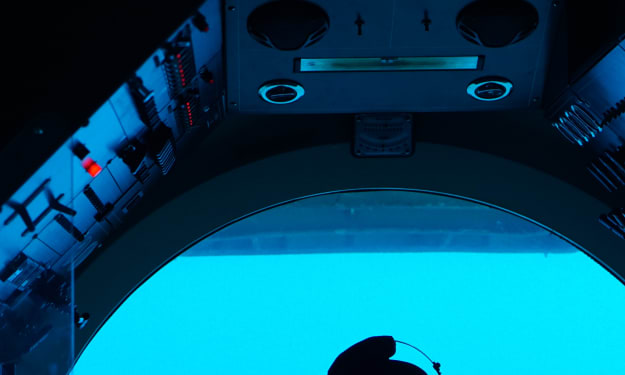
"Tragic Fate of the Titan Submersible: A Catastrophic Implosion Claims Lives in the Deep North Atlantic"
In a devastating turn of events, the Titan submersible met its demise through a catastrophic implosion, tragically claiming the lives of its pilot and four passengers. The incident unfolded in the deep waters of the North Atlantic, where the immense pressure proved to be an insurmountable force. As experts shed light on the nature of this catastrophic event, the true extent of the dangers lurking beneath the surface becomes apparent.
By A.B.M. Mohiuddin3 years ago in Earth
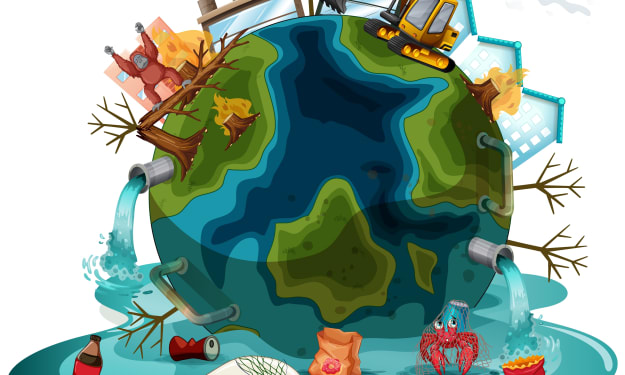
Climate change and pollution
Air pollution and climate change: two sides of the same coin Erupting volcanoes, earthquakes, dust storms and meteorites smashing into the Earth’s crust are natural phenomena that can cause climate change and air pollution: dinosaurs may have met their end after a giant meteorite kicked up so much dust that it blocked out the sun for decades, reducing photosynthesis and preventing the growth of plants. Adding to these potential threats, we have also been contributing to air pollution and global warming through our resource-intensive lifestyles. We’re producing and consuming more than ever before, and we’re generating more greenhouse gases as a result, as well as air pollutants in the form of chemicals and particulate matter, including “black carbon”. Windmills Switching to renewable sources of energy is an important part of the solution to both climate change and air pollution. Photo Credit: hpgruesen/Wikimedia Commons Although they may seem to be two very different issues, climate change and air pollution are closely interlinked, so by reducing air pollution we also protect the climate. Air pollutants include more than just greenhouse gases—principally carbon dioxide but also methane, nitrous oxide and others—but there’s a big overlap: the two often interact with each other. For instance, air pollution in the form of particulate matter from diesel engines is circulated around the globe, ending up in the most remote places, including the polar regions. When it lands on ice and snow it darkens them slightly, leading to less sunlight being reflected back into space, and contributing to global warming. The slightly warmer temperatures encourage plants in the sub-Artic region to grow a tiny bit bigger, and as they grow through the snow they cast a shadow, which, when multiplied over millions of small plants, also has the effect of darkening the Earth’s surface, leading to further warming. The good news is that immediate changes to air pollution levels also have immediate effects. Quick action on reducing highly potent, short-lived climate pollutants - methane, tropospheric ozone, hydrofluorocarbons and black carbon—can significantly decrease the chances of triggering dangerous climate tipping points, like the irreversible release of carbon dioxide and methane from thawing Arctic permafrost. Although they may seem to be two very different issues, climate change and air pollution are closely interlinked, so by reducing air pollution we also protect the climate. Air pollutants include more than just greenhouse gases—principally carbon dioxide but also methane, nitrous oxide and others—but there’s a big overlap: the two often interact with each other. For instance, air pollution in the form of particulate matter from diesel engines is circulated around the globe, ending up in the most remote places, including the polar regions. When it lands on ice and snow it darkens them slightly, leading to less sunlight being reflected back into space, and contributing to global warming. The slightly warmer temperatures encourage plants in the sub-Artic region to grow a tiny bit bigger, and as they grow through the snow they cast a shadow, which, when multiplied over millions of small plants, also has the effect of darkening the Earth’s surface, leading to further warming. “When addressing air pollution, we also address a critical and easy-to-implement solution to climate change. Short-lived climate pollutants are negative in all senses, and we have proven technologies and policies to economically and immediately reduce air pollution,” says UN Environment climate change specialist Niklas Hagelber A recent concern is trichlorofluoromethane, or CFC-11, which is to be phased out worldwide under the Montreal Protocol, the global agreement to protect the ozone layer. The industrial gas, used illegally, for example, in insulation material, also contributes to global warming. Aerosols, the atmospheric pollutant with an effect on the climate The October 2018 report by the Inter-governmental Panel on Climate Change (IPCC) highlights the importance of keeping global temperature rises to 1.5˚C below pre-industrial era levels. Urgent action is need over the next 12 years if there is to be any chance of achieving this target. Aerosols may be of either natural or anthropogenic origin and can influence climate in several ways: “through both interactions that scatter and/or absorb radiation and through interactions with cloud microphysics and other cloud properties, or upon deposition on snow- or ice-covered surfaces thereby altering their albedo and contributing to climate feedback,” says the Panel’s report. It defines aerosols as “a suspension of airborne solid or liquid particles, with a typical size between a few nanometres and 10 μm that reside in the atmosphere for at least several hours.” The report defines air pollution as “degradation of air quality with negative effects on human health or the natural or built environment due to the introduction, by natural processes or human activity, into the atmosphere of substances (gases, aerosols) which have a direct (primary pollutants) or indirect (secondary pollutants) harmful effect.” Air pollution is the theme for World Environment Day on 5 June 2019. The quality of the air we breathe depends on the lifestyle choices we make every day. Learn more about how air pollution affects you, and what is being done to clean the air. What are you doing to reduce your emissions footprint and #BeatAirPollution? The 2019 World Environment Day is hosted by China.
By Waliyullahi Ganiyu3 years ago in Earth
Hope and Inspiration
Once upon a time in a small coastal town, there lived a young girl named Maya. She had grown up amidst the breathtaking beauty of the ocean and the vibrant life that surrounded it. The rhythmic sound of the waves crashing against the shore was like a lullaby that soothed her soul. However, as Maya grew older, she began to witness the devastating effects of climate change on her beloved coastal paradise. The once-teeming coral reefs were bleaching, their vibrant colors fading away like distant memories. The rising sea levels threatened to swallow the homes of her neighbors, forcing families to abandon the places they had called home for generations. Maya couldn't bear to see her community suffer, so she decided to take action. She started educating herself about climate change, attending workshops, and researching sustainable practices. With every bit of knowledge she gained, her determination grew stronger, fueled by a flicker of hope. Driven by her newfound purpose, Maya rallied her friends and neighbors together. They formed a small environmental group dedicated to making a difference. Together, they planted trees to combat deforestation, organized beach cleanups to protect marine life, and launched campaigns to raise awareness about the urgent need for action. Despite facing skepticism and indifference from some, Maya and her group refused to give up. Their passion and resilience became infectious, inspiring others to join their cause. Slowly but steadily, their efforts began to bear fruit. One day, a renowned marine biologist named Dr. Hernandez visited Maya's town. She was renowned for her groundbreaking research on coral reef restoration. Intrigued by the stories of Maya's community, Dr. Hernandez decided to offer her expertise and guidance. Under Dr. Hernandez's mentorship, Maya's group embarked on an ambitious project to restore the dying coral reefs. They tirelessly collected fragments of healthy coral, nurturing them in special tanks and carefully transplanting them onto damaged sections of the reef. It was painstaking work, but their determination never wavered. Months turned into years, and Maya watched as the reef gradually transformed. The once bleached and lifeless corals regained their colors, as marine creatures returned to their vibrant sanctuary. The community's hope soared, knowing that they had played a part in reviving their precious ecosystem. News of Maya's community's success spread far and wide, reaching people from distant lands who were also grappling with the effects of climate change. Inspired by their story, others started taking action in their own communities, creating a ripple effect of positive change across the globe. Maya's heart swelled with pride as she witnessed the collective power of individuals united by a shared purpose. Her small coastal town had become a beacon of hope, a shining example of what could be achieved when people refused to surrender to despair. The emotional journey of Maya and her community reminded the world that even in the face of immense challenges, there is always hope. It showed that the actions of a few can inspire and empower countless others to rise and make a positive difference. Through their unwavering dedication, Maya and her community had not only restored a reef but also reignited a flame of hope that burned brightly in the hearts of people around the world, fueling their determination to protect and heal our precious planet.
By Iweka Omagbu3 years ago in Earth