Science
Unveiling the Art of Rock Balancing: Decoding the Mysteries of Big Rocks on Little Rocks
Introduction to Rock Balancing Rock balancing, an ancient art form that captivates both the mind and the eye, has been practiced for centuries. The art of delicately placing big rocks on little rocks to create stunning sculptures is a testament to human creativity and ingenuity. In this article, we will delve deep into the world of rock balancing, exploring its history, techniques, challenges, and the profound impact it can have on our well-being.
By David Binford3 years ago in Earth
How to Get Rid of Junk: Your Comprehensive Guide
In a world where accumulation seems to be the norm, dealing with the aftermath of clutter and unwanted items can be a daunting task. We understand the struggles you might face when trying to get rid of junk, and that’s why we’re here to provide you with a comprehensive guide on how to tackle this challenge effectively. Let’s dive into the world of decluttering and discover the most efficient strategies to reclaim your space and peace of mind.
By Loise Nepton3 years ago in Earth
The Healing Garden
In the heart of the bustling city, where the relentless rhythm of life often left people feeling disconnected and worn, lived a woman named Lily. Lily was a quiet soul, deeply moved by the beauty of nature and the solace it offered amidst the chaos. She had always believed that a touch of greenery could mend even the most weary of hearts.
By Samuel Onudu3 years ago in Earth
Nostalgia and Change
Amelia stood on the rocky cliff overlooking the once-majestic valley. The vibrant hues of green that had once adorned the landscape had faded to muted shades of brown and gray. The once-gushing river now resembled a mere trickle, struggling to meander through the parched earth. It was a sight that tore at Amelia's heart, evoking a powerful mix of nostalgia and sadness.
By Abdulqayyum Bolaji Alao3 years ago in Earth
Imagine a scenario in which people attempted to land on Saturn
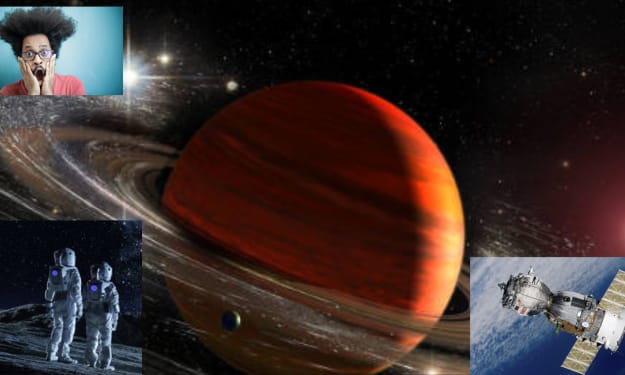
In 2017, NASA's Cassini probe sent us our closest view of Saturn as it dove into the planet's stormy atmosphere. And the results were stunning. But what would it be like if humans made the journey in person? At its closest, Saturn is 1.2 billion kilometers away from Earth. So with today's spacecraft technology, you'll need about eight years to make the trip. Finally, you arrive and get your first glimpse of Saturn with your own eyes. It's an enormous planet, the second largest in the solar system. In fact, over 760 Earths can fit inside. But hold up. We can't visit Saturn and skip over the best part, its iconic rings. Saturn's rings are almost as wide as the distance between the Earth and the moon, so at first glance, they seem like an easy place to land and explore on foot. Except there's one problem. While they look like giant discs, they're not a solid track at all. Instead, they're made of millions of chunks of ice, some as tiny as dust particles, others as large as buses. But if you were able to hike on one of Saturn's outermost rings, you'll walk about 12 million kilometers to make it around the longest one. That's about 15 round trips from the Earth to the moon. Along the way, you'll come across tiny moons and spokes of dust levitating above the surface. Now, you might notice that streams of tiny ice particles are also flying off the rings, heading towards Saturn. That's ring rain. It turns out, Saturn's magnetic fields are slowly but surely draining away the rings, so we're lucky to visit the rings now, because every 30 minutes, they lose enough water to fill an Olympic-sized swimming pool, and if we arrived 300 million years in the future, we'd miss them entirely. Now, let's climb back aboard and visit the planet itself, 282,000 kilometers away. As we reach the north pole, we'll notice a slight problem with our plan to land on the surface below. There is no surface below. Saturn's made almost entirely of hydrogen and helium gas, which is why it's called a gas giant. 4,000 kilometers above the surface, we hit Saturn's upper atmosphere. As we plummet through the north pole, we'll be treated to the sight of a magnificent aurora, like the ones we see in Alaska. It turns out, Saturn's magnetic field generates huge electrical currents, which heat up the atmosphere at the poles. Unfortunately, the electrical activity within this aurora can disrupt our ship's electronics and navigation system, so best marvel at a distance. Next, we'll hit the troposphere, the part of the atmosphere where weather happens. So watch out, powerful winds may slam into us at nearly 400 meters per second. That's over three times faster than the strongest hurricanes on Earth. All around us, thick yellow clouds give the planet its color. These are filled with ammonia crystals. If you take a sniff, you might be able to smell that distinctive scent, but you should probably keep the window closed. Ammonia is very irritating and could wreak havoc on your respiratory system. Plus, it's freezing out here, reaching as low as minus 250 degrees Celsius, much colder than the East Antarctic Plateau, the coldest place on Earth. So let's head down where it's a bit warmer. Down here, at a depth of 300 kilometers, we reach a layer of water, which is a balmy 0 degrees Celsius. Now, the deeper we plunge, the higher the pressure is around us. And in this next layer, the pressure is so high, it forces those liquid water molecules together, creating solid ice. That ice mixes in with surrounding gasses, so get ready to fight through a flurry of hail. Hopefully, the ice won't shred our ship to pieces, but if we make it through, get ready to go for a swim. Because 1,000 kilometers into the interior, the pressure is so high, it forces hydrogen molecules together into a liquid, which doesn't bode well for us, since even the sturdiest submarine would be crushed in these conditions. And if we somehow survive to reach the next layer, we'll hit yet another obstacle. A layer of liquid metallic hydrogen. The problem here is that this metal can conduct electricity, so even if our navigation equipment and electronics escape the aurora upstairs, it's probably down for the count now. But if we could survive here, our final stop might uncover a mystery in the deepest depths of Saturn. You see, scientists suspect Saturn has a core made of iron and nickel, but they're not sure if it's liquid, like the previous layer, or solid, like Earth's core. So maybe we'll be the lucky ones to find out once and for all. Though, it's over 83,000 degrees Celsius in here, hotter than the surface of the sun and hot enough to dissolve our spacecraft with us inside! Hm. Maybe we should leave the Saturn exploration to unmanned probes after all.
By Mayleen Rosa3 years ago in Earth
The largest contributor to climate change is the burning of fossil fuels for energy.
Climate change is a pressing global issue that demands immediate and concerted action. One of the most significant contributors to this challenge is the burning of fossil fuels for energy generation. The adverse impacts of fossil fuel-based energy production on the environment and human health have become increasingly apparent over the last few decades. In response, the world is undergoing a transformative shift towards renewable energy sources – solar, wind, hydro, and geothermal – in an effort to curtail greenhouse gas emissions and mitigate climate change. This essay delves into the importance of transitioning to renewable energy and explores the multifaceted benefits that this shift offers.
By bashir abdullahi3 years ago in Earth
Much Ado About The Climate
Start wrHubris, originating from the Greek language, signifies a perilous level of overconfidence. Based on my investigation, the concept of hubris aptly characterizes our present approach to the challenge of climate change. Consider the following convictions held by many: Firstly, the Earth is undergoing catastrophic warming due to specific human actions. Secondly, advanced computers empower us to forecast the climate's state in 20, 40, or even 100 years. Lastly, it is believed that by solely discontinuing one practice—burning fossil fuels—we can indefinitely stave off climatic alterations. However, each of these assumptions, collectively forming the foundation of our hubristic stance regarding shifting climate, proves to be either erroneous or so far off-base as to render them impractical. Indeed, it holds true that the planet is warming and human activities contribute to this warming influence. But beyond that, paraphrasing a line from the iconic movie "The Princess Bride," it's fair to say, "The science does not convey what you believe it does." For instance, governmental reports unambiguously state that heatwaves in the US are not more frequent now than they were in 1900. Hurricane activity remains unchanged compared to a century ago. Global flood incidents have not escalated in over seventy years. The shrinking rate of Greenland's ice sheet today mirrors that of 80 years ago. Why then are these reassuring facts not as widely recognized? The media overwhelmingly dictates public climate information, and from a media standpoint, fear sells. "Things aren't that dire" doesn't have the same impact. Regrettably, few individuals, including climate news journalists, delve into the actual scientific research. I've done so. And what the hard data from US government and UN Climate reports conveys is that the situation is less dire than assumed. Moreover, the public seems oblivious to the tenuous foundation underlying predictions of catastrophic climate change: computer models. Projecting the future climate proves to be an immensely intricate task. While human actions do exert an influence, the climate's complexity cannot be overstated. Anyone claiming climate models to be purely a matter of physics either misunderstands them or intentionally obfuscates. I can attest to this—I authored one of the initial textbooks on computer modeling. Though modelers base their assumptions on fundamental physical laws and climate observations, substantial judgment comes into play. Given that different modelers adopt different assumptions, outcomes diverge significantly across models. Let's consider a basic yet pivotal assumption modelers must make—the impact of clouds on climate. Natural fluctuations in cloud height and coverage wield an influence comparable to human effects on sunlight and heat distribution. But how could we conceivably predict global cloud coverage, say, in a decade, let alone half a century? The truth is, we can't. Nonetheless, crafting climate models mandates assumptions. This foundation appears frail when used to underpin a transformation of the global economy. Interestingly, refining models proves to be increasingly intricate. As our understanding of the climate system deepens, so does our awareness of its intricacies. Instead of acknowledging this complexity, the media, politicians, and a substantial faction of the climate science community attribute every severe storm, flood, and major fire to "climate change." While past weather events aren't contested, the narrative suggests that "climate change" exacerbates everything. Even if this were accurate, shouldn't the relevant question be: how much worse? Moreover, the term "worse" lacks scientific precision. And how could we ameliorate the situation? For alarmists, the solution is simple: eliminate fossil fuels. Yet, this proposition is not just impractical—given that over 80% of global energy derives from fossil fuels—it is also scientifically implausible. Carbon dioxide (CO2) doesn't dissipate from the atmosphere swiftly like smog; it lingers for an extended period. Roughly 60% of emitted CO2 today will persist in the atmosphere two decades from now, with 30-55% remaining after a century, and 15-30% present after a millennium. Essentially, excess carbon dioxide requires centuries to dissipate from the atmosphere. Partial reductions in CO2 emissions would merely decelerate the rise of human-induced impacts, not thwart or reverse them. CO2 is not a dial we can conveniently adjust to rectify the issue. We lack that capability. Believing otherwise is, in essence, hubris. Hubris leads to misguided choices. A touch of humility and a dose of knowledge would yield superior decisions.
By Olusola Bodunrin3 years ago in Earth
What if the moon was closer to Earth
you hear some noise in the street and Rush up to the window to check what caused it you look up at the sky and just stand there speechless the Moon is giant it looks much larger than usual and it's both beautiful and scary so what would your life be like if the moon moved twice as close to Earth as it is now unfortunately it would be quite a catastrophic scenario you see the moon has a pretty strong gravitational pull on Earth's oceans it produces two high tides and two low tides per day but with the moon so close to us the tides would get eight times higher some regions would be completely covered with water during the day the water would only retreat at night many islands and highly populated Coastline territories would become uninhabited because of this many other regions would experience frequent devastating floods but if you think it would be the only consequence let me tell you this the moon also has a tidal effect on dry land that's why if our planet's natural satellite was to suddenly relocate its gravitational pull would increase Making Waves of energy reverberate throughout the planet this would affect earth's crust triggering earthquakes and starting volcanic eruptions now let's leave Earth and the giant moon for a while and have a look at Jupiter's moon EO which is the most volcanically active World in our solar system this volcanism comes from the push and pull from Jupiter's gravity two other moons of the gas giant also have an effect on poor EO that's why eo's surface is littered with hundreds of volcanoes most of them are spewing sulfurous plumes high above the surface of the Moon our planet might face the same fate should the moon move so close to it and that's not all Earth's spin would start to slow down over time look the moon's gravity pulls the oceans and the resulting friction between the water and the ocean floor slows Earth's spin yes Earth is slowing down even now as you're watching this video but this process is almost imperceptible around one thousandth of a second per century if the moon was twice as close to us the rotation of our planet would slow much more making days and nights longer if people managed to survive unexpected earthquakes high tides and volcanic eruptions and got used to longer days and nights they would get an award solar eclipses spectacular events that occur when the moon passes between the Sun and Earth would happen much more frequently since the moon would cover a much larger area in the sky it would pass in front of the sun more often people on Earth would be able to see the sun's outer atmosphere called the corona it would shine beautifully around the silhouette of the Moon such solar eclipses would also last much longer but what if the moon didn't shorten the distance overnight what if it was a much slower and much more gradual process then our planet's crust would shift more slowly Tides wouldn't change so dramatically either this would let living creatures on the planet get used to the new conditions and adjust in time longer days and nights would likely change the climate and animals would have to evolve to adapt to it their eyes would have to change to be able to deal with brighter Moonlight at night prey would have to learn to hide better but Predators on the other hand would have more advantages when hunting but what catastrophe would have to happen to make the moon move so close to Earth well it could be some massive object like a giant asteroid passing very close to the Earth Moon system if the moon was in the way of this space traveler it could take energy from Earth's satellite which would cause the moon to spiral towards our planet Have You Ever Seen The Other Side of the Moon ah I caught you of course not but maybe you've seen it in photos in that case have you ever wondered why the two sides look so different well let me tell you we can't see the other side of the moon people believe this is because the moon doesn't rotate around its axis but this is not true the moon does rotate it just does it at the same rate as its orbital motion this is a particular case of tidal locking called synchronous rotation the first time we ever saw a Far Side was only in 1959 all thanks to the Soviet Luna missions and later the U.S Apollo program now when Luna 3 and other spacecraft transmitted the first Far Side images they revealed a far more cratered hemisphere that looked more like Mercury or Jupiter's moon Callisto it looked completely different from what we were used to and that's when we learn how me the other side is no seriously just look at it the near side can boast it's thinner and smoother crust these beautiful dark splotches are called lunar mare the last remnants of ancient lava flows and when I say ancient I mean it they're more than 3 billion years old meanwhile The Far Side crust is thicker and crater pot the lava flows had almost no effect on these impact craters it's also devoid of any large-scale mare low-key looks like dried white cheese to be honest don't you agree that the nearby side is much more beautiful write your thoughts in the comments so only 50 years ago we learned something about the apparent differences but then the scientists discovered something weird both sides are different even in the geochemical composition and not only in this our side was thinner than The Far Side by several miles but where did such significant differences come from on an ordinary floating Stone own ball for scientists this was a mystery they started coming up with a lot of theories the melted Moon theory was the main one for a while it said that it was the Earth's fault that our moon looks like this this happened several billion years ago the moon was born because of a collision one day an object about the size of Mars crashed into the Earth at that moment a piece broke off from it which later became the moon however this piece was somewhere 15 times closer to Earth than it is now some scientists created pictures of the so-called early mode unlike our cute little white ball the early moan was a strange looking boiling Scarlet ball that piece didn't leave us after the separation it became tidally locked very soon after the Earth after the Collision was still an incandescent nightmare full of fire and lava it was boiling at a temperature of 4 500 degrees Fahrenheit and since the moon has always been turned toward us with one side this side has melted down a little this would explain why the moon's surface the so-called mantle is thinner on the near side than on the far side during the boiling of the earth certain elements evaporated from it they then settled on the moon this would explain the difference in geochemical composition between the two sides but there was a plot hole in this theory if that's what happened then where did rare foreign chemical elements come from such as unusual isotopes of phosphorus potassium or tungsten the nearby site is full of them and they couldn't have come from the earth there were also other theories another one said that initially we had two teeny tiny moons later they merged into a big one hence the difference in their composition but this Theory sounds a bit crazy and it has a plot hole too for example the transition between the two sides is way too soft if our moon was actually two tiny moons this transition would be more abrupt so scientists were kind of at a loss on this one but recently they finally figured out what really happened to the Moon all thanks to NASA's Grail orbiters they spent over a year whizzing around the Moon mapping it out and studying its composition using this data scientists have created around 360 computer simulations they contain different impacting objects of many sizes traveling at different speeds scientists were comparing the results with our current Moon they try to determine which result was the closest to what we have today and so they finally solved this 50 year old mystery the answer lies in a collision with a dwarf planet this Collision occurred 4.3 billion years ago this huge object was slightly larger than series for those who don't know Ceres is one of the dwarf planets of our solar system its diameter is 580 miles you could say that one France or one Germany would fit into it so this giant object crashed into the moon somewhere near the South Pole this Collision was so strong that it changed the image of the Moon forever it left a trail of 3 500 miles behind it would take you 14 hours by plane to fly that distance this crater covered the entire near Side of the Moon it caused damage to the moon's mantle it also created a so-called South Pole Aiken base or Spa Basin this is an impact crater and has a diameter of 1600 miles which is like adding one UK plus one Germany it's important though the formation of this Basin was a defining event in the history of the Moon and it's the second largest impact crater in the solar system the Collision also caused a powerful hot wave to spread across the moon this wave scattered over the remnants of those rare warm minerals scientists found on the nearby side that's how our beautiful side became home to something called procellarum creep terrain or pkt for short this is basically a compositional anomaly a concentration of potassium phosphorus and other rare elements like thorium you can say that those minerals are a gift to us from Deep base anyway there were many and I mean many collisions in the moon's history all of them only deep in this already large crater that's why the mantle on the near side was Getting Thinner and thinner with the ears also our gifted minerals gave off a lot of heat so the mantle has melted a little bit more and more oops this accidentally caused the moons of volcanoes to wake up volcanic activity has increased on the near side intense lava flows filled the old empty craters ta-da and this is how the beautiful lunar mare was born and that's about how it all happened all this information was found thanks to the researchers from Brown Purdue Stanford universities and NASA's JPL the research was published by the Journal of geophysical research planets so you can read about it in more detail if you're interested there are still many things we need to learn about the moon the highest prior priority is the return Mission from the South Pole the Aitkin Basin samples brought from there will be used to determine the age of the Moon its history and the nature of the crust and mantle more accurately another critical Target is the mosque of Jens this is the name of a large lava plane on The Far Side of the Moon studying it will help us better understand the difference between the two sides as well as tell us how the other side was formed all this knowledge is significant for understanding the history of the moon but it's also handy for space exploration in general scientists use the moon as a reference point to determine the age of other planets and entire worlds in Space the moon helps us determine the chronology of the life of the whole solar system so stay tuned for new exciting research and discoveries you're strapped in your seat in the vast open space with Earth behind you getting smaller and smaller all around you are toggles and controls to keep the spacecraft intact you and two other crew members are working hard at those controls out the window you see some meteorites flying by and stars and planets out in the distance you're about to be one of the first people to land on the moon after years of research and testing you have to consider all the steps perfectly otherwise you could face many complications like crashing into a flying asteroid or even being left in the vacuum of space without any way of getting on track research shows that around one-third of all moon landings faced many problems launching towards the moon requires a special rocket traveling at more than 25 000 miles per hour and once in lunar orbit the spacecraft can detach itself from the rocket and navigate its way to the surface of the Moon and land sounds simple right well figuring out the math to land was the reason Landing a human on the moon used to seem like a ridiculous idea but scientists were able to pull it off by studying and observing the flight of helicopters unlike an airplane that needs velocity to take off the large propellers on a helicopter give it a good push to fly around it basically has to twirl with enough Force to lift its own weight from the ground with that in mind we need to consider the gravitational force pulling everything down on Earth the force of gravity is 32 feet per second squared on the moon it's only five feet per second squared so we got landing on Earth figured out for the most part but what about landing on a surface that barely assists you in that there had to be three steps doing all the research and math needed for calculating the proper conditions using a test vehicle to practice it and using a flight simulator to imitate the conditions of the moon's atmosphere Choppers weren't really good references for landing gravity is doing most of the work and the spacecraft looks nothing like a helicopter they needed to simulate a spaceship of only five six the weight of it since the gravitational pull on the moon is weaker than on Earth navigating it under these conditions is vital for when the real thing comes the scientists of NASA decided to get a crane hanger to lift the spacecraft with cables while simulating the flight and Landing kind of like stunt actors in a movie with cables attached them for Action fight scenes but it still wasn't enough to determine if you could actually land properly on the moon without the safety cables to help you they needed proper freedom so it was back to the drawing board they were about to throw in the towel until they came up with a brilliant idea to simulate The Landing conditions on the Moon by installing a sort of detachable Jet fan into the bottom of the spacecraft to keep consistent thrust upwards by doing this they were able to create a scenario where the craft would be five six of its weight on Earth and without the safety cables to hold it but after many trials and errors the only way to see if landing on the moon was possible was by actually doing it so being so far away from Earth you and your team see the moon out your window it's a lot bigger than it looks from Earth its surface fills up the entire window but landing won't be a piece of cake the spaceship has to orbit around the Moon to determine the best time to land and don't worry that's why you have a team for that it can take more than 24 hours to know when and where the perfect place to land is after performing various tests and measurements and once you get the best calculations the actual spaceship detaches from the orbiting one and makes its way downwards this is where the helicopter physics come into play a helicopter needs to Tilt at least five degrees to move forward after ascending from the ground same for going backwards but that's because we have gravity to assist it up above the Moon soaring through the vacuum of space the ship would need to Tilt at least 30 to 40 degrees to move forward as soon as the ship reached a nice spot for landing it would go back to 90 degrees and slowly land on the surface as you get closer you can see the moon's surface just a few feet away this is the tricky part but it's a success the team back on Earth couldn't be happier the crew members are also thrilled about what you've achieved you put on your spacesuit and gear and climb down the ladder you leave your first footprint on the moon and look out at the distance ahead of you the Earth is just a little blue dot far away you're able to bounce around in the near zero gravity Now That's What I Call moonwalking after spending much time on the moon it's time to head back Neil Armstrong the first man to step on the moon spend only about two and a half hours on its surface before returning but oh no you forgot the keys inside the ship and now you're stranded nah just kidding although it would have made a good plot twist you get back and launch the spacecraft back into orbit to reunite with the other ship above you and once you've reattached you exit the moon's orbit and head back to Earth by sending humans to the Moon consistently the next big step can be achieved by landing on Mars the famous exploration rover Curiosity traveled around the surface of Mars and gathered information needed for humans to land there and NASA is aiming to have the first humans up there after 2030. the journey will be hundreds of times harder than the one towards the moon but many scientific questions will be answered once it happens humans may be able to gather some of the natural resources there and even build outposts and colonies there are endless possibilities as well as challenges the journey from the Earth to the Moon is around 250 000 miles Mars is around 35 million miles away there could be a possibility of a new human Outpost station on Mars building a new Society of scientists and Engineers to make the most out of the conditions it would be completely self-sufficient providing proper ways for farming and Agriculture and by having humans on Mars for so long scientists can properly understand the planet but to understand how the human body responds to deep space environment we'd have to have a lot of practice before getting that ticket to Mars the closest experience of having a colony in the middle of nowhere is the Amazon Scott station on the South Pole it's designed to withstand all the harsh conditions of the freezing dry coal being at the bottom of the world can be pretty stressful without proper practice the journey may not be as far as Mars or the Moon but being on the South Pole is like arriving on a whole new planet the station itself is equipped to provide the proper conditions everyone needs to be comfortable besides the strong heating system the station has a recreational room for sports and music a library a lounge and even a greenhouse to grow all the right veggies and fruits in fact the greenhouse is the only way you'd get to feel like you're in a rainforest and even before applying there you'd have to get screened to see if you can handle the isolation for months not that you'd be completely alone but still away from civilization Antarctica's whole population consists of scientists and engineers and you need to be examined by a doctor to determine if you're physically fit to stay there the station is built there for scientists to study space in things related to geology being in the biggest desert in the world can take its toll on you when leaving the station you have to wear at least three layers of gloves and extremely thick sweaters and jackets to withstand the cold they even compared stepping on the South Pole to walking on the moon.
By Aamir Adam3 years ago in Earth