Science
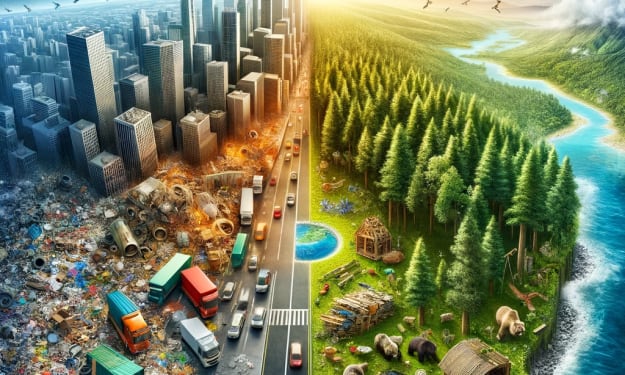
Embracing a Greener Future
In a world where environmental concerns are at an all-time high, the idea of living sustainably has become more than just a trend—it's a necessary shift in how we approach our daily lives. As we navigate this new era of eco-consciousness, the question on many minds is: How can we make a meaningful impact?
By Eladeo Mallett2 years ago in Earth
"Connected Hearts: A Journey Through Time and Tech"
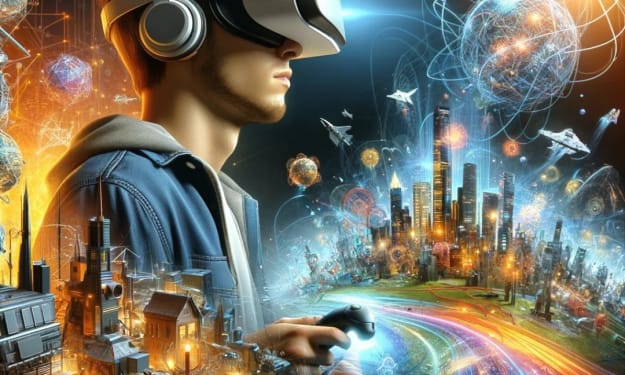
In the year 2084, humanity had reached the pinnacle of technological advancement. Cities hovered in the sky, and artificial intelligence had become so advanced that it could read human emotions better than humans themselves. But amidst all this progress, one thing had remained elusive: the ability to preserve the essence of human connection across time. For many, the world felt more isolated than ever, where relationships were fleeting, and virtual reality stood in place of face-to-face conversations.
By King Great 2 years ago in Earth
What Would Happen If Earth Was a Triangle?
**What Would Happen If Earth Was a Triangle?** Imagine waking up one day, looking up at the sky, and learning that Earth is no longer round but shaped like a giant triangle! How strange would that be? While this sounds like something out of a sci-fi movie, let’s explore what might happen if our planet were triangular. Spoiler alert: it wouldn't be great for life as we know it. ### The Shape Change: Triangular Earth? First, it's important to understand that Earth is a sphere for good reasons. The planet’s round shape evenly spreads out gravity, which keeps everything balanced. Now, if Earth became a triangle, this balance would be completely thrown off. In a triangular world, the corners would be the farthest from the center. These areas would experience weaker gravity because they’re farther from the planet's core. On the other hand, gravity would be much stronger at the center, where the triangle is closest to the core. Imagine trying to walk in a world where gravity changes drastically depending on where you are. In the center, you'd feel extra heavy, while at the corners, you might float a bit! ### Uneven Day and Night Right now, the Earth spins smoothly on its axis, giving us regular day and night cycles. But on a triangular Earth, spinning would be awkward. The shape would cause an unsteady wobble, meaning days and nights would be unpredictable. Some places might be stuck in daylight for months, while others would be in darkness for just as long. This would make it incredibly difficult for plants, animals, and humans to survive. Our bodies, and the ecosystems we rely on, need the regular cycle of day and night to function properly. ### Climate Chaos With a spherical Earth, heat from the Sun is spread out evenly across the planet, creating stable weather patterns. However, on a triangle-shaped Earth, things would be very different. The corners of the triangle would be incredibly far from the Sun during certain times of the year, making them freezing cold. Meanwhile, areas near the center would be scorching hot due to the planet’s odd shape. The extreme temperature differences would cause massive storms, hurricanes, and other wild weather patterns. In some areas, there might be endless rainstorms, while other places could suffer from extreme droughts. Life would struggle to adapt to these ever-changing, intense conditions. ### Oceans and Water Distribution Oceans cover about 70% of our planet, providing water to ecosystems, regulating the climate, and supporting life. But on a triangular Earth, oceans wouldn’t behave as they do now. Gravity would pull water toward the center of the triangle, leaving the corners dry and barren. Large portions of the planet might become vast deserts, while the middle would be flooded with water, creating huge, deep oceans. This uneven water distribution would cause major problems for living creatures. Animals and plants in the dry areas would struggle to find enough water to survive, while those in the center might drown or be forced to live in swampy conditions. ### The End of Earth as We Know It? The truth is, life as we know it would likely not exist on a triangular Earth. The changing gravity, strange weather, unbalanced water distribution, and irregular day and night cycles would make it almost impossible for life to adapt. Earth’s round shape is perfect for creating the stable environment we need to survive, and a triangle just wouldn’t cut it. So, while a triangular planet sounds like a fun idea for a story, it's safe to say we're lucky Earth is round. This shape keeps everything running smoothly, from gravity to weather to the way life has evolved. In the end, the round Earth is the best shape for life to thrive!
By Parth Iataliya2 years ago in Earth
The Button Revolution . AI-Generated.
### **22. AI in Transportation: Revolutionizing Air and Land Mobility** Transportation is a major part of modern life, and the iPhone 16's AI-driven Button Interface brought unprecedented improvements in both air and land mobility. By analyzing traffic patterns, weather conditions, and individual preferences, the AI optimized travel routes and methods, making transportation faster, safer, and more efficient.
By Philip Obafemi2 years ago in Earth
Why does this forest look like a fingerprint?
Uruguay is a small country located on the southeastern coast of South America. Despite being overshadowed politically and economically by its larger neighbors Brazil and Argentina, with whom it shares many cultural and historical ties, Uruguay has significant advantages in terms of land area and population density. As historian Eduardo Galeano notes, Uruguay has five times more land than Holland but only a fifth of the population, and more arable land than Japan with a much smaller populace.
By Gilbert Ay-ayen. Jr2 years ago in Earth
Teenage Killings in High Schools:. AI-Generated.
nsolationndncouragin To the grieving parents, There are no words sufficient to express the depth of sorrow you must be feeling after the unimaginable loss of your beloved child. The pain of losing a teenager—a soul so full of potential, dreams, and love—is a weight no parent should ever have to carry. During this time of profound grief, it’s natural to feel overwhelmed by sadness, anger, and questions that may never be answered. Please know that your loss is felt deeply by many, and you are not alone in this journey of mourning.
By Philip Obafemi2 years ago in Earth
Super Typhoon
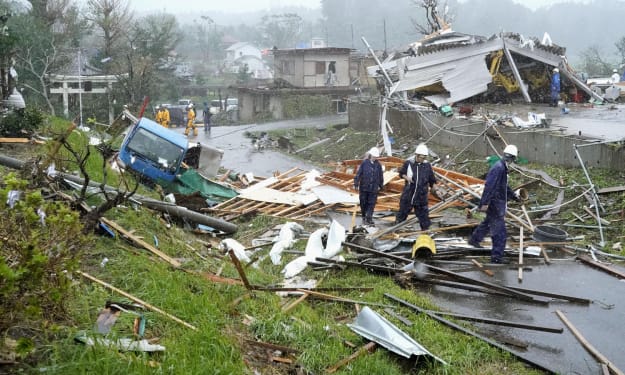
Understanding Super Typhoons A super typhoon is a term used to describe an exceptionally powerful tropical cyclone in the Western Pacific Ocean. These storms are equivalent to a Category 4 or 5 hurricane on the Saffir-Simpson scale, with sustained wind speeds of at least 150 miles per hour (240 kilometers per hour) or higher12. Super typhoons are known for their devastating impact, causing significant damage to infrastructure, ecosystems, and human lives.
By Obo Nature2 years ago in Earth
The Exciting World of Space Exploration
**The Exciting World of Space Exploration** Space exploration is one of the most fascinating and ambitious efforts humans have ever undertaken. It involves sending spacecraft, satellites, and astronauts beyond Earth's atmosphere to learn more about the universe. This quest has led to amazing discoveries, sparked our imagination, and helped us understand our place in the cosmos. The Beginnings of Space Exploration The journey into space began during the Cold War in the 1950s when two superpowers, the United States and the Soviet Union, were in a race to prove their technological superiority. The Soviet Union took the lead by launching *Sputnik*, the first artificial satellite, in 1957. This historic event marked humanity's first step into space. Soon after, in 1961, Yuri Gagarin became the first human to orbit Earth, another great achievement by the Soviets. Not wanting to be left behind, the United States quickly ramped up its space efforts. In 1969, the world witnessed one of the greatest accomplishments in history when NASA's Apollo 11 mission successfully landed astronauts Neil Armstrong and Buzz Aldrin on the Moon. Armstrong's words, "That's one small step for man, one giant leap for mankind," became legendary. Why Explore Space? You might wonder why we invest so much time, money, and effort into exploring space. The answers are many. First, space exploration helps us understand the origins of the universe, stars, and planets, including our own Earth. By studying other planets, we can learn about climate change, geology, and other scientific phenomena that might affect life on Earth. Secondly, space exploration leads to technological advancements. The innovations developed for space missions often find their way into everyday products and services. Things like GPS, satellite communication, and even advancements in healthcare have roots in space research. Moreover, the idea of space exploration sparks curiosity and inspires future generations. It encourages young people to pursue careers in science, technology, engineering, and mathematics (STEM). Space exploration gives us hope that one day we may become a multi-planet species, with the possibility of living on Mars or other planets.
By Parth Iataliya2 years ago in Earth
The Fascinating Theory of Time Travel: Can We Move Through Time?
Time travel has captured our imaginations for centuries. From movies and books to scientific theories, the idea of moving backward or forward in time continues to intrigue us. But is time travel really possible? While it's still a concept mostly found in science fiction, some scientific theories suggest that, under certain conditions, traveling through time might be more than just a dream. What is Time Travel? Time travel means moving between different points in time, much like we move through space. Imagine hopping into a machine that could take you to the past or the future in an instant. In everyday life, time only seems to move forward, like an arrow. However, certain theories in physics suggest that time might not be as rigid as it appears. Einstein’s Theory of Relativity The most famous theory supporting the possibility of time travel comes from Albert Einstein. In 1905, Einstein proposed his **Theory of Special Relativity**, which introduced the idea that time is not constant. According to this theory, time and space are linked together in what scientists call "spacetime." One of the key ideas from this theory is that time moves slower the faster you go. This means that if you could travel at or near the speed of light (the fastest thing in the universe), time would pass differently for you compared to someone standing still. For example, if an astronaut were to travel into space at light speed and return to Earth, they might only have aged a few years, while decades could have passed for everyone else on Earth. This effect is called **time dilation**, and it has been proven through experiments. However, it only affects time in small ways because we can't yet travel anywhere near the speed of light. Black Holes and Wormholes Another possible way to travel through time is connected to **black holes** and **wormholes**. A black hole is a region in space where gravity is so strong that not even light can escape. According to Einstein’s equations, the intense gravity of a black hole can bend time and space in extreme ways. Some scientists think that, near a black hole, time might slow down so much that it could allow someone to see far into the future. Wormholes, on the other hand, are theoretical tunnels in spacetime that could link two different points in time and space. If wormholes exist (we haven't found one yet), they might work like shortcuts, allowing someone to jump from one point in time to another. Think of it as cutting through a folded piece of paper to get from one end to the other faster. The Paradoxes of Time Travel While these ideas sound exciting, they also come with problems. One famous issue is the **grandfather paradox**. Imagine you traveled back in time and accidentally stopped your grandfather from meeting your grandmother. If that happened, you wouldn't be born, but if you weren’t born, you couldn’t have traveled back in time to stop them. This paradox shows how tricky time travel to the past can be. Some scientists think that the laws of the universe might prevent time travel to the past to avoid such paradoxes. Others suggest that if you traveled to the past, you would enter an alternate timeline or universe, which means you wouldn't affect your original timeline. Time Travel in the Future? Right now, time travel remains a theory, with no real evidence that humans can move through time in any significant way. Even though experiments have shown that time can be bent and slowed down, we are still far from building a time machine. But that doesn’t mean it’s impossible. Just as flight and space travel once seemed like fantasy, the future may bring new discoveries that change the way we think about time. Until then, time travel will remain one of the most exciting ideas in science and fiction, fueling our dreams of exploring both the past and the future. Conclusion Time travel might be one of the most complex topics in science, but it’s also one of the most fascinating. While we don’t yet know if we’ll ever be able to move through time like we do through space, the theories that suggest it’s possible open up a world of possibilities. Whether it’s speeding up time by traveling at incredible speeds or finding shortcuts through wormholes, the journey of understanding time travel has only just begun.
By Parth Iataliya2 years ago in Earth
The Jurassic Period: A Time of Giants
The Jurassic Period, a fascinating era in Earth's history, took place between 201 and 145 million years ago. It’s best known for the incredible dinosaurs that roamed the planet, but many other exciting changes were also happening during this time. The Jurassic was part of the larger Mesozoic Era, also known as the "Age of Reptiles," and it came right after the Triassic Period. It was a time when life on Earth truly flourished. The Land of Dinosaurs When people think of the Jurassic Period, they often picture massive dinosaurs, and for good reason. During this time, dinosaurs ruled the land, growing larger and more diverse than ever before. Some of the most famous dinosaurs, like **Brachiosaurus** and **Stegosaurus**, lived during this period. The plant-eating Brachiosaurus was one of the largest land animals to ever exist, with a long neck that allowed it to reach the tallest trees. On the other hand, Stegosaurus, with its distinct plates along its back and spiky tail, used its tail for defense against predators. Speaking of predators, this was also the time of **Allosaurus**, a large, fierce carnivore that hunted smaller dinosaurs. Though not as famous as the later Tyrannosaurus rex, Allosaurus was one of the top predators of the Jurassic. A Changing World The Earth itself was very different during the Jurassic Period. The supercontinent Pangaea, which had formed earlier in the Mesozoic Era, was starting to break apart. This split created new oceans and reshaped the land. The separation of the continents created new coastlines, which brought about changes in climate and geography. Warmer temperatures and a more tropical climate covered much of the planet. This allowed lush forests and vast vegetation to spread, providing plenty of food for plant-eating dinosaurs. Along with the dinosaurs, the Jurassic Period saw the rise of other creatures. **Flying reptiles**, like the **Pterosaurs**, soared in the skies. These weren’t dinosaurs, but they were close relatives. Some, like the famous **Pterodactyl**, had long wingspans and sharp beaks to catch fish and other prey. In the oceans, marine reptiles, like **Ichthyosaurs** and **Plesiosaurs**, dominated. Ichthyosaurs looked somewhat like dolphins, with streamlined bodies perfect for fast swimming. Plesiosaurs had long necks and powerful flippers, making them fearsome hunters in the water. Early Birds and Mammals The Jurassic Period also marked the first appearance of **birds**. One of the earliest known birds, **Archaeopteryx**, lived during this time. It had feathers and wings, but also had sharp teeth and a long tail, traits similar to its dinosaur relatives. These early birds were small and would have looked more like feathered reptiles than the birds we see today. While dinosaurs and reptiles were the stars of the Jurassic, small mammals also began to evolve during this time. These early mammals were tiny, often no larger than a squirrel. They likely stayed out of sight, avoiding the giant dinosaurs that dominated the land. Plants and Forests The Jurassic landscape was covered in rich forests, mainly made up of **conifers**, which are trees that produce cones, like modern-day pines and firs. There were no flowering plants yet, but **ferns** and other primitive plants were abundant, providing food for many herbivorous dinosaurs. These plants thrived in the warm and humid conditions of the time.
By Parth Iataliya2 years ago in Earth
Climate Change and Historical Environmental Movements:. AI-Generated.
From the Industrial Revolution to Today: How History Shaped the Environmental Movement Introduction The journey from the Industrial Revolution to the present climate crisis has shaped our approach to environmentalism. This article explores the historical milestones that have influenced today's environmental movement, illustrating how past events and responses continue to guide our actions for a sustainable future.
By Adebayo Mahmud2 years ago in Earth