Science
How Planet Smashing Collisions Stole Earth’s Life Essential Elements
How Planet Smashing Collisions Stole Earth’s Life Essential Elements The Earth teeming with life and natural beauty is a product of billions of years of cosmic evolution. But many people are unaware that the very elements critical to sustaining life such as carbon nitrogen and sulfur might have once been much more abundant here. Intriguingly recent scientific research suggests that planet smashing collisions in the early solar system might have robbed Earth of a significant portion of these vital ingredients. Understanding this cosmic theft offers deep insights into how rare and precious life on Earth truly is. The early solar system was a chaotic violent place. After the Sun formed about 4.6 billion years ago countless rocky bodies planetesimals orbited around it frequently crashing into one another. These collisions played a crucial role in building the planets including Earth. However they were not always constructive. Some impacts were so massive that they did not add material but instead stripped planets of their outer layers vaporizing minerals and elements critical to life. One particularly famous collision is the hypothesized giant impact that led to the formation of the Moon. Scientists believe that a Mars sized body named Theia slammed into the early Earth about 4.5 billion years ago. The debris from this cataclysmic event coalesced into the Moon. However it wasn’t just the Moon that formed. The violent energy of the impact also likely vaporized significant amounts of Earth's surface material sending essential volatile elements such as water carbon and nitrogen hurtling into space. Modern Earth is relatively poor in volatile elements compared to what scientists would expect based on the original building blocks of the solar system which are preserved in primitive meteorites known as chondrites. These meteorites are rich in carbon nitrogen sulfur and other life essential materials. Given that the early Earth should have started with a similar composition scientists have long wondered where did all the volatiles go? The idea that massive impacts could have vaporized and ejected these elements into space offers a compelling explanation. Studies using computer simulations show that high energy collisions could easily strip away a planet’s atmosphere and upper crust both of which would have contained high concentrations of volatile elements. In particular elements with low boiling points like carbon and sulfur would have been especially vulnerable to being lost during such catastrophic events.
By Adnan Rasheedabout a year ago in Earth
At Least 500 Injured in Large Explosion at Iran Port
A significant explosion struck the port city of Chabahar in southeastern Iran on Thursday, resulting in injuries to at least 500 individuals and extensive destruction. The incident, which took place close to the city's gas storage facilities, generated shockwaves throughout the region, prompting worries regarding safety measures and the possibility of sabotage in this strategically vital location.
By Tech Alaminabout a year ago in Earth
Bitcoin Tops $95K for the First Time in Months as Stocks Remain Flat
In a stunning display of resilience and market confidence, Bitcoin has surged past the $95,000 mark for the first time in several months, signaling renewed investor interest in the cryptocurrency sector. This milestone comes at a time when traditional stock markets remain largely flat, reflecting broader economic uncertainties and a cautious approach from institutional investors.
By GLOBAL NEWSabout a year ago in Earth
Motorola’s Latest Razr Phones Are All In on AI
Introduction Motorola has long been a pioneer in innovative smartphone design, from its early flip phones to its modern foldable Razr series. Now, with the 2024 Razr and Razr+, the company is taking a bold step forward by integrating artificial intelligence (AI) at the core of the user experience. These new devices aren’t just about sleek folding screens—they’re about making smartphones smarter, more intuitive, and more personalized than ever before.
By Mahmud Sykatabout a year ago in Earth
Landslides: Understanding the Causes and Impacts :
Landslides are a herbal catastrophe that happens whilst there may be a downward motion of rock, soil, and particles because of gravity. These moves can take location on diverse scales, starting from small rockfalls to large slides related to whole mountainsides. While they cannot be fully prevented, understanding their causes and impacts allows us to take steps to mitigate their effects. Through monitoring, early warning systems, and improved land use planning, we can reduce the risks posed by landslides and better protect lives and property.
By SATTYABRATA ROYabout a year ago in Earth
NASA Releases Most Stunning Mars Footage Yet Captured from 140 Million Miles Away
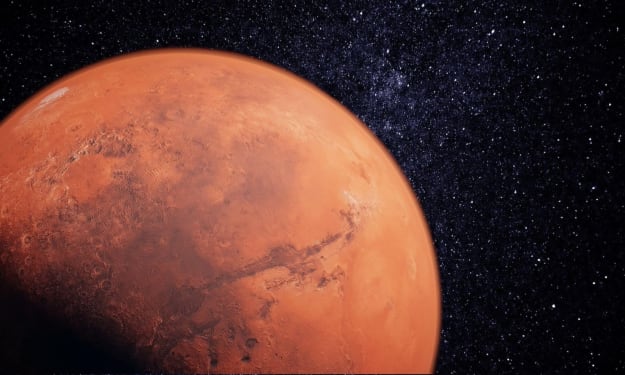
NASA Releases Most Stunning Mars Footage Yet Captured from 140 Million Miles Away In a monumental leap for space exploration and planetary science NASA has released the clearest and most detailed footage ever captured of Mars despite the Red Planet being approximately 140 million miles away from Earth. This new footage taken by the Perseverance and Curiosity rovers reveals stunning views of Martian landscapes in unprecedented detail showcasing everything from rocky terrains and ancient riverbeds to massive craters and mountainous ridges. This release is more than just a visual treat it is a scientific breakthrough that has the potential to change our understanding of Mars its history and its potential to support life past or present. The high definition video and images were captured using advanced imaging systems aboard the Perseverance and Curiosity rovers. NASA’s Perseverance rover which landed on Mars in February 2021 is equipped with Mastcam-Z a camera system capable of capturing 3D high resolution color images and videos. Similarly the Curiosity rover uses its Mast Camera (Mastcam) and the Mars Hand Lens Imager (MAHLI) to capture intricate details of the Martian surface. The conditions during the time of recording were ideal with exceptionally clear Martian skies and minimal dust interference enabling the rovers to transmit sharp high resolution images back to Earth. These visuals give scientists and space enthusiasts alike a crystal clear view of Mars’ terrain comparable to drone footage from Earth.
By Adnan Rasheedabout a year ago in Earth
"The Natural Resource Titans: Countries with the Greatest Wealth Beneath Their Feet"
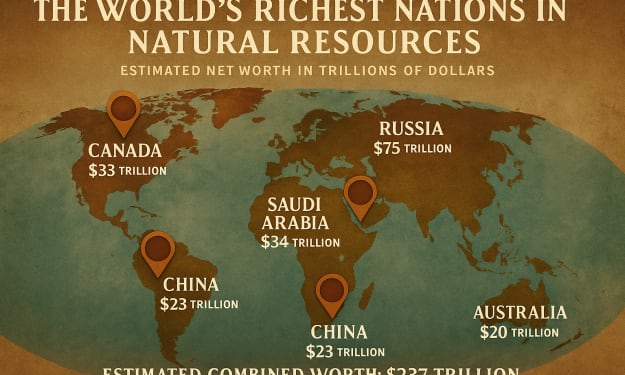
The World's Most Affluent Nations in Natural Resources: A Global Assessment Natural resources serve as the concealed engines fueling a nation's prosperity, supplying the fundamental materials necessary for industry, energy, and economic development. From petroleum and gas to minerals, timber, and arable land, nations endowed with resources frequently exercise considerable global authority. But which countries genuinely occupy the pinnacle of the world's treasure trove? In this article, we investigate the nations with the greatest natural resource wealth, evaluate their estimated net worth, and analyze how they harness (or mishandle) their natural endowments. 1. Russia Estimated Net Worth: $75 Trillion Russia is, by a considerable margin, one of the wealthiest countries regarding natural resources. It possesses extensive reserves of oil, natural gas, timber, coal, and a diverse array of minerals such as gold, nickel, and platinum. Oil and Gas: Russia holds the largest natural gas reserves and ranks as a leading global exporter. Forests: The Siberian taiga encompasses the largest continuous forest on the planet. Minerals: Russia is a significant producer of diamonds, copper, iron ore, and coal. Nevertheless, economic sanctions and political instability frequently hinder Russia from fully realizing the value of its natural riches. 2. United States Estimated Net Worth: $45 Trillion The United States boasts an impressive array of resources, spanning energy reserves to agricultural abundance. Energy: The U. S. ranks among the top producers of oil and natural gas. Minerals: It possesses substantial deposits of coal, gold, copper, uranium, and rare earth elements. Agriculture: Fertile land positions the U. S. as the foremost exporter of corn, soybeans, and wheat. Robust infrastructure and technological advancement have enabled America to effectively leverage its resources, propelling it into the status of the world's largest economy. 3. Saudi Arabia Estimated Net Worth: $34 Trillion Saudi Arabia's economy is intrinsically linked to oil. With the second-largest proven oil reserves after Venezuela, it stands as the globe’s leading oil exporter. Oil Wealth: Oil constitutes approximately 90% of Saudi Arabia’s exports and around 42% of its GDP. Minerals: Recent discoveries of gold, phosphate, and other minerals have expanded the resource portfolio. Initiatives such as the "Vision 2030" plan aim to diversify the economy beyond oil, preparing for a future with decreased reliance on fossil fuels. 4. Canada Estimated Net Worth: $33 Trillion Canada is endowed with a vast array of natural wealth. Energy: Extensive reserves of oil (particularly in the oil sands of Alberta) and natural gas. Minerals: A principal source of potash, uranium, gold, and nickel. Forests and Water: Canada’s plentiful freshwater lakes and forests are invaluable resources. A stable government and stringent environmental protections aid Canada in balancing resource extraction with sustainability. 5. China Estimated Net Worth: $23 Trillion China, often recognized for its manufacturing prowess, is also significantly rich in natural resources. Coal: China holds the largest coal reserves globally. Rare Earth Elements: Dominates the global supply of these essential materials crucial for contemporary technologies. Minerals: A leading producer of gold, tin, and aluminum. Resource wealth, coupled with industrial expansion, has propelled China’s swift economic ascent over the last three decades. 6. Australia Estimated Net Worth: $20 Trillion Australia’s affluence is embedded within its crimson soils. Minerals: Premier global exporter of iron ore, bauxite, gold, and lithium. Energy: Vast reserves of coal and natural gas. Agriculture: Fertile land yields substantial agricultural exports such as wheat and wool. With a comparatively modest population and robust governance, Australia proficiently exports its resources, particularly to burgeoning Asian economies. 7. Brazil Estimated Net Worth: $17 Trillion Brazil is abundant in both mineral resources and biodiversity. Minerals: Leading producer of iron ore, niobium, and bauxite. Forests: The Amazon rainforest, the planet’s largest, serves as an immense reservoir of timber and carbon sequestration. Agriculture: A dominant force in soybeans, coffee, and beef. However, ecological challenges such as deforestation present significant threats to its long-term resource wealth. How Resource Wealth Influences Nations Resource abundance can yield both affluence and adversity: Affluence: Countries like the United States and Canada have harnessed their resources to establish diversified, resilient economies. Resource Curse: Conversely, others, like Venezuela and sections of Africa, have experienced resource wealth inciting corruption, disparity, and instabilitya phenomenon termed the "resource curse. " The crucial factor is governance: administering wealth transparently, investing in infrastructure, education, and sustainability. Conclusion From the oil fields of Saudi Arabia to the mineral-rich territories of Australia, the world’s natural resources are unevenly allocated but universally vital. Estimates position Russia at the forefront, with an astounding $75 trillion in natural resources, followed by the U. S. and Saudi Arabia. Yet possessing underground riches does not ensure prosperity above ground. The genuine treasure resides in how nations manage, preserve, and equitably allocate their natural inheritance for future generations. In an era of climate change and evolving energy demands, prudent stewardship will dictate which countries remain resource-rich not solely in value but in genuine affluence and sustainability.
By Say the truth about a year ago in Earth
Could Life Exist on a Distant World? LHS-475b Offers Clues
Could Life Exist in a Distant World? LHS-475b Offers Clues Picture a planet 41 light-years away, dancing around a faint red star, possibly holding answers to one of humanity’s oldest questions: Are we alone? Scientists using NASA’s James Webb Space Telescope have stumbled upon something remarkable on LHS-475b, an exoplanet in the constellation Octans. They’ve detected dimethyl sulfide (DMS), a chemical that, on Earth, comes only from living things like marine plankton. Published in The Astrophysical Journal Letters on April 20, 2025, this finding has astronomers buzzing with cautious excitement, though the road to confirming life remains long and winding.
By Mahfujur Rahmanabout a year ago in Earth
A Green Oasis in the Sky
Want to get rid of urban heat? Then here's the solution- Rooftop gardening is a literal breath of fresh air in bustling cities where concrete dominates. This novel method transforms underutilized areas into flourishing green spaces by cultivating plants, herbs, vegetables, and even small trees on your building rooftops. Rooftop gardens offer an eco-friendly solution to our food security, climate resilience, and improved quality of life as urbanization intensifies and green spaces diminish. In this article, you'll be learning all the necessary information about rooftop gardening. So, buckle up, folks-
By Syed Alauddin Ahmed Rizveabout a year ago in Earth