Science
Transforming Waste into Value: How We Recycle PET Bottles for Future Solutions
Around the globe, millions of plastic bottles are disposed of on a daily basis. The majority of these are made of PET (Polyethylene Terephthalate) which is a type of plastic that can easily be recycled. Used PET bottles might look like waste, but in reality, they have the prospect of transforming into something valuable. Through innovative recycling processes, today's discarded materials can be transformed into resources for the future.
By Rakshitam Ecofibreabout a year ago in Earth
The Invisible Force That Anchors Life on Earth
Gravity, though invisible and often taken for granted, is one of the most fundamental forces governing our universe. Without it, there would be no planets, no oceans, and no atmosphere. Life, as we know it, wouldn't exist. This 1500-word exploration delves deep into the mechanics, significance, and mysteries of Earth's gravity, from Isaac Newton's groundbreaking insights to modern-day scientific perspectives.
By Md Muij Ahmedabout a year ago in Earth
Where Should We Focus in 2025?
As climate change accelerates, 2025 marks a pivotal moment in our response to a warming world. From rising sea levels and record-breaking heatwaves to floods and wildfires, the consequences of climate change are no longer abstract predictions—they are part of our everyday reality. In this context, policymakers, scientists, and communities are faced with a crucial dilemma: Should we focus more on adapting to the effects of climate change or on mitigating its root causes?
By Iftekhar Islam Jihadabout a year ago in Earth
Where Is the Hottest Place in the Universe?
Have you ever wondered what the hottest place in the universe is? And what the actual temperature is—or was—at that location? When I used to hear that the fuel of Hell would be stones and humans, it left me puzzled. We’re used to thinking that fire needs wood to burn, so how could stones possibly ignite? How could rocks become fuel for fire? But once I began studying the universe, this mystery unraveled in the most astonishing way. I realized that the heat of burning stones can far surpass that of any wood-based fire. If you’re skeptical, like I once was, then this article is especially for you. Let’s begin with the basics. We know that water freezes at 0°C (32°F)—this is the freezing point for water, not for all substances. If something contains water molecules, it will solidify at this temperature. Now consider the average room you’re in right now—its temperature is probably around 25°C. The normal human body temperature is 37°C, and even a slight fluctuation can cause health issues, because our bodies are finely tuned to operate at this range. The highest temperature ever recorded on Earth's surface is 56.7°C (134°F), and water boils at 100°C. These are familiar figures—but the temperatures we’re about to explore go far beyond anything we encounter in daily life. Let’s venture beyond Earth. The closest planet to the Sun is Mercury. Thanks to NASA’s space missions, we now know that Mercury can reach temperatures of up to 427°C. However, it's Venus, the second planet from the Sun, that holds the title of the hottest planet in our solar system, with surface temperatures around 462°C. This is due to its thick atmosphere, which traps heat through a runaway greenhouse effect. Let’s go hotter. Molten lava, which emerges from Earth’s volcanoes, can reach temperatures of around 1,200°C. That’s hot enough to melt many metals. For instance, iron melts at 1,538°C, and beyond that, it can vaporize into gas. Imagine temperatures where solid metals behave like steam. Now let’s look at our Sun. The surface of the Sun burns at approximately 5,500°C, while the core—the heart of the Sun where nuclear fusion takes place—reaches a staggering 15 million°C. That’s fifteen million degrees Celsius. Hard to imagine, right? But the universe still has more surprises. When a massive star reaches the end of its life, it undergoes a supernova explosion—a violent burst of energy that marks the star's death. During this cataclysmic event, temperatures can soar up to 550 million°C. That’s 550,000,000 degrees Celsius. To put this in perspective, we humans struggle with 50°C weather, and here we’re talking about over ten million times hotter. Yet the story doesn’t end here. Next comes the neutron star—one of the densest and most mysterious objects in the universe. When a massive star collapses under its own gravity after a supernova, it can form a neutron star. The heat generated during this process is almost unimaginable: 12 billion°C (12,000,000,000 degrees Celsius). That’s billion with a ‘B’—making neutron stars some of the hottest known objects in the current universe. And still, we’re not at the ultimate temperature. To find the hottest point ever, we need to go back in time—to the birth of the universe itself. According to the Big Bang theory, all matter, energy, time, and space were compressed into an infinitely small, dense point known as a singularity. The universe as we know it began from this singularity in a colossal burst around 13.8 billion years ago. Now, brace yourself. Scientists estimate that at the exact moment of the Big Bang, the temperature of this singularity reached an incomprehensible 142 nonillion°C. That’s 142 followed by 30 zeros: 142,000,000,000,000,000,000,000,000,000,000°C This is called the Absolute Hot—the highest possible temperature in theoretical physics. At this point, our current laws of physics break down. Temperatures beyond this are not just unknown—they are unknowable with current science. This figure marks the upper limit of thermal energy. Beyond this, our equations, our theories, and our understanding cease to function. No object or environment in our universe—or any universe we can currently theorize—has ever reached a temperature higher than this. Final Thoughts What began as a simple curiosity about how rocks can burn led us on a breathtaking journey through space, time, and science. From volcanic lava to supernovae, from neutron stars to the very origin of the cosmos, the range of temperatures in our universe is staggering. So the next time you feel the heat of a summer’s day, remember—you’re only scratching the surface of what the universe is capable of. The hottest place in the universe isn’t a planet or a star. It’s a moment—a flashpoint in time when everything began. And that moment burned hotter than anything we can truly comprehend. ---
By Umair Khanabout a year ago in Earth
5 Tech Innovations That Could Reshape Global Power Dynamics by 2030
Our ability to make things has always shaped human civilization. Productivity has been a key component in changing society from the agrarian age to the industrial revolution and the age of advanced technology.
By sabbir Ahmedabout a year ago in Earth
Green Promises, Grey Realities
There’s a story we like to tell ourselves. A future free from fossil fuels, where cities run on sunshine and oceans are tamed by the wind. In this vision, solar panels stretch across rooftops, wind turbines turn gracefully on distant hills and electric vehicles glide silently through traffic. It’s a hopeful picture and one we desperately need.
By Dr Husain Shabbarabout a year ago in Earth
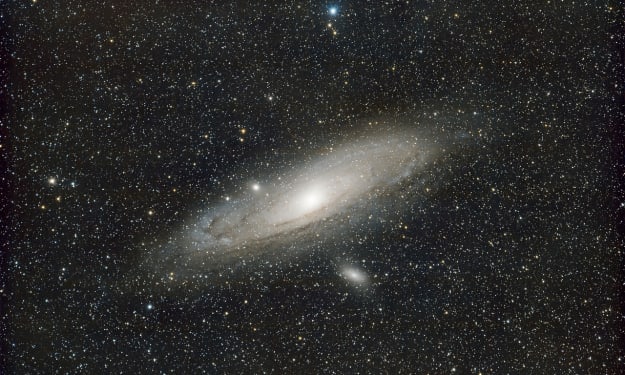
The universe
The Universe is everything that exists — space, time, matter, and energy. It includes billions of galaxies, each containing millions or even billions of stars, planets, and other celestial objects. From the smallest subatomic particles to the largest galaxy clusters, the Universe is an awe-inspiring tapestry of complexity and wonder. Yet despite centuries of study, much about it remains mysterious.
By Ratul Hasanabout a year ago in Earth
1,000 Foot Mega Tsunami Could Devastate U.S Coastline Experts Warn of 3 Danger Zones
1,000 Foot Mega Tsunami Could Devastate U.S Coastline Experts Warn of 3 Danger Zones In a chilling revelation scientists and disaster preparedness experts are sounding alarms over a potentially catastrophic event that could reshape parts of the U.S coastline a 1,000 foot tall mega tsunami. Though it may sound like a plot from a Hollywood thriller the danger is rooted in real science with three specific regions of concern identified the Canary Islands in the Atlantic the Aleutian Islands in Alaska and the unstable volcanic slopes of Hawaii. The implications for millions of Americans living along the coast are sobering.
By Adnan Rasheedabout a year ago in Earth
NASA ready for the Red Planet? US senator's 'Mission to MARS Act' aims to modernize Johnson Space Center
As the global race to explore Mars accelerates, the United States is staking a bold claim to remain at the forefront of deep space exploration. A key step in that ambition comes from Capitol Hill, where U.S. Senator John Cornyn (R-TX) has introduced the “Mission to Modernize Astronautic Resources for Space” (MARS) Act—a sweeping $1 billion proposal aimed at revitalizing NASA’s Johnson Space Center (JSC) in Houston. The legislation reflects growing national interest in ensuring that NASA’s infrastructure is not only mission-ready for lunar operations but fully capable of supporting future missions to Mars. Why Modernize Now? NASA's Artemis program, which aims to return humans to the Moon by the late 2020s, is laying the foundation for future Mars expeditions. However, to achieve those long-duration missions, NASA needs ground facilities that match the technological complexity and operational demands of interplanetary travel. The Johnson Space Center has long served as the hub of America’s human spaceflight efforts, including astronaut training, spacecraft operations, and mission control. But much of its infrastructure dates back decades. Without significant investment, experts warn that the facility could struggle to support the next generation of exploration. “The Johnson Space Center has always been a cornerstone of NASA’s mission,” said Sen. Cornyn. “This bill is a recognition that if we are serious about going to Mars, we must be just as serious about modernizing the critical facilities that will get us there.” A Breakdown of the MARS Act The MARS Act proposes a 10-year, $1 billion infrastructure overhaul at JSC. This includes major renovations and new facilities that will directly support lunar and Martian mission objectives. Among the specific upgrades: Neutral Buoyancy Laboratory (NBL): One of NASA’s most iconic astronaut training sites, the NBL simulates microgravity and underwater environments. The bill proposes modernizing this facility to accommodate new space station modules, lunar equipment training, and enhanced safety standards. Astromaterials Curation Facility: With upcoming missions returning samples from both the Moon and Mars, NASA’s curation center must be updated to store, analyze, and protect these scientifically invaluable materials. Mission Control Center: The very room where Apollo 11 was guided to the Moon is overdue for a technological facelift. Enhancing real-time operations capability will be crucial for managing missions millions of miles from Earth. Ellington Field: Home to NASA’s T-38 astronaut training jets, this airfield’s facilities would be renovated to support pilot training and suborbital flight readiness. Space Food Systems Lab: Long-term missions to Mars will require sustainable, nutrient-rich food options. A new lab will support innovation in food preservation and delivery systems suited for deep space. Critical Infrastructure Upgrades: From asbestos removal and HVAC upgrades to electrical and plumbing overhauls, much of the JSC's backbone systems will be renewed to modern standards. The Mars Mission: A National Strategy Senator Cornyn argues that the investment is about more than just Texas—it’s a strategic imperative for the U.S. space program. “We’re entering a new space race,” he said, pointing to China’s rapidly expanding space ambitions, including lunar bases and robotic Mars landers. “We can’t afford to fall behind.” Experts agree that modernizing NASA’s ground infrastructure is critical. “No matter how advanced your rockets or spacecraft, missions will only succeed if your support systems on Earth are up to the task,” said Dr. Marcia Smith, president of the Space and Technology Policy Group. Funding and Political Path Ahead The legislation has been referred to the Senate Committee on Commerce, Science, and Transportation, where it’s expected to garner bipartisan interest. Fellow Texas Senator Ted Cruz, who chairs the subcommittee on space and science, has expressed support for continued investment in NASA. Still, the MARS Act comes during a time of fiscal scrutiny. President Biden’s FY2026 budget proposed modest increases to human exploration programs, while scaling back some science missions. If passed, the MARS Act would need to secure appropriations that align with broader budgetary priorities. A Launchpad for the Future For Houston—and the nation—the MARS Act represents a vital commitment to maintaining leadership in space exploration. Beyond the symbolic weight of Mars, the legislation promises thousands of jobs, partnerships with private aerospace companies, and long-term scientific and economic returns. Whether the first human to step on Mars will train at a newly revitalized Johnson Space Center remains to be seen. But if the MARS Act succeeds, it could be the launchpad that ensures America's next giant leap. --- Let me know if you'd like this in a specific format (PDF, blog post style, etc.) or tailored to a particular audience.
By Md Abdullaabout a year ago in Earth