Nature
The Resilience of Life: Surviving Ancient Super Volcanoes. Content Warning.
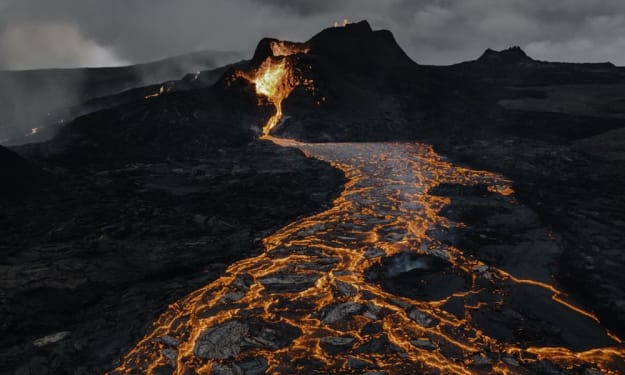
Introduction: Millions of years ago, the American landscape bore witness to an extraordinary geological phenomenon - the "ignimbrite flare-up," a series of super volcanic eruptions that shaped the course of history. These catastrophic events unleashed unimaginable power, dwarfing even the colossal eruption of Yellowstone. Surprisingly, these massive eruptions occurred relatively frequently, approximately every 10,000 years, engulfing North America in a thick layer of ash. However, life endured and thrived, leaving behind a remarkable fossil record. In this blog, we will delve into the astonishing resilience of ancient creatures and plants, exploring how they not only survived but also bounced back to shape the present-day world.
By Rohit Singh3 years ago in Earth
The Mysterious Decline of Nautiloids: Unravelling the Impact of Pinnipeds
Over the vast expanse of Earth's history, the oceans have been witness to a mesmerising dance of life – the emergence, flourishing, and eventual disappearance of diverse animal groups. Among these ancient survivors, one group has defied the test of time: the nautiloids. These enigmatic cephalopods have graced the oceans for nearly 500 million years, making them one of the oldest continually existing animal lineages on our planet. However, their journey has not been without challenges, and around 30 million years ago, a series of mysterious events occurred, forever altering their fate.
By Rohit Singh3 years ago in Earth
The Resilient Dodo: Unravelling the True Story of Extinction and the Hope for De-Extinction
Introduction: The dodo, a plump flightless bird once native to the island of Mauritius in the Indian Ocean, has captivated the world for centuries. Often portrayed as a simpleton and a symbol of extinction, recent discoveries have challenged these misconceptions and painted a different picture of this enigmatic creature. In this blog, we will explore the fascinating history of the dodo, from its unique adaptations to its eventual demise, and the ongoing quest for de-extinction.
By Rohit Singh3 years ago in Earth
How Whole Genome Duplication Saved Plants from Extinction
Introduction The prehistoric world was a place of immense natural beauty and ferocious creatures. However, the reign of the dinosaurs came to a catastrophic end some 66 million years ago, as a massive asteroid collided with the Earth, causing a devastating mass extinction. Amidst the chaos, plants faced a daunting challenge – 60% of all plant species went extinct. Yet, amidst the darkness and dust, some plant ancestors managed to survive, and their secret to survival lies in a fascinating evolutionary phenomenon called Whole Genome Duplication (WGD). This accidental doubling of their DNA bestowed upon them the genetic flexibility and adaptability needed to thrive in extreme environmental conditions. Today, angiosperms, or flowering plants, owe much of their evolutionary success to this ancient event. In this blog, we will embark on a journey to explore the remarkable world of WGD and its pivotal role in shaping the course of plant evolution.
By Rohit Singh3 years ago in Earth
The Fascinating Tale of Yi qi and the Evolution of Membraned Wings
Subtitle 1: Unearthing the Discovery of Yi qi In 2007, a farmer in northeastern China stumbled upon an extraordinary fossil in a quarry just outside his village. The fossil, initially believed to be that of a small dinosaur, turned out to be something much more remarkable. Purchased by a museum, this unique find was later revealed to be Yi qi, a pigeon-sized, feathered creature from the Late Jurassic Period, approximately 159 million years ago. What made Yi qi truly exceptional was its bat-like membraned wings, a feature never before seen in any ancient bird relative or dinosaur. This discovery shed new light on the origin of birds and challenged our understanding of evolutionary flight.
By Rohit Singh3 years ago in Earth
The Wallace Line: Unravelling the Invisible Barrier Shaping Indonesia's Biodiversity
Introduction: Welcome to the fascinating world of the Wallace Line, an ancient and mysterious boundary that separates the diverse ecosystems of Indonesia's islands. Discovered in 1859 by the British naturalist Alfred Russel Wallace, this invisible line marks a stark contrast in the animal life found on either side of it. In this blog, we will delve into the story behind the Wallace Line, explore the forces that shaped it, and understand why it is a crucial concept in the study of biogeography. Join us as we uncover the secrets of this remarkable biogeographic boundary.
By Rohit Singh3 years ago in Earth
Miami Unveiled: Your Ultimate Guidance to the City’s hidden beauty gems and Must-See Attractions
Miami Unveiled: Your Ultimate Guidance to the City’s hidden beauty gems and Must-See Attractions Welcome to the enchanting city of Miami, a captivating destination that offers a unique blend of stunning natural beauty, vibrant cultural experiences, and vibrant nightlife. where sun-kissed beaches, art-deco architecture, and sizzling nightlife await. While Miami's glitzy reputation is well-known, it is the local knowledge that unlocks the city's true essence. Miami has something special in store for you. In this ultimate guide, we will unveil the hidden gems and must-see attractions that make Miami a truly unforgettable place to visit. So pack your bags and get ready to embark on a journey through the heart and soul of Miami.
By Aqeel Saddiquue3 years ago in Earth
10 Fascinating Facts About Our Planet You Might Not Have Learned in School
While our school education provides us with a solid foundation of knowledge about our planet Earth, there are many intriguing facts that often don’t make it into the curriculum. From mind-boggling natural phenomena to surprising discoveries, here are 10 fascinating facts about our planet that you may not have learned in school.
By Sefanja Hiwat3 years ago in Earth
Lost Black Hole Satellite Saw Before It Died
On February seventeenth of this current year the Japanese aviation investigation organization sent off a rocket conveying a satellite called Hitomi that was named in cosmic observatory in space it has the ability to catch x-beams that generally gotten away from discovery on earth not exclusively will these beams permit scientists to investigate what occurs around dark openings they are additionally expected to give them data on the development of system groups which will help further unwind a portion of the secrets of the universe tragically about a month after the fact the 273 million dollar satellite tumbled crazy because of a mix of human and programming blunders yet just before it kicked the bucket is sent one final picture hello folks it's Mike Chen there has been two or three truly fascinating reports about dark openings this previous week and I thought I'd let you know folks about it here previously we should discuss the satellite that passed on just subsequent to sending us his last picture as per subtleties delivered in another paper distributed in nature this is everything he said to me saw just before it passed on the Perseus bunch a world group around 240 million light-years from Earth with a monstrous dark opening in the center the lost satellite had the option to quantify the x-beam action of gases at the Perseus bunch Center multiple times over and above anyone's expectations previously despite the fact that specialists expected to see a ton of choppiness and turbulent developments inside the bunch since we figured gases there would be hot and thick with a ton of dim matter yet what they truly found was that the hot gases were moving at a lot more slow speed and expected and this is significant in light of the fact that it assists specialists with estimating the boundaries of cosmology and the development of design in the universe as per co-writer brian making a reflection of the college of waterloo in addition to the fact that they were shocked that everything was so moderately quiet inside the bunch it likewise gave them an understanding into what dark openings meant for the possible size of a system he said this hot gas we're taking a gander at everything that he said to me is the stuff representing things to come it's the gas out of which universes structure there is substantially more of this gas than there are stars in the occasion see were there's more stuff that wasn't made into universes then that was the amazement is that incidentally, the energy being siphoned out of the dark opening is by and large productively retained what it shows is that dark openings successfully controlled the development pace of universes losing the satellite was gigantic in light of the fact that just from the smidgen of data we had the option to assemble before it went disconnected informed us a ton about what we assumed we realized about what dark openings meant for the development of universes and it truly shows how little we truly have some familiarity with dark openings yet we truly do realize one thing dark openings eat stars and that carries us to our next story by utilizing the European VLBI Organization which is an organization of radio telescopes that line together to make a huge earth estimated telescope specialists had the option to see interestingly a nearby perspective on a stream of particles shooting out of a supermassive dark opening at near light speed in a drago heavenly body 3.9 billion light years away the Planes are made when a star gets excessively near a dark opening then a dark opening will begin to attract the star and a portion of that gas will shape into a circle around the opening as gravitational energy was changed over into electromagnetic radiation this a portion of the star matter will discharge from the dark opening accordingly making a slender fly of light known as relativistic Planes which was found quite a while back for this situation analysts say that fly is the size of a two euro coin and they are probably the most honed estimations made by radio telescopes as per Stephanie Comeau so stargazers at the Maximum Planck Establishment for radio cosmology perceptions with the up and coming age of radio telescopes will educate us seriously regarding what really happens when a star is eaten by a dark opening and how strong Planes structure and develop right close to dark openings you realize we are so keen on dark openings since they are quite possibly one of the most un-comprehended peculiarity in space and we in a real sense know barely anything about them some of what we can be sure of is that the gravitational draw of a dark opening can extraordinarily dial back time itself that is similar to the entire thing a few analysts feel that each dark opening contains a universe which could imply that we are inside a dark opening right now we think their gravity is solid to the point that not even light can get away from it as of late Stephen Peddling said that dark openings may be entryways to another universe which is the hypothesis I support the most this is an extremely intriguing space peculiarities like we in a real sense don't have the foggiest idea what dark openings are and what day - and a few of us don't for even a moment accept that they exist they're basically the phantoms of the universe additionally when a dark opening eats a star that is all there is to it haul it out anyplace things to think about.
By Emmanuel Cheeseman3 years ago in Earth
The Chernobyl Disaster. Content Warning.
In the early hours of April 26, 1986, a catastrophic event unfolded at the Chernobyl Nuclear Power Plant in Pripyat, Ukraine. The world was about to witness one of the worst nuclear disasters in history, leaving an indelible mark on the environment, human health, and our understanding of nuclear safety.
By Saseen mohamed3 years ago in Earth