Nature
Imagine a scenario in which people attempted to land on Saturn
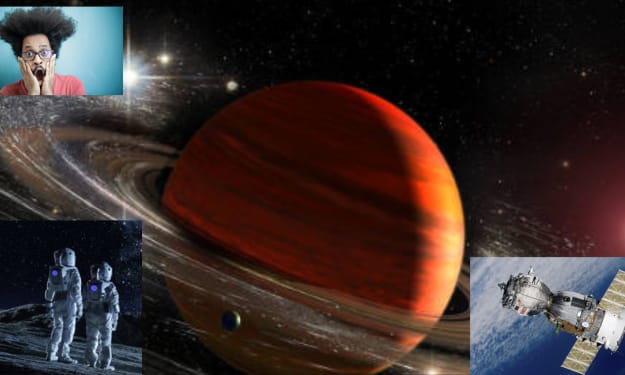
In 2017, NASA's Cassini probe sent us our closest view of Saturn as it dove into the planet's stormy atmosphere. And the results were stunning. But what would it be like if humans made the journey in person? At its closest, Saturn is 1.2 billion kilometers away from Earth. So with today's spacecraft technology, you'll need about eight years to make the trip. Finally, you arrive and get your first glimpse of Saturn with your own eyes. It's an enormous planet, the second largest in the solar system. In fact, over 760 Earths can fit inside. But hold up. We can't visit Saturn and skip over the best part, its iconic rings. Saturn's rings are almost as wide as the distance between the Earth and the moon, so at first glance, they seem like an easy place to land and explore on foot. Except there's one problem. While they look like giant discs, they're not a solid track at all. Instead, they're made of millions of chunks of ice, some as tiny as dust particles, others as large as buses. But if you were able to hike on one of Saturn's outermost rings, you'll walk about 12 million kilometers to make it around the longest one. That's about 15 round trips from the Earth to the moon. Along the way, you'll come across tiny moons and spokes of dust levitating above the surface. Now, you might notice that streams of tiny ice particles are also flying off the rings, heading towards Saturn. That's ring rain. It turns out, Saturn's magnetic fields are slowly but surely draining away the rings, so we're lucky to visit the rings now, because every 30 minutes, they lose enough water to fill an Olympic-sized swimming pool, and if we arrived 300 million years in the future, we'd miss them entirely. Now, let's climb back aboard and visit the planet itself, 282,000 kilometers away. As we reach the north pole, we'll notice a slight problem with our plan to land on the surface below. There is no surface below. Saturn's made almost entirely of hydrogen and helium gas, which is why it's called a gas giant. 4,000 kilometers above the surface, we hit Saturn's upper atmosphere. As we plummet through the north pole, we'll be treated to the sight of a magnificent aurora, like the ones we see in Alaska. It turns out, Saturn's magnetic field generates huge electrical currents, which heat up the atmosphere at the poles. Unfortunately, the electrical activity within this aurora can disrupt our ship's electronics and navigation system, so best marvel at a distance. Next, we'll hit the troposphere, the part of the atmosphere where weather happens. So watch out, powerful winds may slam into us at nearly 400 meters per second. That's over three times faster than the strongest hurricanes on Earth. All around us, thick yellow clouds give the planet its color. These are filled with ammonia crystals. If you take a sniff, you might be able to smell that distinctive scent, but you should probably keep the window closed. Ammonia is very irritating and could wreak havoc on your respiratory system. Plus, it's freezing out here, reaching as low as minus 250 degrees Celsius, much colder than the East Antarctic Plateau, the coldest place on Earth. So let's head down where it's a bit warmer. Down here, at a depth of 300 kilometers, we reach a layer of water, which is a balmy 0 degrees Celsius. Now, the deeper we plunge, the higher the pressure is around us. And in this next layer, the pressure is so high, it forces those liquid water molecules together, creating solid ice. That ice mixes in with surrounding gasses, so get ready to fight through a flurry of hail. Hopefully, the ice won't shred our ship to pieces, but if we make it through, get ready to go for a swim. Because 1,000 kilometers into the interior, the pressure is so high, it forces hydrogen molecules together into a liquid, which doesn't bode well for us, since even the sturdiest submarine would be crushed in these conditions. And if we somehow survive to reach the next layer, we'll hit yet another obstacle. A layer of liquid metallic hydrogen. The problem here is that this metal can conduct electricity, so even if our navigation equipment and electronics escape the aurora upstairs, it's probably down for the count now. But if we could survive here, our final stop might uncover a mystery in the deepest depths of Saturn. You see, scientists suspect Saturn has a core made of iron and nickel, but they're not sure if it's liquid, like the previous layer, or solid, like Earth's core. So maybe we'll be the lucky ones to find out once and for all. Though, it's over 83,000 degrees Celsius in here, hotter than the surface of the sun and hot enough to dissolve our spacecraft with us inside! Hm. Maybe we should leave the Saturn exploration to unmanned probes after all.
By Mayleen Rosa3 years ago in Earth
The largest contributor to climate change is the burning of fossil fuels for energy.
Climate change is a pressing global issue that demands immediate and concerted action. One of the most significant contributors to this challenge is the burning of fossil fuels for energy generation. The adverse impacts of fossil fuel-based energy production on the environment and human health have become increasingly apparent over the last few decades. In response, the world is undergoing a transformative shift towards renewable energy sources – solar, wind, hydro, and geothermal – in an effort to curtail greenhouse gas emissions and mitigate climate change. This essay delves into the importance of transitioning to renewable energy and explores the multifaceted benefits that this shift offers.
By bashir abdullahi3 years ago in Earth
Reflecting on my one terrible sin
As humans we all have our flaws. Are prone, to making mistakes. These mistakes often have an impact on our lives. Shape the choices we make. Every now and then there's that one grave wrongdoing that becomes a turning point in our journey. In this article we explore the process of facing and learning from such a sin as well as the subsequent journey towards redemption and personal growth.
By Olaleye Olayemi Marvellous 3 years ago in Earth
Climate Change Impacts
Climate change, driven primarily by human activities, has emerged as one of the most pressing global challenges of our time. Its far-reaching impacts encompass ecosystems, communities, and economies, posing unprecedented challenges and necessitating urgent action. This essay delves into the multifaceted repercussions of climate change, discussing the intensification of heatwaves, alterations in precipitation patterns, sea-level rise, melting glaciers and polar ice, ocean acidification, and disruptions to ecosystems and biodiversity. Through a comprehensive analysis of these impacts, we aim to underscore the urgency of mitigating and adapting to climate change.
By bashir abdullahi3 years ago in Earth
Exploring the Life-Saving Role of Horses in Combating Snakebites
In the treacherous landscapes of Australia, where danger lurks in the form of venomous snakes and spiders, a unique alliance has formed between humans and horses, working together to save lives. The captivating journey into this partnership reveals the intricate process of collecting snake venom, producing antivenom, and the vital role horses play in this life-saving endeavor.
By Terry Price3 years ago in Earth
Much Ado About The Climate
Start wrHubris, originating from the Greek language, signifies a perilous level of overconfidence. Based on my investigation, the concept of hubris aptly characterizes our present approach to the challenge of climate change. Consider the following convictions held by many: Firstly, the Earth is undergoing catastrophic warming due to specific human actions. Secondly, advanced computers empower us to forecast the climate's state in 20, 40, or even 100 years. Lastly, it is believed that by solely discontinuing one practice—burning fossil fuels—we can indefinitely stave off climatic alterations. However, each of these assumptions, collectively forming the foundation of our hubristic stance regarding shifting climate, proves to be either erroneous or so far off-base as to render them impractical. Indeed, it holds true that the planet is warming and human activities contribute to this warming influence. But beyond that, paraphrasing a line from the iconic movie "The Princess Bride," it's fair to say, "The science does not convey what you believe it does." For instance, governmental reports unambiguously state that heatwaves in the US are not more frequent now than they were in 1900. Hurricane activity remains unchanged compared to a century ago. Global flood incidents have not escalated in over seventy years. The shrinking rate of Greenland's ice sheet today mirrors that of 80 years ago. Why then are these reassuring facts not as widely recognized? The media overwhelmingly dictates public climate information, and from a media standpoint, fear sells. "Things aren't that dire" doesn't have the same impact. Regrettably, few individuals, including climate news journalists, delve into the actual scientific research. I've done so. And what the hard data from US government and UN Climate reports conveys is that the situation is less dire than assumed. Moreover, the public seems oblivious to the tenuous foundation underlying predictions of catastrophic climate change: computer models. Projecting the future climate proves to be an immensely intricate task. While human actions do exert an influence, the climate's complexity cannot be overstated. Anyone claiming climate models to be purely a matter of physics either misunderstands them or intentionally obfuscates. I can attest to this—I authored one of the initial textbooks on computer modeling. Though modelers base their assumptions on fundamental physical laws and climate observations, substantial judgment comes into play. Given that different modelers adopt different assumptions, outcomes diverge significantly across models. Let's consider a basic yet pivotal assumption modelers must make—the impact of clouds on climate. Natural fluctuations in cloud height and coverage wield an influence comparable to human effects on sunlight and heat distribution. But how could we conceivably predict global cloud coverage, say, in a decade, let alone half a century? The truth is, we can't. Nonetheless, crafting climate models mandates assumptions. This foundation appears frail when used to underpin a transformation of the global economy. Interestingly, refining models proves to be increasingly intricate. As our understanding of the climate system deepens, so does our awareness of its intricacies. Instead of acknowledging this complexity, the media, politicians, and a substantial faction of the climate science community attribute every severe storm, flood, and major fire to "climate change." While past weather events aren't contested, the narrative suggests that "climate change" exacerbates everything. Even if this were accurate, shouldn't the relevant question be: how much worse? Moreover, the term "worse" lacks scientific precision. And how could we ameliorate the situation? For alarmists, the solution is simple: eliminate fossil fuels. Yet, this proposition is not just impractical—given that over 80% of global energy derives from fossil fuels—it is also scientifically implausible. Carbon dioxide (CO2) doesn't dissipate from the atmosphere swiftly like smog; it lingers for an extended period. Roughly 60% of emitted CO2 today will persist in the atmosphere two decades from now, with 30-55% remaining after a century, and 15-30% present after a millennium. Essentially, excess carbon dioxide requires centuries to dissipate from the atmosphere. Partial reductions in CO2 emissions would merely decelerate the rise of human-induced impacts, not thwart or reverse them. CO2 is not a dial we can conveniently adjust to rectify the issue. We lack that capability. Believing otherwise is, in essence, hubris. Hubris leads to misguided choices. A touch of humility and a dose of knowledge would yield superior decisions.
By Olusola Bodunrin3 years ago in Earth
The Luminaries
A For years the Ancients used to look up in the sky and notice the effects of luminaries on human affairs. -The word "planet" comes from the ancient Greek word "planētēs," which means "wanderer." This is because, to the ancient Greeks, the planets appeared to move across the sky in a way that was different from the fixed stars. The word was adopted into Latin as "planeta," and from there it entered into various European languages.
By 21° in Libra3 years ago in Earth
Health and Wellness
In a bustling city where life moved at breakneck speed, Emma found herself caught in the whirlwind of constant demands and deadlines. Her days were consumed by work, leaving little time for self-care and personal well-being. Struggling with fatigue, stress, and an increasing sense of imbalance, she knew something needed to change.One fateful evening, as she walked past a serene park on her way home, Emma noticed a flyer for a holistic wellness retreat. Intrigued by the promise of rejuvenation, she decided to embark on a transformative journey towards health and well-being.The retreat, nestled amidst lush greenery, offered a respite from the urban chaos. Under the guidance of experienced wellness practitioners, Emma began to explore the pillars of health: physical, mental, emotional, and spiritual. Each day brought new insights and practices that gradually shifted her perspective.Mornings began with invigorating yoga sessions that awakened her body's vitality. Guided meditation sessions helped Emma navigate the labyrinth of her thoughts, allowing her to find moments of calm amidst the storm. Engaging workshops on nutrition and mindful eating reshaped her relationship with food, fostering a deeper connection to nourishment.But it wasn't just about individual wellness; the retreat emphasized community and connection. Emma formed bonds with fellow participants, sharing stories and supporting each other's growth. In the evenings, around a crackling bonfire, they engaged in open discussions about life's challenges, forging a network of empathetic souls.As days turned into weeks, Emma's transformation became evident. Her complexion glowed with health, her step was lighter, and her smile more genuine. However, the most profound change was within. She had learned the art of balance - the delicate dance between pushing herself to achieve and knowing when to pause and recharge.The retreat's climax came during a silent mindfulness hike to a breathtaking summit. Standing atop, surrounded by nature's grandeur, Emma felt a profound sense of unity with the universe. Her journey had come full circle, reminding her that true wellness transcends the physical and encompasses the harmony of mind, body, and spirit.Returning to the city, Emma faced the same demands as before, but her approach had shifted. Armed with mindfulness tools, healthier habits, and a renewed sense of purpose, she navigated challenges with grace. She became an advocate for wellness in her workplace, promoting breaks, mental health support, and team bonding.The story of Emma's journey towards health and wellness spread through her actions, inspiring others to reconsider their priorities. With each step taken on her path, the ripple effect of positive change expanded, transforming lives one decision at a time."Harmony Renewed" is a tale of awakening, reminding us that amidst life's chaos, the pursuit of health and wellness is a lifelong journey, and the key to a fulfilled existence lies in finding balance and harmony within ourselves and the world around us.
By Waliullah Ibrahim3 years ago in Earth
the challenges of changing weather patterns, droughts, and unpredictable crop yields,
Amid the rolling hills of Greendale, where golden fields stretched as far as the eye could see, the Cooper family had cultivated the earth for generations. Their farm was a haven of life, where the whispering winds told tales of resilience and love for the land. However, as time marched on, the familiar patterns of the seasons began to unravel, ushering in an era of uncertainty that would test the Coopers' very connection to the soil beneath their feet.
By owolabi abdulakeem idowu3 years ago in Earth