Nature
How strange is the world from animal's perspective ?
Some insects, like flies, have thousands of little eyes that work together to give them a big picture of what's going on around them. They can also see ultraviolet light, which helps them differentiate between males and females of their own species and navigate in their surroundings.
By Nisi Andriah3 years ago in Earth
Loss of Biodiversity
In a far-off land shrouded in lavish vegetation and lively life, a singular figure remained at the edge of a gleaming stream. This was Ava, a youthful scientist whose heartbeat as one with the rhythms of nature. Her hazel eyes held a combination of wonder and pity as she watched the smooth dance of the last Indigo-winged Butterfly in presence. Its wings were an entrancing mix of sky blue and lavender, catching the quintessence of a world that was gradually getting endlessly.
By Ngoka Nnamdi3 years ago in Earth
Hawaii Wildfires Destroy Homes, Force Evacuations
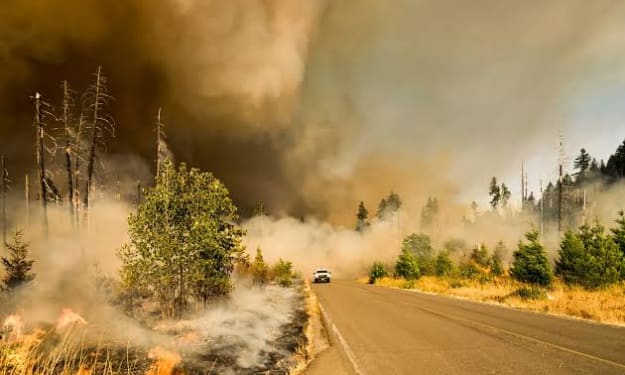
Hawaii Wildfires Claim Six Lives, Devastate Environment A series of wildfires on the Hawaiian island of Maui have killed at least six people and destroyed dozens of homes. The fires, which began on Tuesday, August 8, 2023, have been fueled by strong winds and dry conditions.
By Motivation Motivation3 years ago in Earth
Embers of Change. Content Warning.
In the heart of nature's embrace, the world can be both benevolent and relentless. "Embers of Change" unravels the harrowing narrative of a community as they face the wrath of bush burning. Through the eyes of those who witness the fury of the flames, this story delves into the resilience of the human spirit and the enduring power of nature's cycles.
By Nwabuwa Emmanuel3 years ago in Earth
Harmony of Diversity
The animal kingdom, a tapestry woven with myriad species, colors, and behaviors, is a testament to the stunning diversity of life on Earth. "Harmony of Diversity" delves into the fascinating world of animals, from the tiniest insects to the mightiest predators. This essay takes a journey through the intricate web of relationships, adaptations, and behaviors that define the animal kingdom.
By Nwabuwa Emmanuel3 years ago in Earth
Embers of Change
In the heart of nature's embrace, the world can be both benevolent and relentless. "Embers of Change" unravels the harrowing narrative of a community as they face the wrath of bush burning. Through the eyes of those who witness the fury of the flames, this story delves into the resilience of the human spirit and the enduring power of nature's cycles.
By Nwabuwa Emmanuel3 years ago in Earth
What if planets were triangles or cubes?
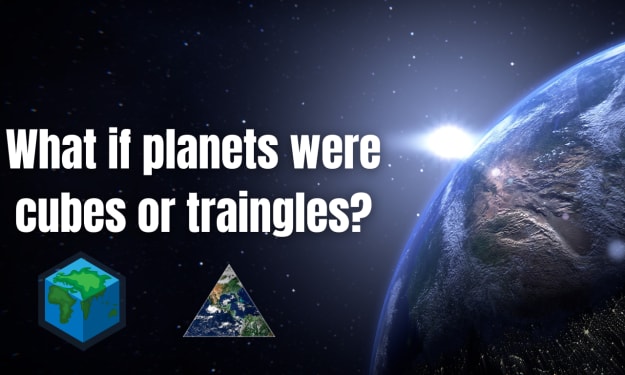
Have you ever wondered about the intriguing spherical shape of all planets? Imagine if these celestial objects decided to challenge convention and adopt different forms. Could we end up with cube-shaped planets, triangular moons, or even unimaginable intergalactic structures? Let's dive into this concept. So, how do planets actually come into existence? The universe contains massive clouds of dust and gas, known as molecular clouds, consisting of various elements like hydrogen, helium, carbon, and oxygen. These clouds act like a cosmic kitchen, providing the ingredients necessary for creating new planets. The initial step in forming planets is known as the accretion theory. Consider a scenario where an event triggers gravitational instability, perhaps a nearby supernova explosion. This disturbance causes the gas and dust within the cloud to come together due to gravity. These particles start to gather around a central point, much like squeezing a ball in your hand. Over time, they compact tightly, causing the cloud to flatten and form a disk shape, much like mixing flour and water to make pizza dough. This resulting disk is referred to as a protoplanetary disk, and its rotation is a consequence of the initial spin of the cloud particles. Visualize tiny dust particles and gas molecules dancing within the disk. Occasionally, they collide and stick together, forming clumps called planetesimals—these serve as the fundamental building blocks of planets. Through subsequent collisions and mergers, these planetesimals gradually grow larger, evolving into protoplanets. As these protoplanets gain mass, their gravitational pull intensifies, making them the dominant entities within their cosmic realms—the planets we're familiar with. Each planet possesses its own unique combination of gases, rocks, and potentially water. But what's responsible for the planets' spherical appearance? This is primarily due to gravity. Imagine squeezing a balloon—the air inside resists this pressure, resulting in equilibrium. Similarly, on planets, gravity compresses material inward, while the material's pressure pushes outward, counteracting the force of gravity. This balance is referred to as hydrostatic equilibrium. Another contributor to the spherical shape is the planet's rotation. Think of a rapidly spinning ball of Play-Doh—the material at the equator pushes outward, causing a bulge, while the poles flatten. The same principle applies to planets as they rotate on their axes. The interplay of gravity and rotation leads to a bulging effect at the equator, giving planets their spherical form. This unique interplay of factors is responsible for their distinct appearance. However, what if planets were not spherical? What if they took on cube-shaped or triangular forms? If a celestial body deviates from a sphere, its mass distribution changes significantly, impacting gravity. On a cube or triangle-shaped planet, gravity would vary across its surface. Standing at the center of a face, you'd feel the strongest gravitational pull, as the faces are closest to the center of mass. As you move toward the edges or corners, gravity's angle becomes steeper, much like ascending a mountain or steep slope. Water and atmosphere distribution would also change, rendering certain regions inhospitable due to extreme climates and reduced atmospheric pressure. To conclude, while our Earth embraces its spherical form, contemplating alternative shapes lets our imagination run wild. This exploration prompts us to appreciate the wonders of our remarkable planet, regardless of its shape.
By Danesh Kumar Thiyagarajan3 years ago in Earth
Maui wildfires
In the heart of Maui's picturesque paradise, where the sea meets the sky and the air is scented with the sweet tang of tropical flowers, a nightmare descends like a shroud. A devastating wildfire, born from the convergence of nature's elements and human vulnerability, rages through the island, obliterating everything in its fiery path. The once-thriving forests that held secrets of generations past are reduced to hauntingly beautiful landscapes of charred remains, their vibrant life replaced by the mournful crackling of embers.
By OluwaToyin Adams3 years ago in Earth
Navigating Climate Change: Agreements and Innovations in Environmental Conservation
Climate change, an existential challenge of our era, is reshaping the world as we know it. The relentless increase in global temperatures, driven by the accumulation of greenhouse gases, has triggered a chain reaction of environmental disruptions. In response, the international community is forging agreements and pioneering innovative approaches to mitigate the effects of climate change and safeguard the planet's future.
By sumit suryavanshi3 years ago in Earth
The Untold Story Behind Bee extinction
In spite of the fact that they might not be our favorite aspect of eating outside, bees are crucial to our ecosystem because they are prolific natural pollinators and play a significant role in modern agriculture. Unfortunately, bee populations are in grave danger, which makes them even more crucial. The scientists may have found a reason that might fundamentally alter our understanding of bees and their habitats, beginning with a microscopic realm we had no idea existed before.
By Bethania Kassahun3 years ago in Earth