Nature
Harmony's Rebirth
In a world marred by environmental devastation, there emerged a shimmering beacon of hope: Harmony. Amidst the ruins of what was once a sprawling, concrete jungle, a group of visionary scientists and dedicated activists had come together to create an oasis of life. They called it Harmony.
By Aditya Agrawal3 years ago in Earth
What are Hurricanes?
Have you heard the news of Hurricane named Idalia is moving towards the Florida and it is categorized as category 3 strength Hurricane? If you have heard the news then do you know how Hurricanes forms and how are they classified? If you don't know then let's get to know. When a cluster of thunderstorm develop over warm tropical Ocean and moves towards low pressure area it starts rotating when these clusters grow in size they known as tropical cyclones. The word cyclone is derived from the Greek word Cyclos meaning the coils of a snake and it was coined by Henry Piddington. Cyclones are the most violent storms on Earth. People call these storms by other names, such as typhoons or cyclones Tropical cyclones that form over the Atlantic Ocean or eastern Pacific Ocean are called Hurricanes. Hurricanes are large storms which can produce wind of upto 120km/hr. Winds of Hurricane can damage buildings and trees and can also cause flooding in affected areas. There are 6 factors that can be held responsible for the formation of the cyclone: 1. Warm temperature at the surface of the sea. 2. Instability in atmosphere. 3. Coriolis force: Coriolis force is an apparent force caused by the earth's rotation. The Coriolis force is responsible for deflecting winds towards the right in the northern hemisphere and towards the left in the southern hemisphere. 4. High level of humidity in lower part of troposphere. 5. Low pressure area 6. Low vertical wind shear: Wind shear is a change in wind speed and/or direction over a short distance. There are five categories of hurricanes. The categories are based on wind speed. 1. Category 1: wind speed 119 to 153 km/hr. 2. Category 2: wind speed 154 to 177 km/hr. 3. Category 3: wind speed 178 to 208 km/hr. 4. Category 4: wind speed 209 to 251 km/hr. 5. Category 5: wind speed more than 252 km/hr. There are three main parts of Hurricane. Eye: The eye is the "hole" at the center of the storm. Eye wall: The eye wall is a ring of thunderstorms. The wall is where winds are strongest and rain is heaviest. Rain bands: Bands of clouds and rain go far out from a hurricane's eye wall. These bands stretch for hundreds of miles. How are Hurricanes Named? There can be more than one hurricane at a time. This is one reason hurricanes are named. Names make it easier to keep track of and talk about storms. Each year, tropical storms are named in alphabetical order. The names come from a list of names for that year. There are six lists of names. Lists are reused every six years. If a storm does a lot of damage, its name is sometimes taken off the list. It is then replaced by a new name that starts with the same letter. Some most devastating Hurricanes: 1. Hurricane Katrina: It is Category 5 Hurricane forme in Atlantic Ocean on 23rd August 2005. It takes the lives of 1836 people and damage the property of around $145 billion. 2. Hurricane Maria: This category 5 Hurricane hits the Puerto Rico in September 2017 and accounted for almost 3000 deaths. 3. Hurricane Sandy: It was extremely destructive Hurricane of Octavia 2012. It was largest Atlanic Hurricane. 4. Hurricane Sandra: It was one of the major hurricanes in the north-east Pacific region. 5. Hurricane Camille: Hurricane Camille impacted the southeast Mississippi and southwest Alabama Hurricane Camille made landfall along the Mississippi Gulf Coast. Camille ranks as the 2nd most intense hurricane to strike the continental US, Camille ranks just below the 1935 Labor Day Hurricane. 6. Labor Day Hurricane: The 1935 Labor Day Hurricane, which struck the Florida on September 2, still holds the record for the lowest pressure ever recorded for any tropical cyclone or hurricane in the Western Hemisphere.
By Nikhil Jadhav3 years ago in Earth
Facts about Solar System
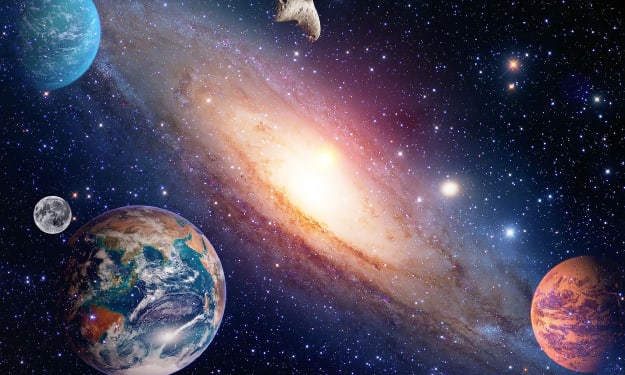
Our solar system is one of over 500 known solar systems in the entire Milky Way galaxy. The solar system came into being about 4.5 billion years ago, when a cloud of interstellar gas and dust collapsed, resulting in a solar nebula, a swirling disc of material that collided to form the solar system. The solar system is located in the Milky Way's Orion star cluster. Only 15% of stars in the galaxy host planetary systems, and one of those stars is our own sun. Revolving around the sun are eight planets. The planets are divided into two categories, based on their composition, Terrestrial and Jovian. Terrestrial planets including Mercury, Venus, Earth, and Mars, are primarily made of rocky material. Their surfaces are solid, they don't have ring systems, they have very few or no moons, and they are relatively small. The smallest and closest to the sun is Mercury, which has the shortest orbit in the solar system at about three Earth months. Venus is the hottest planet, with temperatures of up to 867 degrees Fahrenheit, due to an atmosphere of carbon dioxide and extensive lava flows. Next to this world of fire is a world of water, Earth. The water systems on this planet help create the only known environment in the universe capable of sustaining life. The last of the terrestrial planets, Mars, might have also supported life about 3.7 billion years ago, when the planet had a watery surface, and moist atmosphere. Beyond the four Terrestrial planets of the inner solar system lie the Jovian planets of the outer solar system. The Jovian planets include gas giants Jupiter and Saturn and ice giants Uranus and Neptune. The gas giants are predominantly made of helium and hydrogen, and the ice giants also contain rock, ice, and a liquid mixture of water, methane, and ammonia. All four Jovian planets have multiple moons, sport ring systems, have no solid surface, and are immense. The largest Jovian is also the largest planet in the solar system, Jupiter. Nearby is Saturn, the solar system's second largest planet. Its signature rings are wide enough to fit between Earth and the moon, but are barely a kilometer thick. Past Saturn are the ice giants, Uranus and Neptune. The slightly bigger of these ice giants, Uranus, is famous for rotating on its side. Next to Uranus is Neptune, the outermost planet in the solar system, and also one of the coldest. Orbiting the Terrestrial planets is the asteroid belt, a flat disc of rocky objects, full of remnants from the solar system's formation. From microscopic dust particles, to the largest known object, the dwarf planet, Ceres. Another disc of space debris lies much further out, and orbits the Jovian planets, the icy Kuiper Belt. Apart from asteroids, the Kuiper Belt is also home to dwarf planets, such as Pluto, and is the birthplace of many comets. Beyond the Kuiper Belt is the Oort Cloud, a vast, spherical collection of icy debris. It is considered the edge of the solar system since that is where the gravitational and physical influences of the sun end. Our solar system's particular configuration of planets and other celestial objects, all revolving around a life-giving star, make it a special place. Most of the extrasolar planets discovered in the first decade or so following the initial discoveries have masses similar to or greater than that of Jupiter. As techniques are developed for detecting smaller planets, astronomers will gain a better understanding of how planetary systems, including the Sun’s, form and evolve.
By Praachi Ajmera3 years ago in Earth
The Bottom Dwellers of the Aquarium World
Corydoras catfish are a fascinating group of freshwater, bottom-dwelling fish that are known for their unique traits and compatibility with a variety of tank mates. They are social creatures that prefer to live in groups of at least six individuals . In this article, we will explore the best substrate for Corydoras catfish.
By Kevin Smith3 years ago in Earth
A Galactic Getaway:
In the not-so-distant future, humanity had reached a pivotal milestone: the advent of commercial space travel. The dream of traversing the cosmos was no longer confined to the pages of science fiction but had become a tangible reality. This was the era of "Astral Odyssey," the world's first space tourism company, and the story of its inaugural interstellar voyage was about to unfold.
By Sound-Scribe-Space3 years ago in Earth
Beyond the Blue Horizon:
In the not-so-distant future, Earth's skies were no longer the limit. The concept of space tourism had transformed from a mere dream into a tangible reality. The tale follows Alex Turner, an ordinary software engineer, as he embarks on a once-in-a-lifetime adventure to explore the celestial playground above.
By Sound-Scribe-Space3 years ago in Earth
The Role of Human, Technology in Disaster Relief
In recent years, technological advancements have revolutionized disaster relief efforts, particularly in the aftermath of catastrophic events like hurricanes. Drones and Artificial Intelligence (AI) have emerged as indispensable tools, playing a crucial role in expediting response, enhancing situational awareness, and aiding in the recovery process. Their ability to navigate challenging environments, gather data, and assist in decision-making has transformed the way relief organizations approach hurricane recovery.
By OKAFOR OGECHUKWU3 years ago in Earth
Changing Rainfall Patterns in East Africa.
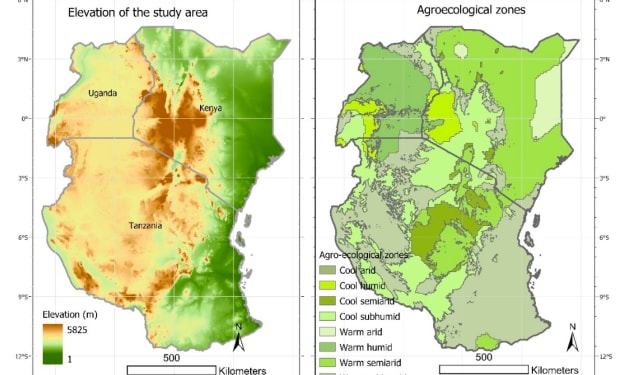
Climate change, which leads to low agricultural productivity, tragic losses of crops and livestock, and worsened food insecurity and water scarcity, has been the major challenge faced by rural farmers in Africa. The adoption of proper adaptation measures to climate change has become inevitable for people who depend on agricultural production and subsistence farming. Climate extremes resulting from climate change have made many African rural farmers more vulnerable as many of them have insufficient adaptation strategies and limited access to financial resources (Rahut et al., 2021; Trisos et al., 2022; Ayanlade et al., 2023), and the situation is unlikely to become better.
By John Nnaji 3 years ago in Earth