Nature
The Carboniferous Chronicles
Embark on a riveting journey through time, over 300 million years ago, when Earth's landscapes were dominated not by dinosaurs but by colossal insects, ushering in the Carboniferous period, picture an atmosphere steeped in oxygen, a richness far surpassing our contemporary norms. Join me in this extraordinary exploration and the mysteries of this transformative era, where wonder, evolution, and the rise and fall of gigantic insects unfolded. Read through as I delve into the captivating reasons behind the enormity of these ancient creatures, connecting their size to the very air they breathed – an oxygen-rich atmosphere, unique ecological conditions that fueled the gigantism of these ancient beings, a tale intricately woven into the fabric of Earth's history unlike anything we know today.
By Mary Emmanuel3 years ago in Earth
Interesting Facts of Milky Way Galaxy
The solar system has few or no moons. They are relatively small. Mercury is the smallest and closest to the sun. Its orbit is about three Earth months. Venus is the hottest planet, reaching temperatures up to 867 degrees Fahrenheit. This is due to its carbon dioxide atmosphere and extensive lava flows. Earth is a world of water. Its water systems create a unique environment capable of sustaining life. Mars, the last terrestrial planet, might have supported life about 3.7 billion years ago. It had a watery surface and moist atmosphere. Beyond the terrestrial planets are the Jovian planets. They include gas giants like Jupiter and Saturn and ice giants like Uranus and Neptune. The gas giants are made mostly of helium and hydrogen. The ice giants also contain rock, ice, and a liquid mixture of water, methane, and ammonia. All four Jovian planets have multiple moons, ring systems, no solid surfaces, and are immense. Jupiter is the largest planet in the solar system. Saturn has wide, thin rings. Uranus is bigger and famous for rotating on its side. Neptune is the outermost and one of the coldest planets. Orbiting the terrestrial planets is the asteroid belt. It is a flat disc of rocky objects left from the solar system's formation. The Kuiper Belt is another disc of space debris further out and orbits the Jovian planets. It is home to dwarf planets like Pluto and birthplace of many comets. The Oort Cloud is a vast, spherical collection of icy debris beyond the Kuiper Belt. It marks the edge of the solar system. The solar system's configuration and celestial objects revolve around a life-giving star, making it a special place to call home.
By Alin Vinitha Viegas3 years ago in Earth
MYTHS AND TRUTH ABOUT SPACE
Now, as much as we enjoy epic SpaceBattles with blasters cutting through the black void and causing cheerful booms, that's not exactly what happens when something explodes in the big black space. Space is basically a vacuum, meaning it has no oxygen. And oxygen is essential for any burning process here on Earth. You might argue that stars can burn and explode into Supernova, but that's not exactly true either. Stars don't rely on oxygen, so they're not burning. There are constant thermonuclear reactions going on inside them. So, a spaceship can only explode like that if it has a nuclear power plant installed in it. If it doesn't, then the only special effect you get is a brief flash that disappears quickly. Liquid oxygen, which is often on board spaceships, burns out very quickly in the vacuum of outer space. As for the boom, oxygen plays a crucial role here too. Sound only travels through air molecules bumping into each other. Since there's no air in space, the whole scene would be silent. And that's not a bad thing either. Just imagine how deafening the sun would be if sound could travel in space. Despite what many sci-fi directors want us to believe, there's no dark side to the Moon. Our satellite is tidally locked with Earth, meaning it's always turned towards us with one side while the other always looks away. The sun is much farther from us than the moon, and we're both turning round and round, warming and lighting this side and that. In turn, it means that once in every short while, the Moon is lit by the Sun from either side. It's just that we can't see it from where we are. While things appear weightless in outer space, there's actual gravity all over the place. It becomes weaker the further you get from a heavy object like our planet, but it's still there. In fact, there's not a single place in the universe that isn't affected by the gravity of this or that cosmic object. Everything that has mass has gravity as well, yes, even you and me. But space objects are so massive that they tug smaller things towards them. That's why the planets of the solar system orbit the sun.Stronger gravity implies that celestial bodies can maintain stable rings after their formation. Some experts speculate that Earth may have had a ring system in the past, possibly formed from a collision with a Mars-sized object. This collision could have created a dense ring of debris around our planet, which eventually coalesced to form what we now know as the Moon. Additionally, scientists propose the existence of a mysterious planet, referred to as Planet 9, lurking at the outer edges of our solar system beyond Neptune. If Planet 9 does exist, it is believed to be similar to Uranus or Neptune but approximately ten times more massive than Earth. It likely orbits the Sun at a distance about 20 times farther than Neptune. Another intriguing theory suggests that Planet 9 could potentially be a black hole the size of a grapefruit, warping space similar to a large planet. Contrary to previous beliefs, water is actually quite abundant in our solar system. It can be found in asteroids, comets, craters on the Moon and Mercury, and even at the poles of Mars, mostly hidden beneath layers of ice and the planet's dusty surface. Europa, one of Jupiter's moons, is considered the most promising candidate for hosting life outside of Earth. It is believed to have a vast ocean of liquid water beneath its frozen surface, potentially containing twice as much water as all of Earth's oceans combined. Despite being significantly farther from the Sun than Earth, Neptune surprisingly emits more heat than it receives. It also exhibits greater atmospheric activity compared to its neighboring planet, Uranus, even though Uranus is closer to the Sun. The reason behind Neptune's extremely strong winds remains unknown.On May 20th, the docking with the station was successfully completed. Alongside another engineer named Serge, they diligently carried out their space duties. They embarked on multiple spacewalks, conducted repairs, took care of the station, and even conducted scientific experiments. Living in space became more manageable with company and a lot of work. However, things took a turn for the worse on the day Serge was supposed to return home. According to the mission plan, the mission was meant to last for 5 months, and a new astronaut was scheduled to replace the old ones. The transport ship finally docked with the station on October 10th, but only one astronaut returned to Earth. Serge was left alone at the mere station, continuing his work as the sole flight engineer of the crew. The station couldn't remain empty, so they had to send someone to replace Serge. Although he wasn't prepared for such a long stay in space and hadn't trained for it, there was no other choice. One month passed, and Sergey was informed that he would soon return home. However, an unexpected turn of events occurred. They contacted Sergey and informed him that he couldn't return because the country that promised to bring him home no longer existed. Meanwhile, a major crisis unfolded in Russia, making the cosmonaut's return impossible due to lack of funds. Just imagine the condition Serge found himself in - hundreds of miles away from home, alone in the vastness of outer space, with no idea how many days he had left to endure. The days passed slowly, turning into weeks, and then into months. It would have been much easier if being in space didn't harm one's health. However, in the conditions of zero gravity, the human body suffers significant damage. The muscles weaken due to the lack of necessary load, leading to atrophy. Although astronauts perform daily exercises, it is insufficient to maintain their physical condition. Additionally, the bones start to weaken, leaving the person feeling weak. Even after six months of such a life, it takes a considerable amount of time for an astronaut to regain their previous physical shape upon returning home. Furthermore, there are numerous other challenges to overcome.
By cecil Wekesa3 years ago in Earth
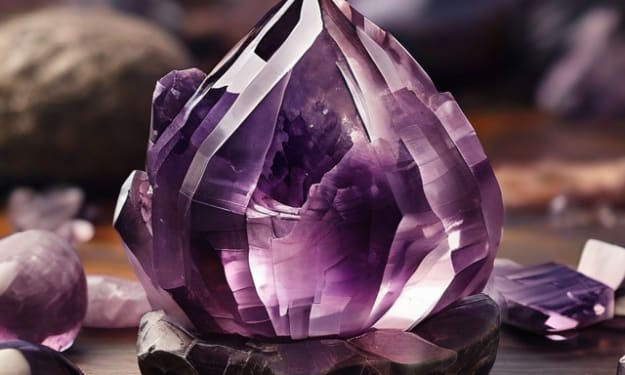
The Enchanting World of Amethyst: Unveiling Nature's Purple Treasure
Amethyst, with its enchanting hue and mystical allure, has captivated humanity for centuries. From ancient civilizations to modern-day enthusiasts, this gemstone continues to hold a special place in the realm of crystals and minerals. Join us as we embark on an illuminating expedition into the origins, mining process, and cultural significance of amethyst.
By Christopher Ezeh3 years ago in Earth
Voices of the Wind
In a world painted in hues of azure and emerald, where the skies once harmonized with the rhythmic patterns of the wind, a lone migratory bird named Zephyr embarked on a journey fraught with challenges. The air, once a navigational symphony of whispers and currents, now murmured a discordant tale of climate change.
By MOONGREE HAANGALA3 years ago in Earth
Vanishing Islands
The island of Ondoru had always been a refuge, cradled in the gentle embrace of the cerulean sea. Its shores were adorned with golden sands, and the air was thick with the scent of tropical blooms. For generations, the people of Ondoru had lived in harmony with nature, their lives entwined with the ebb and flow of the tides. Yet, as the years unfolded, a silent menace began to emerge from the horizon – rising sea levels, the harbinger of an irreversible change.
By MOONGREE HAANGALA3 years ago in Earth
HUMAN VISION V/S THOSE OF DOGS AND CATS
HUMAN VISION VERSUS THOSE OF DOGS AND CATS Have you ever wondered how the world appears to animals with different eyes? Not just from another person's viewpoint, but from the perspective of a whole other creature. It's fascinating to discover that animals see the world in completely different ways than we do. Some have glowing eyes that allow them to see in the dark, while others have super-powered vision that can perceive colors beyond our imagination. Join me on this journey as we explore how different animals perceive the world around them.
By Hannah Wangere3 years ago in Earth
Five Seconds of World Without Oxygen
As I sit here, contemplating the very air I breathe, the idea of a world without oxygen feels like an abstract concept. But what if, just for a fleeting five seconds, all the oxygen on Earth disappeared? What would happen to our atmosphere, to the environment, and to us? Join me in this intriguing exploration of the hypothetical scenario in which the world loses oxygen for just five seconds.
By Abdallah Daud3 years ago in Earth
Something Strange Is Happening On Saturn
Do you perceive this Lofty world the second biggest planet from the sun check a gas goliath with a foggy yellow earthy colored appearance check seven colossal scaring Rings check you're correct it can't be anything more yet Saturn and as of late the Hubble Space Telescope has caused a shocking Revelation evidently the planet's rings to have been doing something to the planet for quite a while another review has uncovered that these famous rings are warming Saturn's upper air the coolest thing however is that specialists from NASA guaranteed that it's something researchers have never noticed elsewhere in our nearby planet group this mystery has been concealing on display for a very long time and solely after utilizing the perceptions of the planet got from the Hubble Space Telescope and resigned Cassini test and Explorer 1 and 2 rocket did cosmologists sort it out this unforeseen expected collaboration of the gas monster with its rings could turn into a device for foreseeing assuming planets in other star frameworks have heavenly Saturn-like ring frameworks too so how could obviously the gas planet is gradually cooked by its own Rings The Obvious proof is an abundance measure of bright radiation it tends to be viewed as a ghostly line of blistering hydrogen in the air of the gas goliath there's a knock in radiation that can must imply that something is warming the upper climate from the external it's still sort of hazy how this cycle is going on yet the most plausible clarification is that frosty ring particles downpour down on Saturn and cause this warming yet it could likewise be the effect of minuscule shooting stars or the particles of sun based breeze the warming could be brought about by sun oriented bright radiation or a few electromagnetic powers that get electrically charged dust when NASA's Cassini test completed its Central goal and dove into Saturn's air it had sufficient opportunity to quantify the air parts and it worked out that numerous particles were without a doubt tumbling from its rings regardless, the warming system occurs affected by the gravitational field of the gas goliath you see cosmologists truly do be aware of the sluggish deterioration of Saturn's rings yet sorting out what this cycle means for the planet that is new now do you recollect NASA's Cassini space apparatus I referenced before for over 10 years it was concentrating on Saturn sharing pictures of the gas monster and its frigid moons it took us to grand universes where methane Waterways ran into methane oceans and planes of gas and Ice were shooting material into space at any rate that very Cassini additionally concentrated on Saturn's magnetosphere the thing is powers acting somewhere inside the planet produce a ginormous attractive air pocket under the planet and this air pocket is known as the magnetosphere sadly space experts actually have next to no data about this peculiarity on Saturn since attractive fields are undetectable and are obviously best considered from inside envision this million m each hour streams of electrically charged particles from the Sun Also known as sunlight based breeze are spreading through the planetary group unexpectedly something shows up in their manner gracious it's Saturn's attractive field it safeguards the planet making sunlight based particles step back subsequently the sun's attractive powers are seething external Saturn's magnetosphere while inside the gas Monster's defensive air pocket its own attractive powers rule our home planet additionally has an attractive field yet it makes a lot more modest magnetosphere yet it really shields us from the unsafe particles coming from the Sun and from space yet despite the fact that Saturn is safeguarded by its magnetosphere the sun actually figures out how to screw with the planet vigorous breezes from our Star clear over the gas monster causing huge auroras yet dissimilar to auroras here on Earth Saturn's auroras must be found in bright light all in all they're undetectable from Earth's surface you can see them in the event that you travel to space yet clearly there are various types of auroras on the gas monster for instance another sort is set off by the charged particles coming from volcanic ejections in the world's moons and a portion of Saturn's auroras may be brought about by strong breezes twirling in the planet's own air these breezes blow in the ionosphere which is a locale situated underneath the magnetosphere similar breezes may be liable for the variable pivot pace of the planet this peculiarity makes it challenging for researchers to sort out how long one day on the ringed planet endures discussing winds Saturn has a secretive Vortex whirling over the planet's South Pole the entire situation looks like a gigantic typhoon like tempest on The planet yet its eye alone measures very nearly 2,500 M across for correlation the eye of a regular earthbound storm is a simple 2 to 3 m wide what confounds space experts is that albeit the peculiarity seems to be a storm it doesn't act like one it's fixed and continues to turn over a similar region of the South Pole and keeping in mind that polar vortices on earth have cold centers the one on Saturn is warm and presently prepare yourself for one more shock Saturn has arranged for us in a picture shipped off Earth by the Hubble Space Telescope one can see several dull shadowy spots on the left half of the planet's rings those are casually called spokes perhaps on the grounds that they look like spokes on a bike the overshadowing and state of spokes fluctuate they might appear to be dim or light it relies upon the point and enlightenment some of the time they might try and seem to be masses as opposed to something with a traditional spiral talked shape they additionally don't keep going long yet the uplifting news is increasingly more will begin to seem the nearer we are to May 6 2025 that is the point at which the aomin Equinox on Saturn will happen now on Earth that is the second when the sun is precisely over the equator of the planet and day in and day out are of a similar length yet on Earth it's something a bit unique like our planet Saturn is shifted on its hub that is the reason it has four seasons yet since the circle of the gas goliath is a lot bigger every one of these Seasons goes on around seven Earth years an equinox happens when Saturn's rings are shifted Edge on to the Sun yet what causes the spokes stargazers figure it very well may be the gas Monster's attractive field when a planetary attractive field cooperates with the sunlight based breeze it establishes an electrically charged climate as we definitely know on Earth this outcomes in Aurora Borealis likewise called Aurora poet and assuming that we talk about Saturn the littlest frigid ring particles could get charged as well and it presumably briefly suspends these particles over the bigger Rocks in the Rings interestingly the spokes in Saturn's rings were spotted by NASA's Explorer Mission it occurred in the mid 1980s around then we didn't realize that these spokes were an occasional peculiarity Explorer 2 just passed by the planet all things considered and afterward sped on to sort out what these spokes were and the way that they worked space experts required a space telescope that could notice Saturn's rings from a far distance like Hubble the most recent Equinox on Saturn happened in 2009 that is the point at which the Cassini space test was going around the gas goliath it sent many astonishing pictures back to Earth it figured out how to demonstrate rapidly that the spokes weren't brought about by gravitational connections with Saturn or the impact of the gas monsters moons or little moonlets which make up the planet's rings it was the Year 2005 when Cassini affirmed that the spokes were connected with Saturn's attractive field and despite the fact that that mission was done in 2017 now Hubble keeps its drawn out observing of the progressions close by Saturn in spite of the relative multitude of perceptions stargazers actually can't anticipate the start and term of the spoke season fortunately Saturn's unmistakable rings are an ideal lab for St studing this peculiarity since despite the fact that different gas monsters in the planetary group likewise have rings those are not really noticeable and researchers don't know whether spokes happen on those planets
By Oseni Deborah3 years ago in Earth
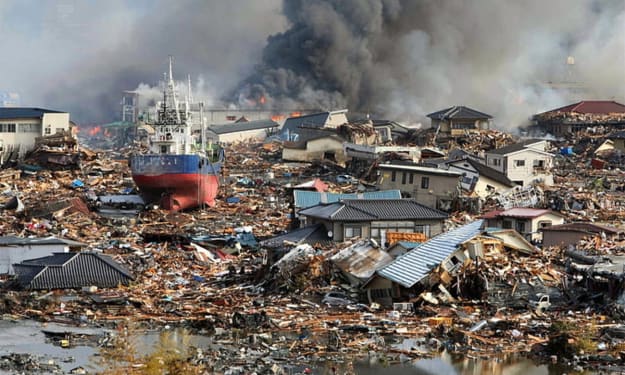
Description of Earthquake
An earthquake is a type of natural disaster that is defined by the abrupt release of energy from the Earth's crust, which causes the surface to tremble or shake. The movement of tectonic plates beneath the surface of the Earth is what causes this release of energy. The intensity of earthquakes can vary widely, from mild tremors to catastrophic occurrences that can result in extensive damage and fatalities.
By Vijay Kumar3 years ago in Earth
Title: The Prophetically calamitous Orchestra of Super Volcanoes.
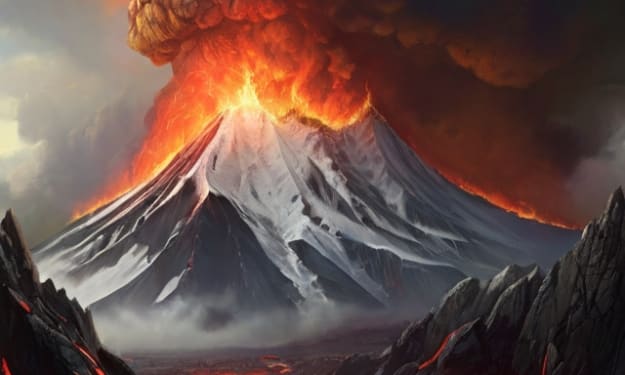
Volcanoes, those stewing goliaths underneath the World's surface, stand as both dazzling marvels and harbingers of annihilation. While most falsehood torpid, the speculative situation of numerous super volcanoes emitting as one presents a frightful vision of a prophetically catastrophic scene. Just imagine a scenario where excursion wanders into the pit, investigating the destructive situation that could unfurl, winding around a story of a volcanic bad dream that leaves mankind on the edge.
By Mary Emmanuel3 years ago in Earth