Nature
The Sahara Desert
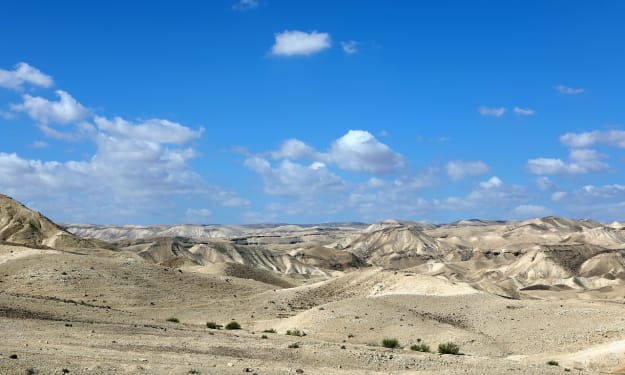
The Sahara Desert captivates our minds with its huge size and wilderness that has not been tamed as it seems that it is an ocean of sand across North Africa. It goes to an amazing extent of close to 9 million square kilometers making it the world's largest hot desert exceeding that of continuous United States. The name “Sahara” originates from the Arabic language which means “a desert” but it’s unbelievable that there is a complicated community sustained in these areas that seem like can’t be lived in.
By el hariti adil2 years ago in Earth
Green life for a better future
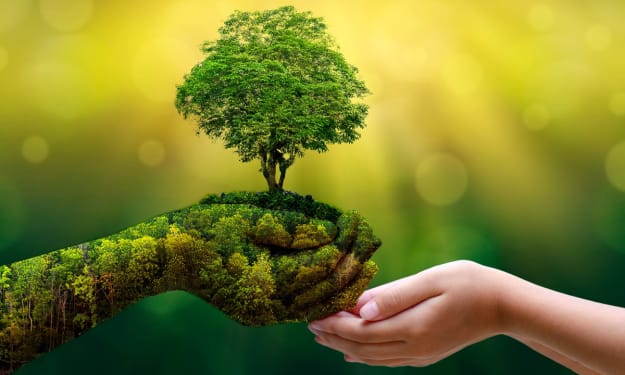
In an era where environmental concerns loom large, the concept of green living has gained significant traction. At its core, green living involves adopting practices and making choices that prioritize environmental sustainability and reduce our ecological footprint. By embracing green living, individuals can play a pivotal role in shaping a better future for both themselves and the planet.
By Bindu Bhardwaj2 years ago in Earth
What If the World Lost Oxygen for 60 Seconds
The Day the World Lost Oxygen: Alien Scenario A and Alien Scenario B Let us embrace ourselves and visualize every day in the morning, the familiar path along the street, when suddenly, our world around us starts to collapse. One building topples after another forming a pile of brick dust as if a house of cards was dropped, the sky is no longer impressive and livens but instead is ominous dark dulling, and the burning sensation literally is like breathing fire. This is the the all-out-apocalyptic end of the human race? The first thing you perceive is a quiz question. You struggle with the words trying to answer but suddenly, you are no longer there, you are gone with all the existence. Such a spooky scenario suggests what would be happening on Earth in the case of oxygen depletion for a minute and it does this perfectly.
By Amine Oubih2 years ago in Earth
The highest mountain in the world is not Everest
It turns out that there are two mountains, not one, that surpass Everest in height. Everest's towering height (8,849 m) makes the famous Himalayan mountain rank as the world's highest, however, in reality this is not the case, according toIFL Science. Mount Everest is the world's highest mountain above sea level, but there are several different parameters for measuring its height. Mauna Kea in Hawai'i is the tallest mountain from base to summit. Meanwhile, because the Earth's crust is slightly thicker at the equator, Mount Chimborazo in Ecuador is the highest if its peak is measured from the center of the Earth.
By Culture Discovery2 years ago in Earth
The End of Moonlight
A few years ago the moonlight disappeared from my courtyard. Previously, on a clear night, the leafy grove outside my door had been awash in silver glow. But suddenly that space and all the other courtyards in my apartment complex had no moonshadows.
By Marie Wilson2 years ago in Earth
Exploring Our Solar System:
Exploring Our Solar System: Our solar system, a mesmerizing tapestry of celestial bodies, holds within its grasp an array of planets, each with its own unique characteristics, mysteries, and allure. From the scorching inferno of Mercury to the icy depths of Neptune, let's embark on a captivating journey through the planets that grace our cosmic neighborhood. Mercury: The Sweltering Messenger Closest to the Sun, Mercury boasts extreme temperature variations, swinging from scorching heat to freezing cold. Its surface is adorned with craters, cliffs, and vast plains, offering a glimpse into the relentless forces shaping our solar system's rocky worlds. Venus: The Shrouded Beauty Venus, veiled by thick clouds of sulfuric acid, presents a hostile environment with crushing atmospheric pressure and high temperatures. Despite these challenges, its rocky terrain and volcanic features hint at a turbulent past, captivating astronomers and explorers alike. Earth: The Blue Gem Our home planet, Earth, is a haven of life and diversity, adorned with oceans, continents, and a life-sustaining atmosphere. From towering mountains to sprawling plains, Earth's beauty and complexity continue to inspire awe and curiosity. Mars: The Red Planet Mars, with its rusty hues and enigmatic landscapes, beckons humanity with the promise of exploration and discovery. Ancient riverbeds, polar ice caps, and rugged terrain hint at a planet that once may have harbored liquid water and potentially supported life. Jupiter: The Giant of the Solar System Jupiter, a gas giant with swirling bands of clouds and a mesmerizing Great Red Spot, commands attention as the largest planet in our solar system. Its numerous moons, including the intriguing Europa with its subsurface ocean, hold tantalizing secrets for future exploration. Saturn: The Ringed Wonder Saturn's iconic rings, composed of icy particles and rock fragments, make it a celestial marvel visible even through small telescopes. Beyond its rings, Saturn boasts a diverse family of moons, including Titan with its thick atmosphere and lakes of liquid methane. Uranus: The Sideways Ice Giant Uranus, known for its unique tilt on its axis, presents a serene blue-green hue and a system of rings and moons. Its icy composition and distant orbit invite scientific scrutiny, offering insights into the formation and evolution of our solar system. Neptune: The Windy Ice Giant Neptune, with its turbulent atmosphere and supersonic winds, represents the outer boundary of our known solar system. Its moon Triton, with its retrograde orbit and geysers of nitrogen, adds to the intrigue of this distant ice giant. As we marvel at the diversity and wonder of our solar system's planets, we are reminded of the vastness of space and the endless possibilities for exploration, discovery, and understanding. Each planet, with its distinct features and mysteries, contributes to the rich tapestry of our cosmic journey, inviting us to delve deeper into the wonders of the universe. As we conclude our journey through the planets of our solar system, we are left with a profound sense of wonder and awe at the beauty, diversity, and mysteries that adorn our cosmic neighborhood. From the fiery realms of Mercury to the icy expanses of Neptune, each planet tells a story of cosmic evolution, geological wonders, and the potential for life beyond our own blue gem, Earth. As inhabitants of this pale blue dot, we are privileged to witness and explore the wonders of our solar system, from the majestic rings of Saturn to the tumultuous storms of Jupiter. Our quest for knowledge and understanding continues to drive exploration missions, scientific discoveries, and technological advancements that unravel the secrets of these celestial bodies. The planets serve as celestial guides, reminding us of the interconnectedness of our universe and the limitless possibilities that await us in the vastness of space. They inspire curiosity, imagination, and a sense of wonder that transcends borders and cultures, uniting humanity in our shared quest to unravel the mysteries of the cosmos. As we gaze upon the stars and planets that adorn our night sky, let us embrace the spirit of exploration, discovery, and appreciation for the beauty and complexity of our solar system. With each new revelation and scientific endeavor, we venture closer to unlocking the secrets of our cosmic origins and our place in the grand tapestry of the universe.Start writing...
By David Aristotle 2 years ago in Earth
WHERE'S THE RAMP?
WHERE’S THE RAMP … that’s some high tide … May people, especially those living in Florida, love to boat. Whether powered by wind (sailboat) or engine, there seems to be something especially enjoyable about being on the water. I include myself in that category.
By Margaret Brennan2 years ago in Earth
The important of environmental justice
a bustling city, with its skyscrapers reaching for the sky, its streets filled with people of all walks of life. Amidst this vibrant scene, there exists a stark contrast. In the shadows of these towering buildings, tucked away from the glitz and glamour, lie communities that bear the brunt of environmental injustices. These are the neighborhoods where the air is thick with pollutants, where access to clean water is a luxury, and where the impacts of climate change are felt most acutely.
By james crus2 years ago in Earth
Tremors Below: Understanding Earthquakes
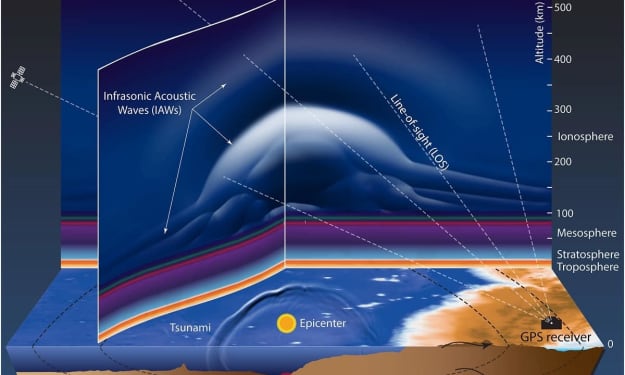
Earthquakes, the powerful and often terrifying natural phenomena, have fascinated and terrified humans for centuries. These geological events, characterized by the sudden shaking of the Earth's surface, can cause immense destruction and loss of life. Understanding the science behind earthquakes is not only essential for predicting and mitigating their impact but also for unraveling the mysteries of our planet's dynamic processes.
By Bindu Bhardwaj2 years ago in Earth
The Role of Artificial Intelligence in Climate Change
Introduction As the world grapples with the devastating effects of climate change, it's time to harness the power of artificial intelligence (AI) to combat this global crisis. AI can be a game-changer in mitigating climate change by leveraging its capabilities in data analysis, prediction, and decision-making.
By HAFIZ WASAF2 years ago in Earth