Nature
The Fascinating World of Fractals. AI-Generated.
Hey, smart people, Joe here! Ever noticed how the branches of a tree can look remarkably like the whole tree? And why do the roots of a tree often resemble the branches? It’s almost as if there’s a hidden design that links various elements of nature in an uncanny way. But it doesn’t stop at trees. Look at our veins, lightning bolts, rivers, or even broccoli, and you’ll start to see a similar branching pattern everywhere. This phenomenon isn’t just a quirky coincidence; it’s a deep, underlying pattern in nature known as fractals.
By Mercia Wippenaar Davids2 years ago in Earth
Fractals in nature
R- Hey, smart people, Joe here. Ever notice how if you look at part of a tree, it looks a lot like an entire tree? And why does this underground part of a tree look so much like the rest of the tree? That's pretty weird. This isn't a tree, but it sort of looks like one. And so does this, hmm. And these branches, sure look an awful lot like these branches, except those are blood vessels and so are these, which also kind of look like a tree, although this part reminds me of a river or maybe every river? Lightning, lungs, cracks in the ceiling, what's going on here? Why do all these things look so similar? Once you start seeing it, you see it everywhere. It haunts your dreams! It's like there's some spooky connection between rivers and lightning bolts and broccoli and trees and all sorts of living and non-living things. Well, all these objects have one thing in common, zoom in or out, and we see the same branching pattern repeat itself over and over at different scales. These are fractals, a special kind of self-similar shape that mathematicians, and the rest of us, go extra crazy for. And this video is about why we see them everywhere. I don't know if you've ever looked at a tree as deeply as I have, but that weird thing where part of the tree also looks like a tree, that's called self similarity. It's like one of those triangles with an infinite number of smaller triangles inside it or whatever this thing is. And unlike the self-similar shapes we see in nature, these perfectly self-similar shapes are infinite. We could zoom in or out and continue to see those patterns repeat forever! Mathematician Benoit Mandelbrot named these self repeating shapes, fractals, because they exist sort of in between dimensions or in fractured dimensions. What the heck does that mean? Let's take a quick sidebar to talk about how the way that mathematicians use a word, it isn't always the same as how you and I use a word. (upbeat music) You and I think of dimensions as the three that we live in or the two that exist on paper or even the one dimension of a line, because that's what we learned in geometry class. What Mandelbrot meant by, "Dimension," has to do with how different shapes fill space as they get bigger or smaller and this is kind of the key thing for us as we explore fractals in nature. You can 2X the length of this line and you get twice as much line. Another way of saying that is you scale it up by two to the power of one. If we do the same to a square, 2X its length and width, you get four times as much square, or you scale it up by two to the two. Do it to a cube, 2X length, width, and height and we get eight times as much cube or two to the three. This power right here is the dimension Mandelbrot was talking about and for simple shapes, it matches with our usual idea of dimension. But what's interesting about a fractal like this one is when you scale it up by 2X, you get three times as much fractal. (fractal reverberating) That exponent isn't one or two, you get 1.585 dimensions. Even though the fractal sits in a two dimensional plane, just like a regular triangle does, when you scale it up, it doesn't fill space quite the same as a two dimensional object. The same thing is true for fractals with volume, like this. To a mathematicianologist or whatever, it's more than two dimensional, but not quite three dimensional. Fractals exist in this weird in-between space and that's part of what Mandelbrot found so fascinating about 'em. By the way, you know what Benoit B. Mandelbrot's middle name is? Benoit B. Mandelbrot. Nerdiest joke I know right there. Anyway, Mandelbrot pointed out that fractals are not just a toy for mathematicians to make psychedelic art for your dorm room wall. They can help us understand nature better, because they're everywhere. To start off, why do trees even look like trees? Well, the thing is, biologically speaking, there's no such thing as a tree. Sure, there are things you and I call, "Trees," because of the way they look. (buoyant music) But if you look at a tree like this one, many of the plants we call, "Trees," are more closely related to things that aren't trees and more distantly related to other things that do look like trees. So, "Tree," is just a way of describing plants that look kind of tree-like. It's almost as if growing fractal-like branches that look similar at different scales was the solution to some problem that all these different plants faced and that problem is soaking up a bunch of sun and CO2. Growing tall is one solution to that problem or maybe growing just a few gigantic leaves on top of a trunk or even a canopy the size of a city block with all the leaves on the very tip. But all of these options require spending a bunch of energy to grow for not that much gain, basically, you gotta make a whole lot of wood for not that much sun. Luckily there's a better way to do it and that's where being a fractal is really useful. A perfect fractal lets you put infinite surface area in a finite amount of space. This snowflake isn't getting any bigger, but you can keep zooming in then you'll keep finding another smaller layer just like the first. And you can keep doing this forever, meaning its outer edge, the line you need to draw this shape, is infinitely long. Trees do something similar, by growing out each level as a smaller version of the previous level a tree can pack a bunch of surface area in its volume, not an infinite amount, like a mathematically perfect fractal, but it's a pretty cool way of soaking up more sun without wasting energy by getting all bulky. And it's no coincidence that trees roots grow in a similar way, they need lots of surface area to soak up water and nutrients and fractal branching is the best bang for their buck, maximizing the volume that the tree can draw from without wasting unneeded energy building plumbing that's too big. Meanwhile, inside our bodies, we have our own little trees. A lung's job is to take in oxygen and an adult body needs around 15 liters of O2 every hour. If our lungs were just two balloons, they'd never keep up. Fractal branching means our lungs can hold half the area of a tennis court while staying packed up nicely inside our chest. (graphics whirring) (crowd clapping) And our lungs aren't the only trees we have inside us. Our entire circulatory system looks kind of like a bunch of fractal branches too. We have almost a 100,000 kilometers of blood vessels in our bodies delivering oxygen and nutrients and removing wastes. Fractal branching lets our circulatory system pack in as many blood vessels as we need to protect every point A with every point B, while also spending the least possible energy building our body's plumbing and manufacturing all the blood that runs through it. In a way, it's like each of these living systems has a goal. A tree wants to soak up a bunch of light and CO2, a lung wants to take in a bunch of air, a blood vessel wants to exchange nutrients with every cell in the body. In all these cases, fractal branches are the most efficient way to scale up while staying basically the same size. This secret pattern shows up in non-living things too. All around the world, from their sources to their ends, rivers arrange themselves into branching shapes. And by now you can probably guess why, at their source, fractal branching is the most efficient way to drain water from a given area of land. And at their mouths we see fractal branching as sediment piles up and splits a river into smaller and smaller strands. Cracks and lightning bolts are both ways of dissipating energy and it shouldn't surprise you that fractal branches are the most efficient way to do that inside of a given space. And when scientists model all these ways of growing, it turns out that, like perfect mathematical fractals, these branching shapes are best described as in between dimensions. At this point, it might be tempting to think there's one universal rule that underlies every branching fractal pattern that we see around us, but as usual, nature isn't so predictable. We also see fractal branches in crystals, the shapes of snowflakes, even strange mineral deposits people sometimes mistake for ancient plant fossils. Similar fractals, but a different reason. Here, things like temperature, humidity, and the concentration of different chemicals act as a set of rules for building the thing. And as these structures grow, those rules repeat themselves at multiple scales giving us self-similar fractal shapes. What's amazing is that as much as these fractal shapes pop up in nature, there isn't a single gene or law of physics or brain making all these things grow fractal branches. But one by one, as each of these systems evolved to be as efficient as possible, they all landed on the same solution to their individual problems, letting us look at things in an interestingly new dimension and making them infinite
By Tshepang Gontse Matloa 2 years ago in Earth
Beat the Heat: Your Ultimate Survival Guide
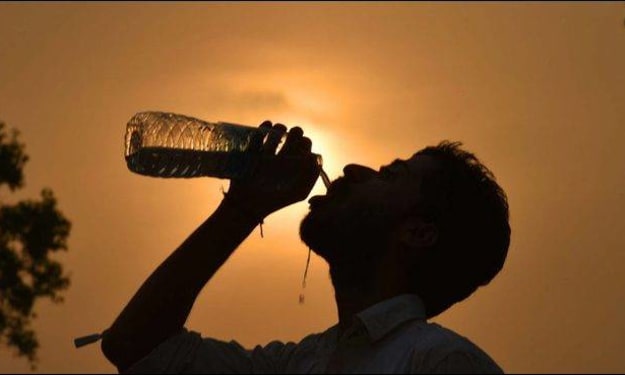
Click and watch don't miss out :- hottrendingnews45.blogspot.com Beat the Heat: Your Ultimate Survival Guide Introduction As our planet warms, understanding how our bodies can adapt to heat becomes increasingly crucial. How our bodies can adapt to heat is a complex interplay of physiological mechanisms that allow us to maintain a stable internal temperature despite external challenges. This blog post will delve into the fascinating ways our bodies respond to heat, exploring the science behind these adaptations and providing practical tips for staying cool and comfortable. Understanding Heat Stress Before we dive into how our bodies can adapt to heat, it's important to grasp the concept of heat stress. This occurs when the body's cooling system is overwhelmed, leading to an increase in core body temperature. Several factors contribute to heat stress, including high ambient temperature, humidity, and physical exertion. How Our Bodies Can Adapt to Heat: Thermoregulation Our bodies possess an intricate system called thermoregulation, designed to maintain a core temperature of around 37°C (98.6°F). How our bodies can adapt to heat involves a complex interplay of physiological mechanisms that kick in when temperatures rise. One of the primary ways our bodies can adapt to heat is through sweating. Sweat glands produce moisture that evaporates from the skin's surface, cooling the body down. However, excessive sweating can lead to dehydration, so it's essential to replenish fluids regularly. Vasodilation: Expanding Blood Vessels Another key mechanism in how our bodies can adapt to heat is vasodilation. This process involves widening blood vessels near the skin's surface, allowing more blood to circulate and release heat into the environment. This is why your skin often appears flushed when you're hot. Acclimatization: Training Your Body for Heat How our bodies can adapt to heat also involves a process called acclimatization. This occurs when your body gradually adjusts to heat exposure over time. By spending increasing amounts of time in warmer conditions, your body becomes more efficient at sweating, regulating blood flow, and conserving energy. The Role of Hormones in How Our Bodies Can Adapt to Heat Hormones also play a crucial role in how our bodies can adapt to heat. For instance, the hormone aldosterone helps regulate sodium and water balance, preventing excessive fluid loss through sweat. Additionally, anti-diuretic hormone (ADH) helps retain water in the body to maintain hydration. How Our Bodies Can Adapt to Heat: Behavioral Adaptations While physiological adaptations are essential, how our bodies can adapt to heat also involves behavioral changes. Choosing lightweight, loose-fitting clothing made from breathable fabrics can help to dissipate heat. Scheduling outdoor activities during cooler parts of the day and seeking shade can also be effective strategies. Protecting Vulnerable Groups Certain individuals are more susceptible to heat-related illnesses, including the elderly, young children, and those with chronic health conditions. How our bodies can adapt to heat varies from person to person, and it's crucial to take extra precautions to protect these vulnerable groups. The Impact of Climate Change on How Our Bodies Can Adapt to Heat Climate change is exacerbating heat-related challenges. As temperatures continue to rise, understanding how our bodies can adapt to heat becomes even more important. While our bodies have remarkable adaptive capabilities, it's essential to implement measures to mitigate the effects of climate change and protect public health. Conclusion How our bodies can adapt to heat is a testament to the human body's resilience. By understanding the physiological mechanisms involved in thermoregulation and adopting appropriate strategies, we can better protect ourselves from heat-related illnesses. As our climate continues to change, it's crucial to stay informed and take steps to safeguard our health and well-being.
By Mohamed sha2 years ago in Earth
Cellulosic Ethanol Market Size, Status, Top Emerging Trends, Growth and Business Opportunities 2031
The escalating prices of crude oil, fueled by ongoing political tensions and the Russia-Ukraine conflict, have reached unprecedented highs, peaking in 2022. The disruption in global oil trade has led Russian crude oil traders to claim a scarcity of buyers. This situation, coupled with the high carbon footprint associated with crude oil derivatives compared to biofuels, has significantly influenced the shift towards renewable energy sources. As a result, the cellulosic ethanol market is experiencing robust growth, driven by the increasing adoption of biofuels.
By aakansha tiwari2 years ago in Earth
The Ultimate Airsoft Adventure:
Have you ever wanted to step into a real-life action-packed adventure? Airsoft is a thrilling activity that brings your favorite movies and video games to life in a fun, safe environment. Whether you're strategizing with your team, exploring exciting terrain, or outwitting your opponents, an airsoft game is a fantastic way to enjoy the great outdoors and bond with family and friends. In this blog post, we'll explore the excitement of airsoft games, share some useful tips and tricks, and recommend the best gear to enhance your experience. Plus, check out our links for top-notch equipment that will make your next airsoft game unforgettable!
By Melvin Dahlin2 years ago in Earth
Relaxed
On the edge of an ancient forest, nestled in a hidden glade, a symphony of nature unfolded each day as the sun began its descent. The glade was a place of enchantment where the air was thick with the scent of blooming wildflowers, and the light filtered through the canopy in golden streams. It was here that the creatures of the forest gathered to perform their evening concert, a ritual as old as the trees
By Ziyandi Agness ngcwadi2 years ago in Earth
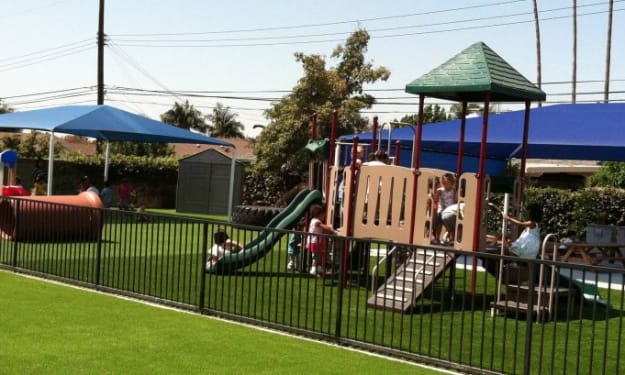
7 Benefits of Switching to Artificial Grass for Your Lawn
Artificial grass has become an increasingly popular alternative to natural grass for homeowners looking to enhance their lawns. With advancements in technology, synthetic turf now looks and feels more like the real thing than ever before. Here are seven compelling benefits of making the switch to artificial grass:
By John Shawn2 years ago in Earth