Nature
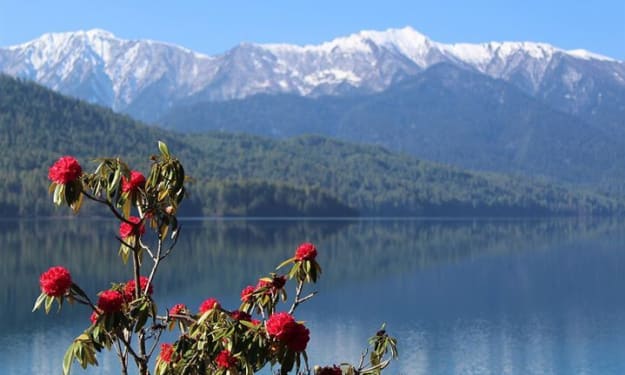
Spring Rides in Nepal: Biking Through Blooming Rhododendrons
Is the idea of biking through a carpet of colors something that interests you? Imagine this-scenic, serpentine mountain roads; emerald, lush valleys; and an astonishing view of rhododendrons, blooming in every color imaginable, from furious crimson to pink delicate. That is spring riding in Nepal-honestly, what every adventure biking enthusiast would have ever dreamt of.
By Nepal Moto Tours2 years ago in Earth
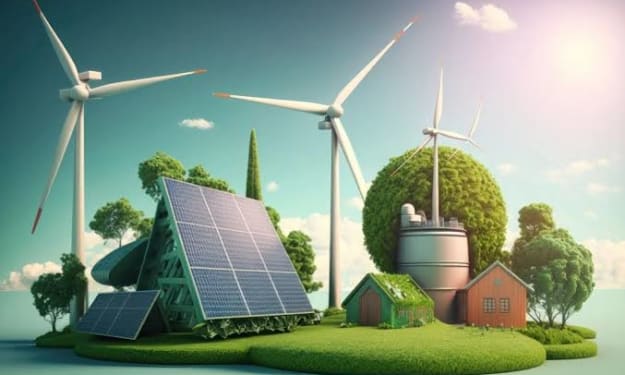
Green Energy Solutions: Exploring Earth's Potential for Sustainable Resources. Content Warning. AI-Generated.
In this day and age, the requirement for perfect and economical energy is a higher priority than at any other time. With environmental change, contamination, and the developing interest in energy, individuals are searching for ways of lessening mischief to the climate while meeting the world's energy needs. Environmentally friendly power energy offers an answer. It utilizes normal assets like daylight, wind, and water, which are inexhaustible and don't run out. We should investigate probably the most famous efficient power energy sources and their capability to make a manageable future.
By Tanushree Das2 years ago in Earth
Trapped In The Forest. Content Warning.
**Trapped in the Forest** That morning, Rudi and his friends, Dita and Budi, decided to go on an adventure. They chose to climb a mountain known for its dense forest. Although Rudi had heard stories that the forest often got people lost, he still felt confident that he could make it through. The three of them brought complete equipment, careful preparation, and a great sense of enthusiasm.
By ahmad syamil annabil2 years ago in Earth
Trapped In The Forest. Content Warning.
**Trapped in the Forest** That morning, Rudi and his friends, Dita and Budi, decided to go on an adventure. They chose to climb a mountain known for its dense forest. Although Rudi had heard stories that the forest often got people lost, he still felt confident that he could make it through. The three of them brought complete equipment, careful preparation, and a great sense of enthusiasm.
By ahmad syamil annabil2 years ago in Earth
The Ocean's Perilous Depths: 10 Dangerous Places in the World's Waters
The ocean, our life-giving source, can also be a formidable and unforgiving force. From the depths of enigmatic sinkholes to the treacherous grip of powerful currents, these 10 locations represent some of the most dangerous places in the world's oceans. 1. The Blue Hole of Dahab, Egypt: A Diver's Cemetery
By Lisa Ann Bastiaan2 years ago in Earth
Mom's Diner - For the Birds
I grew up watching birds. My mother loved to feed the birds, and we spent many happy hours watching our feathered guests as they partook of our offerings. Mom spent a fortune filling those hungry bellies, and she had a stack of field guides at the ready to identify our visitors.
By Laura DePace2 years ago in Earth
6 countries in the world that have the most dense forests in the world
Here are 6 countries with the most dense forests in the world 1. Suriname: Suriname, a small South American nation, boasts an astonishing 93% forest cover, making it one of the most forested countries globally. Its dense rainforests are home to an incredible biodiversity, including jaguars, giant river otters, and countless species of birds and insects. The Amazon rainforest extends into Suriname, contributing significantly to its lush greenery.
By Moharif Yulianto2 years ago in Earth
6 countries in the world with the longest daylight hours
The countries with the longest daylight hours are those located in the Arctic regions, where the tilt of the Earth's axis causes the sun to remain above the horizon for extended periods during the summer months. Here are six such countries, each with a focus on the unique experiences and challenges of their long summer days:
By Moharif Yulianto2 years ago in Earth
Flu Alert: What You Need to Know About Prevention, Symptoms, and Treatment
### Understanding the Flu: Causes, Symptoms, and Treatment Flu, short for influenza, is a contagious viral infection that affects the respiratory system, including the nose, throat, and sometimes the lungs. It is commonly confused with the common cold, but it is much more severe. Flu season generally peaks during the colder months, but it can affect people year-round. The flu can range from mild to severe, sometimes leading to serious complications, especially in vulnerable populations. This article will explain the causes of the flu, its symptoms, and the steps you can take to prevent and treat it. #### Causes of the Flu The flu is caused by the influenza virus, which has several different strains. The virus is categorized into three main types: A, B, and C, with type A and B being responsible for the seasonal outbreaks. Influenza viruses are constantly changing, which is why new flu vaccines are developed each year. The flu is primarily transmitted through droplets when an infected person coughs, sneezes, or talks. These droplets can land in the mouths or noses of people nearby or on surfaces, where the virus can survive for a short time. You can also contract the flu by touching a contaminated surface and then touching your face, especially your mouth, nose, or eyes. There are several factors that make some people more susceptible to the flu. The most vulnerable groups include young children, elderly adults, pregnant women, and those with weakened immune systems or chronic conditions such as asthma, diabetes, or heart disease. #### Symptoms of the Flu Flu symptoms generally appear suddenly and can vary from mild to severe. Common symptoms of the flu include: 1. **Fever**: A high fever, often above 100.4°F (38°C), is a hallmark of the flu. 2. **Chills**: You may feel cold and shivery, especially as your body temperature rises. 3. **Fatigue**: The flu often leads to extreme tiredness or fatigue that can last for days or weeks. 4. **Cough**: A dry, persistent cough is common in flu cases and can be quite bothersome. 5. **Sore throat**: The throat may feel scratchy, irritated, or painful. 6. **Runny or stuffy nose**: Nasal congestion or a runny nose are also frequent symptoms. 7. **Body aches**: Muscle aches, joint pain, and a general feeling of being sore are often reported. 8. **Headache**: A headache is a frequent symptom and can be severe in some cases. 9. **Gastrointestinal issues**: Though less common, some people, especially children, may experience nausea, vomiting, or diarrhea. Flu symptoms can appear within 1 to 4 days after exposure to the virus. Most people begin to feel better within a week, but some can experience lingering symptoms like fatigue. However, the flu can sometimes lead to complications such as pneumonia, bronchitis, sinus infections, or ear infections. These complications can be severe and life-threatening, especially for those in high-risk groups. #### How to Prevent the Flu
By Nora Ariana2 years ago in Earth
America's Artificial Sun A Major Step Toward Infinite Energy Production
America's Artificial Sun A Major Step Toward Infinite Energy Production Nuclear fusion the same process that powers the Sun has long been regarded as the ultimate clean and efficient energy source. This process can generate massive amounts of energy from minimal fuel while producing zero greenhouse gas emissions. Now America has taken a significant step toward turning this dream into reality. To make nuclear fusion practical on Earth extremely high temperatures exceeding millions of degrees Celsius and strong magnetic confinement are required. However one of the biggest hurdles has been the Greenwald limit which restricts the amount of plasma that tokamak reactors doughnut shaped reactors can sustain.
By Adnan Rasheed2 years ago in Earth
Lost in the Depths: Exploring Earth's Most Remote Locations
The world is vast, and although it might feel like every corner has been mapped and populated, there are still places where the sheer remoteness is staggering. These are places so isolated that the nearest human being could be thousands of kilometers away. For those seeking solitude—or perhaps the ultimate test of survival—here’s a journey through some of the most remote locations on Earth and how you might escape them. Tristan da Cunha: The Most Remote Inhabited Island If you dream of being far from the hustle and bustle of humanity but still crave some semblance of community, Tristan da Cunha is the place for you. This tiny island in the South Atlantic is the most remote inhabited location on the planet, with a population of just 264. The nearest inhabited land is the island of Saint Helena, 2,000 kilometers away, which itself is incredibly remote. The closest continent, Africa, is an astonishing 2,400 kilometers away. There is no airport on Tristan da Cunha, and the only access is by boat. Ships from South Africa visit the island just 8 or 9 times a year, and even then, the journey takes several days. If you found yourself stranded here without access to these infrequent boats, your only real option would be to build or acquire your own seaworthy vessel. The closest airport is on Ascension Island, which would require a week-long voyage to reach. Devon Island: The Largest Uninhabited Island Now imagine being dropped into the middle of Devon Island, located in the Canadian Arctic Archipelago. This island, roughly the size of Croatia, is entirely uninhabited. Walking in any direction will lead you to nothing but barren tundra and icy landscapes. The nearest humans reside on the neighboring island of Cornwallis, in the town of Resolute, with a population of just 229. However, Resolute is 80 kilometers away and separated by frigid waters, making escape impossible without a boat or a suitable ice bridge. Devon Island’s isolation is so extreme that it has been used as a training ground for Mars missions due to its similarities to the Red Planet. If you ever found yourself stranded there, your options would be limited to waiting for rescue or undertaking an arduous trek across treacherous terrain to reach the sea. Antarctica’s Pole of Inaccessibility The South Pole might seem like the pinnacle of isolation, but it pales in comparison to Antarctica’s Pole of Inaccessibility. This location, the furthest point from any ocean on the continent, is 878 kilometers from the nearest research station at the South Pole. While the South Pole is home to up to 150 scientists year-round, the Pole of Inaccessibility has no permanent inhabitants. The only visible sign of humanity here is a bust of Lenin erected by Soviet explorers in 1958. The last recorded human visit was in 2011, making this one of the least-visited spots on Earth. If stranded, your best hope of survival would be to make the daunting journey to the South Pole station, where help could potentially be arranged. Bouvet Island: An Icy Speck in the South Atlantic For those seeking true desolation, Bouvet Island might be the ultimate destination. This tiny, ice-covered island is uninhabited and surrounded by the South Atlantic Ocean. Claimed by Norway, it lies 1,600 kilometers from the uninhabited Queen Maud Land off Antarctica’s coast and 2,260 kilometers from Tristan da Cunha, the nearest inhabited location. Reaching Bouvet Island is already a monumental challenge, but escaping it would be even harder. There are no permanent structures, no facilities, and no regular visitors. With no other land within reach, survival would depend on your ability to construct a seaworthy craft and navigate thousands of kilometers of open ocean. Point Nemo: The Oceanic Pole of Inaccessibility Moving from land to sea, the vastness of Earth’s oceans offers even greater isolation. The most remote oceanic location is Point Nemo, located in the South Pacific. This point is 2,689 kilometers from the nearest inhabited land, Easter Island. To put that into perspective, that’s about 64% of the distance across the continental United States. There are no shipping routes or trade vessels passing through this region, and the fastest recorded journey to reach Point Nemo took over 15 days by boat. If you were stranded here, the closest humans would actually be the astronauts aboard the International Space Station, which orbits Earth at an altitude of around 416 kilometers. Reaching safety from Point Nemo would be an almost insurmountable challenge, requiring a well-prepared rescue mission or a highly skilled navigator with supplies for weeks at sea. The Mariana Trench: The Deepest Point on Earth If distance isn’t enough of a challenge, consider the sheer depth of the Mariana Trench. Nearly 11 kilometers below the ocean’s surface, the trench’s Challenger Deep is the loneliest place on Earth. Only three people have ever ventured to its depths, and the last expedition was in 2012. Survival here is impossible without specialized submersibles capable of withstanding immense pressure. Even if you reached the surface, you would still be in the middle of the ocean with no immediate help in sight. The nearest ship or landmass could be hundreds or thousands of kilometers away. The Arctic Ocean’s Most Remote Point Finally, there’s the Arctic Ocean’s most remote location, situated on shifting ice. This spot is so isolated that no permanent structures can be built. The closest inhabited land is Ellesmere Island in Canada, 1,638 kilometers away. Despite its extreme remoteness, this point has never been reached by humans, offering a tantalizing challenge for adventurers. However, any expedition would face extreme weather, drifting ice, and the constant danger of being stranded without help. Final Thoughts The world is far larger and more remote than it often feels. These places—whether islands, deserts, oceans, or ice sheets—represent the limits of human reach. Surviving in such isolation would require ingenuity, preparation, and a tremendous amount of luck. For those brave enough to venture into these regions, the rewards are unparalleled: the chance to experience the world as it once was—untouched, vast, and profoundly alone.
By Lisa Ann Bastiaan2 years ago in Earth