Nature
NASA on Alert for the First Time: A Meteor Could Collide with Earth in 2032
A Meteor on the Horizon? The 2032 Threat The news has put scientists, astronomers, and citizens alike on edge: NASA has issued an alert about a meteor that could dangerously approach Earth in 2032. This asteroid, estimated to be about the size of the Santiago Bernabéu stadium, has raised alarms at the world's most important space agency.
By Miguel Díaz2 years ago in Earth
The Adorable Quokkas
If you saw a quokka while traveling in Australia you might at first not be sure what you are seeing. These are tiny marsupials that make their homes in parts of southwest Australia and on two nearby islands in the Indian Ocean. One is Bald Island and the other Rottnest located near Perth, Australia. They're most likely relatives of the Rock Wallaby.
By Rasma Raisters2 years ago in Earth
Asian Animals Pakistan and The Philippines
Wildlife of Pakistan Pakistan is located on the Indian subcontinent and a Muslim-majority state. It shares land borders with Afghanistan, Iran, China, and India. The mountains of the Himalayas, the Karakoram, and the Hindu Kush dominate the north and west of the country, the southwest has the Balochistan Plateau, and the southeast has the Indus River Plain. The coastline of the Arabian Sea borders Pakistan to the south.
By Rasma Raisters2 years ago in Earth
Earth’s magnetic field and dynamo theory
The Earth's magnetic is essential for life, as it helps shield the Earth from harmful solar radiation and cosmic rays. Without it, life on Earth would be significantly more exposed to space weather. Understanding the Earth's magnetic field requires looking at both its nature and the dynamo theory, which is the most widely accepted explanation of its origin.
By Badhan Sen2 years ago in Earth
Soil composition and erosion
Soil is the uppermost layer of the Earth's crust, composed of a mixture of organic matter, minerals, gases, liquids, and living organisms. The composition of soil and its susceptibility to erosion are fundamental to the health of ecosystems, agricultural productivity, and the stability of landscapes. Understanding soil composition and the processes of soil erosion is critical for maintaining soil quality and ensuring sustainable land use practices.
By Badhan Sen2 years ago in Earth
From stardust to life
How did life begin on Earth? Was it a divine spark, an alien seed, or something else entirely? The question of life's origin has captivated humanity for millennia. While we may never have a definitive answer, scientific inquiry has revealed a fascinating story of gradual transformation, from non-living matter to the complex life we see today.
By Kamran Khan2 years ago in Earth
Mineralogy and Gemstones
Minerals are Naturally occurring, inorganic substances with a definite chemical composition and crystalline structure. Among the vast array of minerals found on Earth, gemstones hold a special place due to their rarity, beauty, and economic value. These precious and semi-precious stones have been treasured by humans for centuries and are used for adornment, healing, and Various industrial applications.
By Badhan Sen2 years ago in Earth
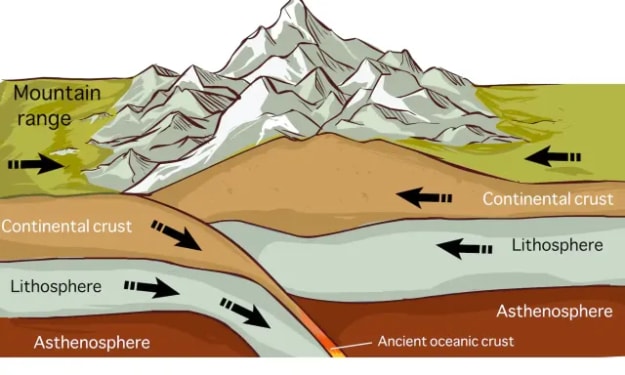
Mountain formation (orogeny, folding, faulting)
The primary mechanisms behind mountain formation include orogeny, folding, and faulting. These processes are driven by plate tectonics and the Earth's internal forces, leading to the creation of various mountain types such as fold mountains, fault-block mountains, and volcanic mountains.
By Badhan Sen2 years ago in Earth
Volcanoes: Types, eruptions, and Geothermal energy
They play a crucial role in shaping the planet’s surface and influencing its climate. While volcanic eruptions can be destructive, they also contribute to the formation of new land and the production of geothermal energy, a valuable renewable resource. This article explores the different types of volcanoes, the nature of their eruptions, and the potential of geothermal energy.
By Badhan Sen2 years ago in Earth
Earthquakes: Causes, measurement, and impacts
When the Earth's tectonic plates suddenly shift, releasing energy in the form of seismic waves. These seismic waves travel through the Earth, causing the ground to shake. Earthquakes can lead to severe consequences for both human populations and the natural environment. Understanding the causes, how earthquakes are measured, and their impacts is vital for disaster preparedness and response.
By Badhan Sen2 years ago in Earth