Nature
“The Cobra: Nature’s Silent King of Venom”
Cobra snakes are among the most fascinating and feared reptiles on Earth. Found mostly in Asia and Africa, cobras are well-known for their unique hood, venomous bite, and legendary presence in culture, religion, and myths. But behind the fear lies a creature full of mystery, intelligence, and survival skills. There are more than 20 species of cobras, with the most popular being the Indian cobra, king cobra, and Egyptian cobra. Each species has different behaviors and features, but they all belong to the family Elapidae — a group of highly venomous snakes. One of the most iconic features of a cobra is its hood — the flared extension of skin around its neck. When the cobra feels threatened, it lifts the front of its body and expands its hood to appear larger and more dangerous. This is a defense mechanism used to scare away predators like mongoose, birds of prey, or humans. The hood is made possible by elongated ribs behind the cobra’s head that spread out the skin like a fan. Cobras are venomous, not constrictors. They inject their venom through their fangs when they bite. The venom is a neurotoxin — it attacks the nervous system, leading to paralysis, respiratory failure, and death in severe cases. However, most cobras will avoid biting unless provoked or cornered. They would rather warn, hiss, and display their hood before attacking. The King Cobra (Ophiophagus hannah) is the longest venomous snake in the world, growing up to 18 feet (5.5 meters) in length. Despite its size and power, it is shy and prefers to escape rather than fight. Unlike other snakes, the king cobra also shows some intelligence and memory — it can recognize intruders in its territory and actively defends its eggs, which is rare among snakes. Cobras are carnivores, feeding on small animals like rodents, frogs, lizards, birds, and even other snakes. The king cobra, in fact, mostly eats other snakes, including venomous ones. After catching their prey, they bite it and wait until the venom paralyzes it, then swallow it whole. One amazing fact is how cobras sense the world around them. Since snakes are deaf to airborne sounds, cobras don’t “hear” in the normal sense. Instead, they pick up vibrations through the ground and sense movement through their sensitive skin. Their forked tongue collects scent particles from the air and delivers them to a special organ called the Jacobson’s organ, which helps them “smell” the world. Cobras have long been part of human culture and mythology. In India, the cobra is sacred and associated with Lord Shiva. In ancient Egypt, cobras were symbols of power and protection — even worn on the crowns of pharaohs. The Egyptian cobra is believed to be the snake that Cleopatra used to take her own life. In many rural parts of Asia and Africa, cobras are both feared and respected. Snake charmers often use Indian cobras in street performances, although this is controversial and often harmful to the snake. It's important to note: the cobra doesn’t dance to music — it follows the movement of the charmer’s flute, mistaking it for a threat. Though feared, cobras play a vital role in the ecosystem. They control rodent populations, reducing the spread of disease and protecting crops. Sadly, many cobra species are now under threat due to habitat loss, road killings, and illegal wildlife trade. Some cobras are killed for their skin, while others are hunted for use in traditional medicines. Conservation groups are now working to protect cobra habitats, raise awareness, and discourage illegal capture. Snakes are a key part of the natural balance, and losing them would affect many other species, including humans. To conclude, the cobra is not just a creature of fear but of elegance, importance, and intelligence. With their powerful venom, graceful movement, and cultural mystery, cobras remind us that nature is both beautiful and dangerous — and that respect is more powerful than fear.
By Shahab Khanabout a year ago in Earth
Earth Spinning Faster.The Shortest Day Recorded on 10 July.
How Fast Does the Earth Spin? Normally, the Earth takes 24 hours to complete one full rotation on its axis. This is what gives us day and night. In reality, the Earth takes slightly more than 86,400 seconds (the exact number of seconds in 24 hours) to rotate once. Scientists have been measuring the length of the day very precisely for decades using atomic clocks, which are incredibly accurate.
By USA daily update about a year ago in Earth
Plastics in Electronics
Plastics are everywhere in electronics, from smartphone casings to circuit board insulation. But choosing the right polymer is about much more than just convenience. It requires a careful balance between performance, safety, cost, and environmental responsibility. The Enviropass article, “Plastics in Electronics: A Guide for Engineers,” explores how different plastics shape the design and sustainability of electronic products.
By Mahgol Nikpayamabout a year ago in Earth
"Where the Earth Speaks in Steam: A Walk Through Sulfur Realms"
Where the Earth Speaks in Steam: A Walk Through Sulfur Realms Tracing the Breath of the Planet in a World of Mist, Minerals, and Fire --- There are places on this Earth that feel less like parts of our world and more like whispers from another realm—untouched, untamed, and almost mythical. Sulfur lakes belong to that realm. Veiled in swirling steam, colored with unnatural hues, and perfumed with the acrid breath of the underworld, they stand as raw, living proof that the Earth is not a static rock but a breathing, pulsing organism. To walk through these sulfur realms is not merely a geological experience—it is a spiritual, sensory, and psychological journey. This is the story of what it feels like to stand at the edge of creation, in places where the planet exhales. --- 🌋 What Are Sulfur Lakes? Sulfur lakes, also called acidic crater lakes, form in areas of intense volcanic activity. These lakes are often born inside volcanic craters or calderas and are rich in dissolved sulfur, producing an eerie, iridescent appearance—ranging from milky turquoise to neon yellow or even a ghostly grey. The water in these lakes is extremely acidic, sometimes with a pH near zero, making it as corrosive as battery acid. They are often heated from below by magma chambers, resulting in the continuous release of steam, sulfur dioxide, and other volcanic gases. Famous examples include: Kawah Ijen, Indonesia — home to electric blue flames at night. Dallol, Ethiopia — one of the hottest, lowest, and most acidic environments on Earth. Yellowstone’s Grand Prismatic Spring, USA — known for its vivid rainbow colors caused by microbial life. Poás Volcano, Costa Rica — with its roiling, acid-green lake shrouded in toxic mist. --- 🥾 My Journey Into the Sulfur Realm The path wasn’t paved. It wasn’t marked clearly either. The air grew thicker as I ascended a rocky trail, and with each step, I felt the terrain becoming more alive beneath my feet—warm, trembling, and unpredictable. The breeze carried the distinct, almost metallic smell of sulfur—like a thousand burnt matchsticks crushed into dust. Approaching the crater’s edge felt like arriving on another planet. The lake before me wasn’t just water. It was color, steam, and sound. The surface boiled gently, hissing and spitting occasionally as if irritated by our presence. Gases escaped in sudden bursts from vents along the shore, and thick plumes of steam curled around jagged volcanic rocks like fingers grasping at the sky. My guide wore a gas mask. I didn’t. Not at first. Within minutes, the sharp, stinging air began to bite my lungs, and my eyes watered uncontrollably. Breathing became difficult. The sulfur stung in ways I never imagined. It was both terrifying and intoxicating. --- 🌫️ The Science Behind the Steam What gives these lakes their character is the combination of volcanic heat, gas emissions, and mineral content. The high sulfur concentration interacts with groundwater and rainwater, creating sulfuric acid. When this acid dissolves minerals in the surrounding rocks, it contributes to the unique coloration and chemical makeup of the lake. In places like Kawah Ijen, miners harvest solidified sulfur at great personal risk. The glowing blue fire that tourists come to witness is caused by ignited sulfuric gases, which burn only at night, creating a supernatural effect. In Yellowstone, the vibrant colors aren’t from minerals alone—but from thermophilic bacteria that thrive in extreme temperatures and pH levels. Each ring of color corresponds to a different microbial colony, adapted to very specific living conditions. --- 💀 Danger and Beauty Intertwined Despite their mesmerizing beauty, sulfur lakes are deadly. The acidity can dissolve flesh and bone. The surrounding area may collapse without warning due to underground activity. The gases—especially hydrogen sulfide and sulfur dioxide—can be lethal in high concentrations. In 2013, two tourists died near a crater lake in Indonesia due to toxic gas exposure. Even experienced geologists tread carefully, often wearing full respirators and monitoring air quality at all times. Yet, this danger only adds to the allure. Much like the edge of a storm, there’s a magnetic pull to these places. They remind us that nature is not just a passive backdrop to human life—it’s powerful, dynamic, and very much alive. --- 🌍 Cultural and Mythical Significance Many ancient cultures considered sulfur-rich areas as entrances to the underworld. In Greek mythology, volcanic sulfur springs were linked to Hades. In some Indigenous traditions, these steaming, bubbling waters are sacred, seen as the breath of gods or spirits that reside within the Earth. The smell of sulfur has long been associated with omens, purging, and transformation. Alchemists in the Middle Ages believed sulfur represented the soul or the divine essence of change. It’s no surprise then that walking through these realms often feels less like tourism and more like a pilgrimage. --- 🧠 A Psychological Experience There is something deeply humbling about standing in front of a sulfur lake. The chaos and power of the Earth become palpable. You feel small—insignificant—but not in a disempowering way. It’s a reminder of your place in the cosmos, a kind of ego-shattering encounter that forces you to listen. The constant hiss of steam is not white noise. It’s like the Earth is breathing, speaking in a language older than words. I stood in silence for a long time, listening to that breath. --- 📸 Photography and Preservation Sulfur lakes are some of the most photogenic but challenging places to photograph. The intense light reflections off the acidic water, the fast-moving steam, and the need to protect camera gear from corrosive air make it a test for even seasoned photographers. Preservation is also a major concern. With increasing tourism, these fragile ecosystems are at risk. Many regions now require permits or guided tours to reduce human impact. The best way to honor these places is with respectful observation—leave no trace, take only memories (and photos). --- 🌐 Why You Should Go (Cautiously) If you ever have the chance to visit a sulfur lake—go. But go with reverence, preparation, and an open heart. Bring protective gear. Learn about the local geology. Hire a guide if it’s remote. And most importantly, take time to feel. These lakes aren’t just about sightseeing; they’re about connection. They are a mirror held up to the raw power of the planet—and to ourselves. To walk through sulfur realms is to feel the pulse of something ancient and eternal. --- Final Thoughts In a world of curated experiences and polished perfection, sulfur lakes stand out as wild, untamed truths. They are not beautiful in a traditional sense. Their beauty is violent, volatile, and honest. They show us that beneath our cities, our comforts, and our illusions of control, the Earth is still alive—and it speaks. Sometimes in fire. Sometimes in steam. And sometimes, if you’re quiet enough, you can hear it breathe.
By Hasbanullahabout a year ago in Earth
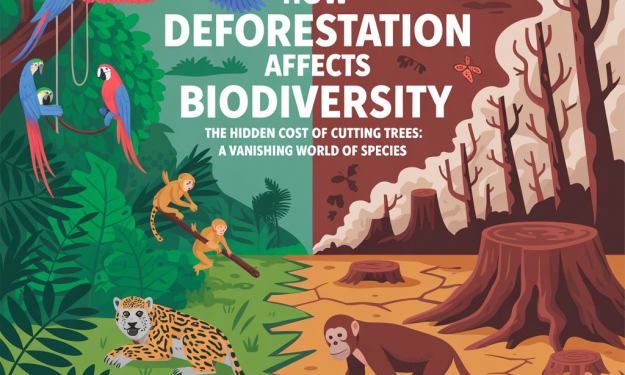
How Deforestation Affects Biodiversity
Introduction Forests are often called the lungs of the Earth, not just because they absorb carbon dioxide and release oxygen, but because they support an extraordinary range of life. From the tropical rainforests of the Amazon to the temperate woodlands of North America, forests are home to more than 80% of terrestrial animals, plants, fungi, and microorganisms. However, this rich biodiversity is under serious threat due to deforestation—a large-scale removal of forested areas, often driven by human activities. As forests disappear, so do the many species that depend on them. Deforestation is not just an environmental issue—it is a biodiversity crisis with far-reaching consequences for ecosystems, climate, and human well-being.
By JAWAD HUSSAINabout a year ago in Earth