Nature
Trending Cultural Events in Europe (August 2025)
A powerful exhibition at Paris’s Institut du Monde Arabe showcases over 5,000 years of Gaza’s rich history. Featuring over 100 artifacts—from Byzantine mosaics to Roman-era statuettes—this show explores Gaza's deep heritage as a crossroads of civilizations. It remains open until November 2, 2025, drawing considerable international attention.
By Muhammad Ibrahimabout a year ago in Earth
The Secret Colors You Can’t See (But Some Animals Can)
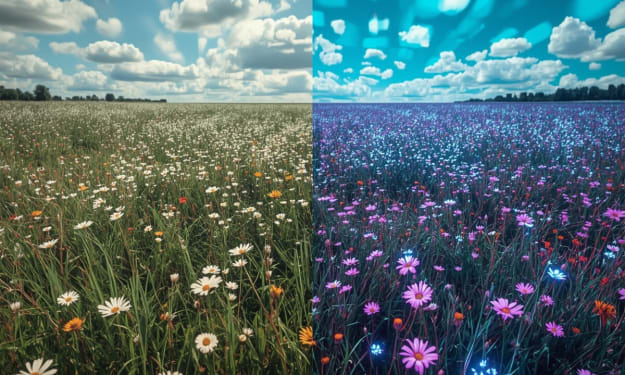
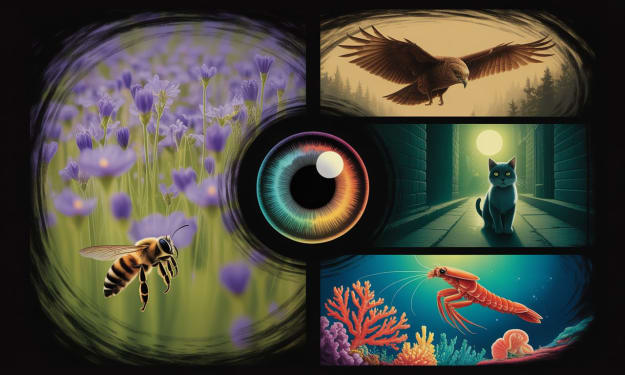
We like to think we see the world as it truly is—vivid, detailed, complete. But the truth is, our eyes only give us a small slice of reality. Hidden all around us are colors we’ll never experience without technology. For many animals, though, these “invisible” colors are part of daily life. Our Narrow Human Window Humans can see a range of light wavelengths from about 380 nanometers (violet) to 700 nanometers (red). This is called the visible spectrum. Anything outside this range—like ultraviolet (UV) or infrared—exists, but our eyes and brains can’t detect it naturally. Our vision evolved around the needs of survival: finding ripe fruit, detecting predators, and recognizing social cues. But in nature, other creatures evolved with completely different priorities, and that changed the colors they see. Ultraviolet: The Hidden Glow of Nature For humans, ultraviolet light is invisible and mostly associated with sunburn. For bees, butterflies, and some birds, UV is a visual superpower. Bees: Many flowers have patterns in ultraviolet that act like landing strips, guiding bees to nectar. These patterns are invisible to us but are essentially neon signs saying, “Food here!” Birds: Some birds’ feathers reflect UV light, revealing patterns that help them recognize mates or rivals. To us, those feathers might just look plain brown. If we could see UV, a garden would look wildly different—flowers would appear with glowing halos and hidden markings, and some animals would seem painted in invisible ink. Infrared: The Heat Map World Infrared light has longer wavelengths than visible red. We can’t see it, but we can feel it as heat. Some animals, however, can literally see heat: Pit Vipers & Pythons: They have specialized heat-sensing pits that detect infrared radiation, helping them hunt warm-blooded prey in complete darkness. Certain Beetles: Some can detect infrared from forest fires miles away, guiding them to freshly burned trees where they lay eggs. If humans could see infrared, we’d notice warm footprints on the ground, the heat of engines, and the glowing outlines of other people—even in the dark. Polarized Light: The Hidden Compass Some animals can’t just see more colors—they can detect patterns in the way light waves vibrate, called polarized light. Mantis Shrimp: Often called the “superheroes of vision,” they have up to 16 types of photoreceptors (we have just 3). They see polarized light and colors far beyond our spectrum. Desert Ants: They navigate by detecting polarized light patterns in the sky, even when the sun is hidden by clouds. For them, the sky contains a map we’ll never naturally see. What We’re Missing—and Why It Matters When we say an animal is “colorful,” we’re judging by human standards. To a bee, a peacock, or a mantis shrimp, that same animal might look unimaginably more vivid—or completely different—because of colors outside our visible range. This matters for more than curiosity. Understanding other animals’ vision helps scientists design better conservation strategies, create new camera technologies, and even develop improved sensors for medical and security purposes. Peeking Beyond Our Limits While we can’t evolve new eyes, technology can give us a glimpse into this hidden world: UV Cameras reveal flower markings and bird feathers we can’t see naturally. Thermal Cameras turn infrared heat into visible colors for hunting, firefighting, or medical imaging. Polarized Light Filters let scientists study animal navigation and vision. These tools remind us that what we see is only a version of reality—not the full picture. The Bigger Perspective Every time we look at the world, we’re seeing just a fraction of its richness. For a bee, the world hums with glowing ultraviolet highways. For a snake, the night is lit with heat signatures. For a mantis shrimp, color is an ocean far deeper than we can imagine. We think of ourselves as the “seeing” species, but in the grand spectrum of light, we’re almost colorblind. The universe is painted in shades we’ll never truly experience—yet knowing they exist is a reminder of how much wonder is still out there, waiting beyond the limits of our eyes.
By Shoaib Afridiabout a year ago in Earth
Through Their Eyes: How Animals See the World
Imagine living in a world where flowers glow with colors you’ve never seen, where night turns bright as day, and where every rustle in the grass sends a silent signal. For humans, vision feels like the ultimate tool for exploring the world—but for animals, sight is an entirely different universe. They don’t just see what we see; they experience reality in ways we can barely imagine.
By Hilal Hussainabout a year ago in Earth
Copenhagen's Heat-and-Harbour Climate Strategy
by Futoshi Tachino In a city built on islands and inlets, the wind off the Øresund smells faintly of salt and cycling grease. Copenhagen’s answer to climate change is not a single icon so much as a choreography: heat the homes with shared pipes, cool the business core with seawater, turn rainstorms into parks, and turn trash into watts—then capture the carbon on the way out. The system hums in buried mains and pump rooms, but its logic is legible on the street.
By Futoshi Tachinoabout a year ago in Earth
Singapore's Water-Linked Climate Strategy
by Futoshi Tachino In equatorial Singapore, the late-afternoon thunderheads pile up like mountains, then dissolve into warm rain that runs from green roofs to canals and finally to the sea. The city’s response to climate change is not a single showpiece but an interlocking loop: cool the homes, power the water, harden the shores, and close the carbon cycle. The hum here is chilled water in buried pipes, biogas in co-digesters, and solar panels riding the reservoir’s skin. The strategy is small-state pragmatism at system scale.
By Futoshi Tachinoabout a year ago in Earth
Point Nemo: The Loneliest Spot on Earth
Point Nemo: The Loneliest Spot on Earth Point Nemo, tucked deep in the South Pacific Ocean, holds a title that very few places can rival—it is the most isolated point on our planet. Officially referred to as the oceanic pole of inaccessibility, this location is the farthest spot from any coastline, lying about 2,687 kilometers (1,670 miles) from the nearest landmasses. These include the coasts of Antarctica to the south, Easter Island to the northeast, and the Pitcairn Islands to the north. Reaching Point Nemo isn’t just a challenge—it’s practically an expedition into one of Earth’s most profound voids.
By Furqan Elahiabout a year ago in Earth