Humanity
Earthquakes and Tsunamis: Causes, Effects, and Preparedness
One of the most destructive natural disasters on Earth is an earthquake. They happen when the world's structural plates move and shift, delivering energy that makes the ground shake. From minor tremors to catastrophic tsunamis, earthquakes can result in massive destruction. We will investigate the potential for tsunamis and the causes and effects of seismic activity on Earth's surface in this essay.
By prabas naidu4 years ago in Earth
The Succor Punch, Radionics, & Chembusting
The Succor Punch & Radionics Radionics is a science that involves the utilization of technologies that use the Schumann Resonance quantum communication system in order to scan, and reinvigorate the bioelectric fields of any person, place, situation, timeline, or thing in the world. It is a science that has been explored for decades and it's validity has been proven in the EU for holistic treatments of all kinds. It can be used to predict the future, increase ESP abilities(telepathy), scan and enhance the bioelectric field, and increase the rate of manifestations exponentially.
By Brother Gaia4 years ago in Earth
Brazil: "A Multicultural Giant with Endless Possibilities"
Brazil is the largest country in South America and the fifth-largest country in the world by both land area and population. It covers over 8.5 million square kilometers and has a population of over 211 million people. The country is known for its rich culture, diverse wildlife, and natural beauty.Brazil is a federal presidential republic, with the President as the head of state and the government. The country's official language is Portuguese, and it is the only Portuguese-speaking country in the Americas. Brazil is also home to several indigenous languages, which are recognized as official languages in certain regions of the country. One of Brazil's most significant cultural contributions is its music, which has influenced genres around the world, including samba, bossa nova, and choro. Brazil is also known for its love of football, and its national team has won five World Cup titles, the most recent being in 2002. Brazil is home to several natural wonders, including the Amazon rainforest, which covers over 60% of the country's land area. The Amazon is the largest tropical rainforest in the world and is home to an estimated 10% of the world's known species of plants, animals, and insects. Brazil is also home to the Iguazu Falls, a series of waterfalls that stretch over 2.7 kilometers and are a UNESCO World Heritage Site.Brazil's economy is one of the largest and most diverse in the world, with a mix of agriculture, manufacturing, and service industries. The country is a leading producer of several commodities, including coffee, soybeans, and beef. Brazil is also home to several multinational corporations, including Petrobras, Vale, and Embraer.
By DINESH KUMAR.C4 years ago in Earth
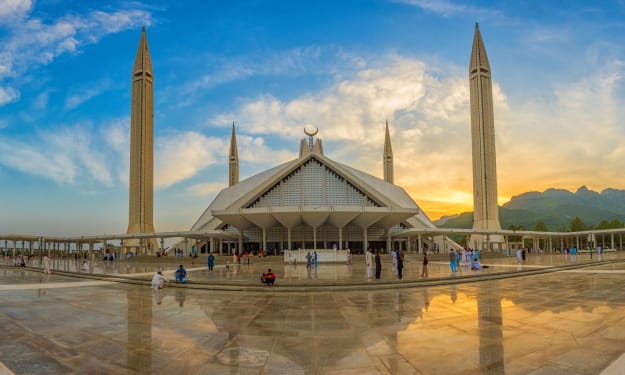
"An Overview of Pakistan"
Pakistan is a country located in South Asia, bordered by India to the east, Afghanistan and Iran to the west, China to the northeast, and the Arabian Sea to the south. It is the world's fifth-most populous country, with a population of over 220 million people. Pakistan gained independence from British colonial rule in 1947, along with India. The country is a federal parliamentary republic with Islamabad as its capital city. Urdu and English are the official languages, although there are many regional languages spoken throughout the country.Pakistan is known for its diverse culture and rich history. The region has been inhabited for thousands of years, and there have been many empires and kingdoms throughout its history, including the Indus Valley Civilization, the Mughal Empire, and the British Raj. Pakistan has a mixed economy, with agriculture being a major sector, along with textiles, manufacturing, and services. The country has a growing middle class, and there has been significant investment in infrastructure and technology in recent years.However, Pakistan faces many challenges, including political instability, terrorism, poverty, and a lack of access to basic services such as healthcare and education. The country also faces environmental challenges such as deforestation, water scarcity, and air pollution.
By DINESH KUMAR.C4 years ago in Earth
Earth Sociology: The Relationship between Human Society and the Natural Environment
Earth sociology is a department of sociology that focuses on the find out about of human social conduct and interactions inside the context of the herbal environment. It examines the methods in which human beings have interaction with every different and with the earth's herbal systems, and how these interactions have an effect on human society as a whole. In this essay, I will discover the key concepts, theories, and lookup that make up the discipline of earth sociology.
By Suresh Patil4 years ago in Earth
"The Future of Artificial Intelligence: Trends and Predictions"
"The Future of Artificial Intelligence: Trends and Predictions" Artificial intelligence (AI) has been around for several decades, but in recent years, it has seen a surge in popularity and adoption. The development of more advanced machine learning algorithms, big data analytics, and cloud computing infrastructure has propelled AI to new heights. In this blog, we will explore the future of AI by discussing some of the latest trends and predictions.
By HIRA SHAHID IQBAL4 years ago in Earth
Pakistan vs India
Introduction India and Pakistan have a long and complicated history of rivalry, dating back to their separation in 1947. This rivalry has resulted in numerous conflicts, including several wars and ongoing tensions over disputed territories such as Kashmir. In this article, we will explore the roots of the India-Pakistan rivalry, the major conflicts that have occurred between the two countries, and the prospects for future peace and cooperation.
By shahnoor sultan 4 years ago in Earth
What is the event horizon of a black hole and what happens when an object crosses it?
Black holes are some of the most fascinating and mysterious objects in the universe. They are formed when massive stars collapse in on themselves, creating a region of space where gravity is so strong that nothing can escape – not even light. At the center of a black hole is a singularity, a point of infinite density where the laws of physics as we know them break down. But what is the event horizon of a black hole, and what happens when an object crosses it?
By Aniket Kumar4 years ago in Earth
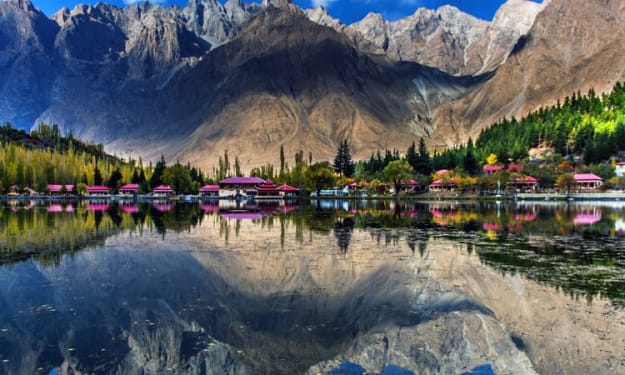
Tourism in Pakistan
Pakistan is a country that is often overlooked as a tourist destination due to its history of political instability and violence. However, in recent years, the country has been making efforts to promote tourism and attract more visitors to its stunning natural landscapes, rich cultural heritage, and historical sites. With a diverse range of attractions, from soaring mountains to bustling cities, Pakistan has much to offer tourists seeking an off-the-beaten-path experience.
By Adnan Afzal4 years ago in Earth
How to start a successful home business in Canada: A comprehensive guide
Starting a home business in Canada can be a great way to achieve financial independence and work-life balance. The internet and technology have made it possible for anyone to start a business from the comfort of their own home. It's a way to pursue your passion, create your own schedule, and be your own boss. However, starting and running a successful home business is not as easy as it sounds. There are many factors to consider, from legal requirements and financial planning to marketing and customer acquisition. In this comprehensive guide, we'll provide you with everything you need to know to start and run a successful home business in Canada. We'll cover topics such as choosing the right business idea, creating a business plan, registering your business, and marketing your products or services. So whether you're looking to start a side hustle or launch a full-time business, read on to learn how to start a successful home business in Canada!
By Wilson Igbasi4 years ago in Earth
Earth planet
Geology of Earth The Earth is approximately 4.5 billion years old and has undergone significant changes over this time. The planet's surface is made up of several layers, including the crust, mantle, and core. The crust is the outermost layer and is made up of solid rock. Beneath the crust is the mantle, which is mostly made up of molten rock called magma. The core is the innermost layer and is divided into two parts: the outer core, which is liquid, and the inner core, which is solid.
By shaked vak4 years ago in Earth