Humanity
7 Wild Creatures I’ve Seen in My Neighborhood
I don’t live in the country, but I don’t live in the city either. Our house is just about half a mile from the nearest freeway, so we have traffic noise. The housing in my neighborhood is mostly manufactured homes that were set here in the 1980s as winter homes for the snow birds from up north, so there’s a little space between us, but not as much as there would be if this were a rural area.
By Suzy Jacobson Cherry3 years ago in Earth
Are psychic abilities real ?
Psychic abilities have long been a topic of controversy and debate among scientists, skeptics, and believers alike. Many people claim to have psychic powers, such as clairvoyance, telepathy, and precognition, while others remain skeptical, citing lack of scientific evidence and possible explanations based on cognitive biases. In this article, we will explore the evidence for and against psychic abilities, examining the scientific research and real-life experiences of individuals who claim to possess these powers.
By Shaun David3 years ago in Earth
Welcome to the Philippines!
If you don't know anything about Asia , the Philippines is like the jolliest of them all. They're just happy fun jolly people and you know what? It's been three years. I'm not taking this anymore. I've been pushed around, I've been threatened , I've been thrown into dungeon, I've been the butt of all the jokes, I'm the Filipino one. This is my time.
By keith singuran3 years ago in Earth
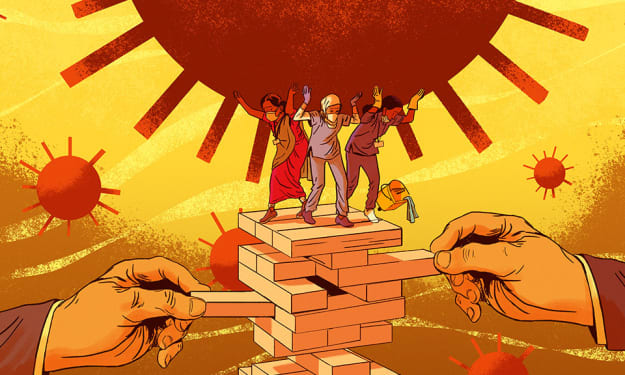
COVID-19 and its impact on society, health, and the economy
Impact on Health The novel coronavirus, or COVID-19, has had a significant impact on human health on a global scale. The virus is believed to have originated in Wuhan, China in late 2019, and quickly spread across the world. Since its emergence, the virus has caused an alarming rate of infections, hospitalizations and mortality.
By Mohamed Abdelaziz3 years ago in Earth
Climate Change
Climate change is an existential threat facing our planet today. It is caused by the accumulation of greenhouse gases (GHGs) in the atmosphere, primarily from the burning of fossil fuels for energy. The effects of climate change are becoming increasingly visible, with rising global temperatures, more frequent and severe natural disasters, and significant impacts on human health, agriculture, and ecosystems.
By Hasnain Khan3 years ago in Earth
The Great Pyramid of Giza in Egypt
Egyptian researchers have discovered two mysterious secret chambers in the Great Pyramid of Giza. The chambers were found thanks to the "Scan Pyramids" project, where researchers used infrared thermography, aerial drones, and laser scanning to non-invasively investigate the inside of structures like the pyramids in Egypt. According to the Scan Pyramids team, they have confirmed the existence of a void hidden behind the North Face, which could have the form of at least one corridor leading inside the Great Pyramid. The exact shape, size, and position of this void are currently under investigation. It remains unknown what researchers might find in these secret rooms.
By DAYO ADEYEMI3 years ago in Earth
"The Future of Work: How Technology is Changing the Job Market"
Technology has been rapidly changing the job market in recent years, and it's not showing any signs of slowing down. With the rise of automation, artificial intelligence (AI), and other technological advancements, the future of work is shaping up to be very different from what we're used to. In this article, we will explore how technology is changing the job market and what this means for the future of work. 1. Automation: One of the most significant ways technology is changing the job market is through automation. Robots and machines are replacing jobs in industries such as manufacturing, transportation, and logistics. This can lead to job losses and displacement for workers in these industries. 2. AI and Machine Learning: Another way technology is changing the job market is through the use of artificial intelligence and machine learning. These technologies are being used to automate tasks and decision-making processes in industries such as finance, healthcare, and customer service. This can lead to increased efficiency and productivity, but it also raises concerns about the potential for job displacement. 3. Remote Work: Technology is also enabling more people to work remotely, which has become increasingly popular in recent years, particularly in the wake of the COVID-19 pandemic. Remote work allows employees to work from anywhere, which can lead to increased flexibility and work-life balance. However, it can also lead to social isolation and communication challenges. 4. Gig Economy: Technology is also changing the way people work by creating new opportunities in the gig economy. Platforms such as Uber, Lyft, and Airbnb have created new ways for people to work and earn money on their own terms. However, these jobs often lack benefits and stability, which can be a challenge for workers. 5. Upskilling and Reskilling: As technology changes the job market, workers will need to develop new skills to stay competitive. This has led to a growing emphasis on upskilling and reskilling programs to help workers adapt to new technologies and job roles. While technology is undoubtedly changing the job market, it's important to remember that it's not all doom and gloom. Technology has the potential to create new opportunities and industries, as well as increase productivity and efficiency. However, it's crucial to address the potential negative impacts, such as job displacement and the gig economy's instability. Governments and companies need to work together to create policies and programs that support workers in the face of technological change. This includes investing in education and training programs, offering benefits and protections for gig economy workers, and creating a social safety net for those who are displaced from their jobs due to automation and other technological advancements. In conclusion, the future of work is changing rapidly due to technology, and it's essential to prepare for this shift. While there will be challenges and disruptions, there will also be opportunities for workers to adapt and thrive in this new landscape. By investing in education, upskilling, and reskilling programs, and creating policies that support workers, we can ensure that the future of work is inclusive, fair, and beneficial for all.
By Balamurugan3 years ago in Earth
The Rise of Cryptocurrency: How It's Changing the Way We Think About Money
Cryptocurrency has taken the financial world by storm in recent years, with many people seeing it as a viable alternative to traditional forms of money. The most well-known cryptocurrency is Bitcoin, which was created in 2009 by an anonymous person or group using the pseudonym Satoshi Nakamoto. Since then, thousands of other cryptocurrencies have been created, each with their own unique features and uses. So, what exactly is cryptocurrency? It is a digital asset that uses encryption techniques to secure and verify transactions and control the creation of new units. Transactions are recorded on a public ledger called a blockchain, which is maintained by a network of users around the world. This decentralization is one of the key features that sets cryptocurrencies apart from traditional forms of money. One of the most significant features of cryptocurrencies is their decentralization. This means that they are not controlled by a central authority, like a bank or government. Instead, transactions are recorded on a public ledger called a blockchain, which is maintained by a network of users around the world. This decentralization gives users more control over their money and can make transactions faster and cheaper. Another feature of cryptocurrencies is that they can be used anonymously. While transactions are recorded on the blockchain, the identity of the user is not. This anonymity can be appealing to some users who want to keep their financial transactions private. Cryptocurrencies use encryption techniques to secure and verify transactions, making them more secure than traditional forms of money. Because of their decentralized nature, it is much harder for hackers to manipulate or steal cryptocurrencies. However, it is still important for users to take precautions, such as storing their cryptocurrencies in a secure wallet and using strong passwords. Because cryptocurrencies are decentralized, they can often be used to make transactions at a lower cost than traditional forms of money. This is because there are no intermediaries involved in the transaction, such as banks or credit card companies, which can charge high fees. Cryptocurrencies can be accessed by anyone with an internet connection, regardless of where they are in the world. This accessibility can be especially beneficial for people who live in countries with unstable currencies or limited access to traditional banking services. Finally, cryptocurrencies have opened up new investment opportunities for people around the world. Because cryptocurrencies are not controlled by a central authority, their value is determined by market demand. This can lead to significant price fluctuations, which can create opportunities for investors to buy and sell cryptocurrencies for a profit. While cryptocurrencies have many potential benefits, they also come with risks. Because they are not regulated by a central authority, there is no protection for users if something goes wrong. For example, if a cryptocurrency exchange is hacked, users may lose their funds with little or no recourse. Additionally, the anonymity that cryptocurrencies offer can be attractive to criminals. Cryptocurrencies have been used to facilitate illegal activities, such as money laundering and drug trafficking. Despite these risks, the rise of cryptocurrencies has opened up new possibilities for the way we think about money. As more people around the world begin to use and invest in cryptocurrencies, it will be interesting to see how they continue to shape the financial landscape. One potential use case for cryptocurrencies is as a means of payment for goods and services. Some businesses are beginning to accept cryptocurrencies as payment, and it is possible that more will follow suit in the future. However, for cryptocurrencies to become a mainstream means of payment, they will need to overcome several hurdles, such as regulatory issues and price volatility. Another potential use case for cryptocurrencies is as a store of value. Some people see cryptocurrencies as a way to protect their wealth from inflation or other economic uncertainties. However, because of their volatility, cryptocurrencies may not be a suitable store of value for everyone. The rise of cryptocurrencies has also spurred the development of blockchain technology, which has potential applications beyond just cryptocurrency. Blockchain is a decentralized database that can
By Balamurugan3 years ago in Earth