Humanity
The Forgotten Land"
Amidst the echoes of silence, Ava walked the desolate streets of the forgotten city. The towering buildings, once symbols of human progress, now stood as weathered remnants of a bygone era. Nature had woven its tapestry of green, claiming what was rightfully its own. The city, once teeming with life, was now a haunting landscape of overgrown vegetation and fading memories.
By Owhiri Kingsley Afoke3 years ago in Earth
The Breathless Earth
In a bustling city, where the sky was once a tapestry of vibrant hues, a cloud of despair had settled. The air was heavy with pollution, choking the lungs of its inhabitants. The city's name was Breathless, and its people struggled for every breath they took.
By Alex Greyson 3 years ago in Earth
The Science Behind Mind-Body Connection
Have you ever wondered how your thoughts can shape your reality? It turns out that there is a fascinating scientific explanation behind the mind-body connection and how our thoughts influence our experiences. The field of neuroscience has uncovered remarkable insights into the power of the mind and how it can shape our perception of the world around us. In this article, we will delve into the science behind the mind-body connection and explore how our thoughts have the ability to shape our reality.
By Joan gobana3 years ago in Earth
The transformative power of nature
Amelia sat alone on the worn wooden bench overlooking the vast expanse of the tranquil meadow. The sun's golden rays bathed her in a warm embrace, but her heart felt cold and heavy. She had been through a difficult time, burdened by the weight of sorrow and loss. Each day felt like a never-ending battle against the darkness that threatened to consume her. Ever since her husband, Thomas, had passed away, Amelia had struggled to find solace and healing. They had shared a deep connection, a love that had transcended time and space. Thomas had been her rock, her guiding light, and without him, she felt adrift in a vast and turbulent sea. Desperate for respite, she turned to the one place that had always held a special meaning in their lives—the great outdoors. On this particular day, Amelia decided to visit their favorite hiking trail in the mountains. As she made her way through the towering trees and listened to the symphony of birdsong, she could feel the weight on her shoulders begin to lift. The air smelled of pine and earth, and the sunlight filtered through the leaves, creating a dappled tapestry of light and shadow. With each step, Amelia allowed herself to become one with nature, shedding the layers of grief that had consumed her. She marveled at the delicate petals of wildflowers that greeted her along the path, their vibrant hues a stark contrast to the darkness she had carried for so long. It was as if the flowers were reaching out, reminding her of the beauty that still existed in the world. Amelia found solace in the rhythm of her footsteps, the steady beat of her heart echoing the pulse of the earth. She reached a clearing, and there, beneath a majestic oak tree, she sank to her knees. Tears streamed down her face, mingling with the soil beneath her, as she released the anguish she had held within. The wind whispered through the branches, a gentle lullaby that enveloped her in its embrace. Amelia closed her eyes and allowed the sounds of nature to wash over her, filling the void left by her husband's absence. It was in that moment of surrender that she felt a presence, a warm and familiar touch on her shoulder. Opening her eyes, Amelia saw a fox standing a few feet away, its golden eyes filled with understanding and compassion. She could almost hear Thomas's voice whispering in the wind, guiding her toward healing. The fox watched her for a moment, as if assessing her spirit, before disappearing into the dense undergrowth. From that day forward, Amelia returned to the mountains whenever she felt the weight of her grief becoming unbearable. Each visit brought her closer to finding peace, as if the mountains themselves held the key to unlocking the shackles that bound her heart. She hiked along winding trails, climbed rocky peaks, and swam in crystal-clear lakes, immersing herself in the vastness and beauty of nature. Amelia discovered that nature had a way of healing even the deepest wounds. The mountains became her sanctuary, a place where she could release her pain and find solace in the quiet strength of the earth. She learned to find beauty in the smallest of details—a butterfly's delicate wings, the shimmering reflection of the moon on a tranquil lake, the sound of raindrops pattering on leaves. As the seasons passed, Amelia began to notice a change within herself. The once-heavy burden of grief had transformed into a gentle ache, a reminder of the love she had shared with Thomas. She no longer felt adrift but rather connected to something greater than herself—a tapestry of life woven together by the forces of nature. One evening, as she watched the sun dip below the horizon, casting a golden glow over the landscape, Amelia whispered words of Climate change is an urgent and global issue that demands both individual and government responsibility. The consequences of climate change are far-reaching, impacting ecosystems, communities, and economies worldwide. To effectively address this challenge, a collective effort is required, with individuals and governments working hand in hand to mitigate and adapt to the changing climate. Individual responsibility plays a crucial role in addressing climate change. Each person has the power to make sustainable choices in their daily lives. By reducing carbon emissions, conserving energy, and adopting environmentally friendly practices, individuals can contribute to mitigating climate change. Simple actions such as using public transportation, practicing energy efficiency, recycling, and supporting renewable energy sources can make a significant impact. Furthermore, individuals have the ability to raise awareness and inspire others to take action. By engaging in discussions, sharing knowledge, and promoting sustainable practices within their communities, individuals can influence a larger societal shift towards a greener future. Education and awareness campaigns can help people understand the urgency of the climate crisis and encourage them to take responsibility for their carbon footprint. However, the magnitude of the climate crisis necessitates strong government action. Governments have the authority and resources to implement policies, regulations, and incentives that can drive systemic change. It is the responsibility of governments to prioritize climate action, invest in renewable energy infrastructure, and set ambitious emission reduction targets. Through legislation, governments can enforce environmental standards, promote sustainable practices, and hold industries accountable for their carbon emissions. Additionally, governments can provide financial support for research and development of clean technologies, incentivize renewable energy adoption, and facilitate international cooperation on climate change. Government responsibility extends beyond national borders. Collaboration between governments is essential to address the global nature of climate change. International agreements, such as the Paris Agreement, provide a framework for nations to work together towards shared climate goals. By participating in these agreements and honoring their commitments, governments can collectively strive for a sustainable and resilient future. It is important to recognize that the responsibility for climate change does not rest solely on the shoulders of individuals or governments. It requires a symbiotic relationship, with individuals holding their governments accountable for taking bold action, and governments providing the necessary tools and support for individuals to make sustainable choices. Ultimately, the fight against climate change necessitates a collective effort that transcends individual and governmental boundaries. It requires a shift in mindset, where sustainability becomes a guiding principle in decision-making at all levels. By embracing this shared responsibility, individuals and governments can work together to safeguard our planet for future generations, ensuring a sustainable and livable future for all. Start writing...
By Precious Chiagozigom Amadi 3 years ago in Earth
African Countries Blame Everyone Except Poor Leadership & Corruption For Deforestation & Used Clothing Dumping
Thursday, 15 June 2023 By: TB Obwoge Most Americans or Westerners donate clothing NOT thinking it'll be resold for high prices on a continent away from their homes. Nor would they imagine that they're clothing would fill African landfills, choking the life out of African citizens.
By IwriteMywrongs3 years ago in Earth
How Wars Contribute to Climate Change and Pollution
Warfare and armed conflict have significant impacts on the environment and climate. Military activities release greenhouse gases and air pollutants, damage ecosystems, and contaminate land and water resources. The environmental consequences of war include short-term and long-term effects that undermine sustainable development and a clean environment.
By zayed Sultan3 years ago in Earth
Our Indifference to the Environment is a Threat to our Existence
As I walked towards the beach, I couldn't help but feel a sense of sadness and despair building up inside me. The once beautiful scenery of blue waves crashing against the shore was now replaced with a nauseating sight of waste scattered all over the sand.
By Agunna Chukwuma 3 years ago in Earth
The Last Oasis
In the year 2150, the world had succumbed to the devastating effects of climate change and environmental destruction. The once vibrant and flourishing planet was now a barren wasteland, with cities in ruins and nature pushed to the brink of extinction. Humanity's relentless pursuit of progress had led to its own downfall. Amidst the chaos, a young woman named Maya clung to hope. She had heard tales of a mythical place known as the Last Oasis, a sanctuary untouched by pollution and destruction. Determined to find this beacon of hope, Maya embarked on a treacherous journey across the desolate wastelands. Equipped with a worn-out map passed down through generations, Maya set off alone, her heart fueled by a deep longing for a restored world. She navigated through dry, cracked earth and climbed over decaying ruins, the remnants of civilizations that had fallen. Days turned into weeks as Maya pressed on, encountering remnants of wildlife struggling to survive. She witnessed the heartbreaking sight of once-majestic forests reduced to charred stumps, and rivers reduced to trickling streams choked with pollution. The sight of a dying world only fueled her determination further. In her solitary travels, Maya stumbled upon other survivors. There was Jack, a weathered old man who had lost his family to the unforgiving elements, and Layla, a young scientist who carried with her a glimmer of hope in the form of seeds resistant to the harsh conditions. Together, they formed an unlikely alliance, united by their shared vision of a restored planet. As they ventured deeper into the wasteland, they faced numerous challenges. Harsh sandstorms threatened to bury them alive, and mutated creatures lurked in the shadows, remnants of nature's desperate attempts to adapt. Yet, Maya and her companions pressed on, their resilience unyielding. Their journey was not just physical; it was a spiritual quest, an awakening of humanity's intrinsic connection to nature. They rediscovered the value of clean air, the beauty of a clear sky, and the importance of every living creature. With each step, Maya felt the weight of responsibility on her shoulders, a duty to protect and preserve what little was left. Finally, after months of perseverance, they caught a glimpse of the Last Oasis. A shimmering expanse of untouched land stretched out before them, an oasis teeming with life and possibilities. The sight was breathtaking, tears of joy mingling with the sweat on Maya's face. But the Last Oasis was not just a place of refuge; it was a symbol of hope and renewal. Maya knew that their journey had only just begun. Together, they would work tirelessly to restore balance and heal the scars of the planet. They would educate others, urging them to learn from the mistakes of the past and embrace a sustainable future. News of the Last Oasis spread like wildfire, reigniting a spark of hope in the hearts of the scattered survivors. Maya and her companions became beacons of inspiration, leading a movement of change. As more people joined their cause, the Last Oasis expanded, gradually transforming the surrounding wasteland into pockets of green, thriving with life. Years passed, and the Last Oasis grew into a sanctuary, a testament to the resilience of humanity and the power of unity. The world had not fully recovered, but the journey had begun. Maya's determination and unwavering belief in the connection between humanity and nature had sparked a revolution, one that would define the future of their species. "The Last Oasis" became more than just a place; it became a state of mind—a reminder that even in the face of immense adversity, hope and resilience could overcome. Maya's journey had shown that it was never too late to change, to make amends for past mistakes, and to build a sustainable future.
By Gideon Gbadero 3 years ago in Earth
Harnessing Renewable Energy for Sustainable Power
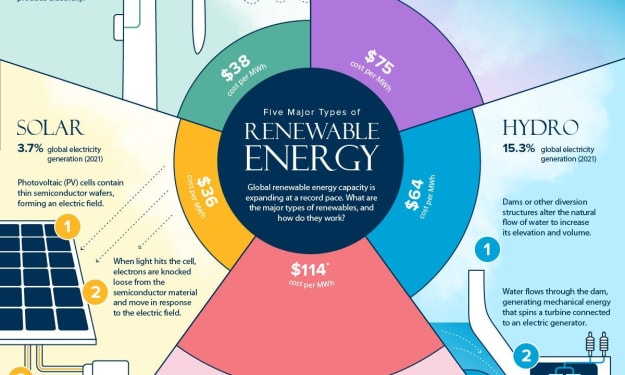
In an era where sustainable energy sources are becoming increasingly vital, the Ultimate Energizer provides an innovative solution to harness renewable energy. This comprehensive guide explores the concept of the Ultimate Energizer, a device designed to generate power through renewable sources such as solar and wind energy. By utilizing simple components and principles, this system offers an affordable and efficient way to produce clean energy, reduce reliance on the grid, and enhance sustainability efforts. This article delves into the functionality, benefits, and steps involved in creating the Ultimate Energizer, enabling individuals and communities to embrace a greener future.
By Faridah Khakayi3 years ago in Earth
Sustainable Living
Sustainable living refers to a lifestyle that minimizes our negative impact on the environment and promotes a harmonious coexistence with nature. It involves adopting eco-friendly practices and initiatives that are aimed at reducing waste, conserving resources, and protecting the planet for future generations. In this detailed and lengthy explanation, we will explore various aspects of sustainable living and delve into specific practices and initiatives that can be implemented.
By Arowoshere Joy3 years ago in Earth
The Rise of Artificial Intelligence. Content Warning.
Artificial Intelligence (AI) has emerged as a transformative force, revolutionizing industries and reshaping the world as we know it. With advancements in machine learning, deep learning, and neural networks, AI technologies are becoming increasingly sophisticated, capable of performing complex tasks and mimicking human intelligence. In this article, we will explore the rise of artificial intelligence, its impact across various sectors, and its implications for the future.
By Levente Gyüre3 years ago in Earth
The Future Unveiled. Content Warning.
The future holds a realm of endless possibilities, where advancements in technology, evolving societal dynamics, and the pursuit of innovation converge. In this article, we embark on a journey to envision what lies ahead and examine the potential impacts and challenges that await us in the future.
By Levente Gyüre3 years ago in Earth