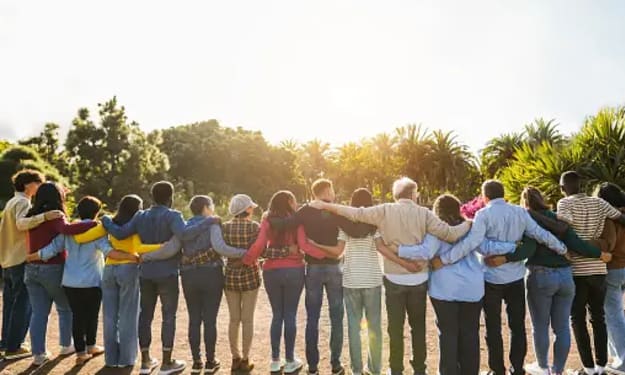
Humanity
Embracing Diversity: Shaping Tomorrow's Workplace with Every Voice
Chapter 1: A Vision of Tomorrow In today's ever-evolving workplaces, diversity isn't just a buzzword – it's the heartbeat of innovation and success. Imagine a workplace where professionals, much like Jackie, yearn for an environment that understands the power of diversity. This shared vision propels us towards a future where each day offers an opportunity to contribute to a workplace culture that defies convention and celebrates individual perspectives.
By Jackline Ojwang3 years ago in Earth
Environmental change
Environmental Change is the characterizing issue within recent memory and we are at a pivotal occasion. From moving weather conditions that undermine food creation, to rising ocean levels that increment the gamble of disastrous flooding, the effects of environmental change are worldwide in scope and extraordinary in scale. Without uncommon activity today, adjusting to these effects later on will be more troublesome and exorbitant. Environmental change alludes to long haul shifts in temperatures and weather conditions. Such moves can be normal, because of changes in the sun's action or enormous volcanic emissions. However, since the 1800s, human exercises have been the fundamental driver of environmental change, principally because of the consuming of non-renewable energy sources like coal, oil and gas.
By Madukaife Samuel 3 years ago in Earth
Biography of Europe.
Europe is a continent located entirely in the Northern Hemisphere and mostly in the Eastern Hemisphere. It is bordered by the Arctic Ocean to the north, the Atlantic Ocean to the west, the Mediterranean Sea to the south, and Asia to the east. Europe is the second-smallest continent by surface area, covering about 10.18 million square kilometers, and the third-most populous continent, with over 700 million people.
By Ayuba Maikudi Bawa3 years ago in Earth
Civilization unveiled
Within the vast expanse of our historical tapestry lies an epic saga of transformation and ingenuity, marking the birth of civilization. Envision the fertile crescents of ancient lands, where the first seeds of agriculture were sown, forever altering the human saga. This journey unfolds from the dawn of humanity, where our ancestors roamed as nomads under open skies, to the awe-inspiring emergence of the first great empires. These empires, with their grandeur and complexity, transcended mere political phenomena; they were crucibles of cultural and technological advancements, molding the very essence of human identity and community. This is a tale of how scattered tribes, bound by the necessity of survival, transcended their nomadic existence to lay down the roots of organized communities. Prepare to embark on a captivating voyage to witness our exceptional journey, joining us for the rise of civilizations. In the early stages, humans were primarily nomadic, constantly moving in search of food, crucial for survival. These small, mobile groups, often extended family units, maintained a close-knit social structure. Their subsistence depended on hunting animals and gathering wild plants, fruits, nuts, and seeds, adapting to varied diets based on region and season. Using stone tools for hunting and butchering, these tools evolved over time, becoming more sophisticated. Social structures were likely egalitarian, with no rigid hierarchies, relying on cooperation and resource sharing for survival. Artistic expression, evident in cave paintings and small sculptural objects, hinted at rich cultural lives and early religious beliefs. Shelters were temporary, often simple constructions, and clothing made from animal skins was essential, especially in colder climates. Early humans showcased adaptability, occupying diverse environments from African savannas to Arctic conditions. The control of fire became a significant milestone, providing warmth, protection, and a means to cook food, enhancing digestibility and safety. During the Paleolithic era, humans faced ice ages, adapting to changing climates and landscapes. Around 12,000 years ago, as the last ice age receded, stable and warmer climates ushered in an abundance of plant and animal life, notably in the Fertile Crescent. Growing populations led hunter-gatherer groups to experiment with the cultivation of wild grains, marking the beginning of the Neolithic Revolution. This shift to deliberate farming fundamentally changed human interaction with the environment, offering a reliable food supply and enabling permanent settlements. With the domestication of animals like goats and sheep, communities became more self-sufficient, fostering the development of complex social structures. The Fertile Crescent, often regarded as the cradle of civilization, witnessed early developments in agriculture and permanent settlements. Advancements in farming techniques allowed communities to produce surplus food, paving the way for specialization in professions such as pottery, weaving, and toolmaking. This surplus also facilitated the emergence of trade networks and the exchange of goods and services. With increased economic and social complexity, the need for organization and governance arose, giving rise to social hierarchies and leaders managing resources, laws, and public works. As settlements grew, organized urban planning became necessary, leading to the development of infrastructure like roads, markets, temples, and storage facilities. Metallurgy, the manipulation of metals, marked a groundbreaking development, with copper being initially used in its natural metallic state during the Copper Age around 5,000 BC. Subsequent ages, such as the Bronze Age and Iron Age, brought about the evolution of metalworking and its applications in agriculture and military technology. The invention of writing systems, such as cuneiform in Mesopotamia and hieroglyphics in Egypt, around 3,500 BC, played a pivotal role in the documentation and preservation of information beyond oral traditions. Mesopotamian cuneiform evolved into a complex writing system used for legal codes, trade records, and literary works, influencing the administration and cultural development of ancient societies. Similarly, Egyptian hieroglyphics contributed significantly to the governance, religious life, and intellectual progress of their civilization. The invention of the wheel around 3,500 BC revolutionized transportation and trade, facilitating the movement of goods and people over greater distances with less effort. The development of the plow, particularly when coupled with animal power, transformed agriculture, leading to more efficient tilling of land and increased crop yields. As human societies evolved and became more complex, conflicts also transformed, reflecting the burgeoning complexities of organized communities. In ancient Mesopotamia, city-states engaged in warfare primarily over vital resources like fertile land and water, essential for their agrarian-based economies. Defensive measures, such as walls around cities like Jericho, indicate early concerns for territorial security. The Akkadian Empire, founded by Sargon of Akkad around 2300 BC, marked the first instance of empire-building in recorded history. Sargon's conquests unified a vast region under a centralized authority, setting a precedent for future empires in terms of scale and governance. The Akkadian Empire introduced new levels of social and administrative complexity, including the use of a standardized language for administration and the implementation of a more sophisticated bureaucracy. As civilizations rose and fell, leaving lasting legacies through structures like the Colosseum, the Hanging Gardens, and the Great Wall, the essence of civilization lies not just in grandiose achievements but in the daily lives of ordinary people. Farmers, weavers, and storytellers form the backbone of communities, shaping the foundations of civilization. As we look forward, facing a world interconnected by technology, we carry the lessons of history with us. Recognizing the importance of learning from past mistakes, celebrating diverse cultures, and using technology to improve lives, our future should focus on knowledge, empathy, and sustainable innovation. In this ongoing story of civilization, we are not just inheritors but active participants tasked with creating a future that honors our past while embracing unity and progress. We have the opportunity to write a new chapter, one that emphasizes harmony and collective well-being, continuing the journey that began millennia ago.
By Abdulmalik Habib3 years ago in Earth
Green-Tech Marvels:
In a world where environmental concerns take center stage, green technologies emerge as the superheroes of our time, championing the cause of a more sustainable future. This article will spotlight cutting-edge innovations that are paving the way for an eco-friendly revolution, providing real-world examples of how these marvels are reshaping our world.
By Kaoset_lay3 years ago in Earth
A landscape architect designs a garden using drought-resistant plants, bringing life to an arid cityscape.
introduction Lila Hayes, a landscape architect, lived in the scorching metropolis of Eldoria, where the unrelenting heat created a shimmering cloud over every building. Her ambition felt too lofty for the parched reality that was all around her. Drought had destroyed the once-thriving metropolis, and its people—who had previously been lively and sociable—moved through the streets like shadows, their hopes dashed by the unforgiving weather.
By VINCENT HATEGEKIMANA3 years ago in Earth
story about characters who rediscover their connection to the environment and the positive impact it has on their lives.
Nina's life had become a relentless pursuit of success in the city. The constant buzz of urban life and the relentless demands of her job left her drained and detached. Yet, buried deep within her was a memory—a childhood spent near a bubbling brook that whispered secrets only nature could understand.
By bukola shittabey3 years ago in Earth
Silent Suffering: The Heartbreaking Symphony of Deforestation and Climate Change"
**"Silent Suffering: The Heartbreaking Symphony of Deforestation and Climate Change"** In a world where the rhythmic hum of nature once played harmoniously, the haunting melody of deforestation has emerged as a tearful dirge, resonating across continents. The role of deforestation in climate change has cast a shadow over our planet, leaving behind a poignant tale of environmental loss and human impact.
By Joseph Wangeci3 years ago in Earth
Culture
Certainly # Culture: A Comprehensive Exploration Culture is a multifaceted concept that encompasses the beliefs, values, customs, behaviors, and artifacts shared by a group of people. It is a lens through which individuals perceive the world, shaping their identities and influencing the structures of societies. The richness of human existence is found in the diverse tapestry of cultures that have evolved over centuries. This exploration will delve into the essence of culture, examining its components and the myriad types of cultures that exist globally.
By Akerele Emmanuel3 years ago in Earth
Climate change
Climate change is a pressing global issue that demands immediate attention and concerted action. The Earth's climate is undergoing significant alterations primarily due to human activities such as the burning of fossil fuels, deforestation, and industrial processes. The consequences of climate change are widespread and impactful, affecting ecosystems, weather patterns, and the overall well-being of the planet.
By Akerele Emmanuel3 years ago in Earth