Humanity
A Tale of Science and Humanity
In the vast expanse of the cosmos, amidst the swirling galaxies and shimmering stars, there exists a tiny blue jewel—Earth. It is a planet teeming with life, a harmonious symphony of ecosystems, each playing its unique part in the grand orchestration of existence.
By Clement Boabeng3 years ago in Earth
A valley without snow in January
Valley In the heart of the rugged mountains, lies a beautiful valley name as Kashmir in which it was unfortunate that the valley did not receive any snow during the month of January. While the rest of the world was covered in snow, this mystical place was untouched by the ice grip of winter. The month of January, with its bitter winter and cold scenery, had no effect on the valley. Instead, it crashed into a perpetual spring, a haven of warmth and vibrant life.
By Mind writer3 years ago in Earth
The Success and perils of short-sighted exploitation
In the vast tapestry of human history, few substances have left as indelible a mark as crude oil. Its discovery in the 19th century sparked a revolution in energy, propelling nations into an era of unprecedented industrialization and prosperity. From powering factories to propelling vehicles, oil became the lifeblood of economies, transforming societies, and lifting millions out of poverty. Yet, beneath its surface of progress, crude oil's story is one of contradictions and complexities that have shaped modern civilization in profound ways.
By Christopher Ezeh3 years ago in Earth
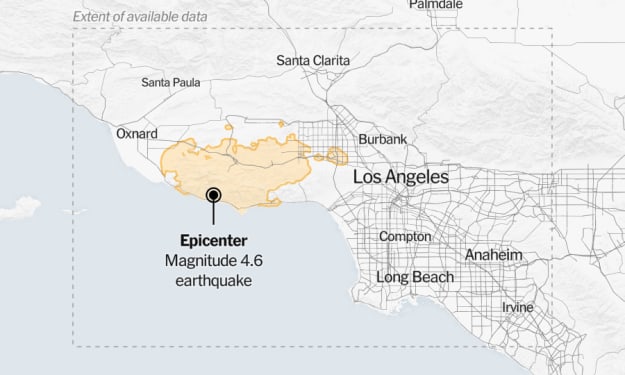
4.6-Magnitude Earthquake Strikes Southern California
An earthquake centered several miles northwest of Malibu, Calif., rattled residents across the Los Angeles area on Friday afternoon, sparking a typical flurry of posts on social media, though the authorities said no major damage or injuries had been reported.
By brownleatherjacket3 years ago in Earth
Your Brain on Coronavirus
Bear with me here, folks, I’m writing this amid the throws of COVID. I noticed an incredible decrease in my cognitive ability over the past few days. As the fevers hit I became rather easily confused, often disoriented, and less cognitively capable than usual. Now, at [what I’m hoping is] the tail end of this bout of illness, I became curious about what exactly happened to my brain over the last week, and if this sort of symptom is common amongst others who have experienced coronavirus. I investigated my brain on COVID while dealing with COVID-brain. Here’s what I found:
By Olivia L. Dobbs3 years ago in Earth
The Silent Sufferers
In the heart of the Amazon rainforest, where the lush green canopy stretches endlessly, lies a hidden world teeming with life. Among the towering trees and winding rivers, there exists a delicate balance that sustains an wonderful and lovely web of life. But beneath the serene front, a silent tragedy unfolds—one that threatens to unravel the very fabric of this biodiverse paradise.
By ikechukwu ndukwe3 years ago in Earth
Echoes of the Marsh
In the heart of the Louisiana bayou, where the lush greenery merges with the murky waters, the Fontenot family has lived for generations. For them, the marsh isn't just land; it's a sanctuary that echoes with the whispers of their ancestors. But as the relentless march of climate change encroaches upon their home, the Fontenots face an agonizing decision: to stay and fight or to leave and preserve what little they have left.
By ikechukwu ndukwe3 years ago in Earth
Effects of cellphones on the bones
What if cellphones were so powerful that they could mutate the shape of our bones? This is a surprising new topic that's recently been popping up all over the media. It stems from a scientific report that suggests using phones and tablets can cause serious and long-lasting changes to our bodies and not in a way that you might think. In the past few years a study has been carried out by David Shahar and mark sayers who specialized in biomechanics at Australia's University of the Sunshine Coast biomechanics, looks at how mechanical laws apply to living organisms from how humans run to how insects beat their wings. Shahar and sayers study also involves osteo biography this is used to work out what someone's life was like from their bones. It's been known for some time that skeletons adapt to a person's lifestyle. Every set of bones tells a story, for example some unusually large skeletons were found on the Pacific island of Tinian in 1924. Stone structures in the vicinity of the skeletons explained the substantial nature of the islands bones by working with heavy stones, they had naturally developed bigger arms, legs and collarbones . In Australia, Shaw heart and sayers believe that modern tech is shaping young people's skeletons. How is it doing this? It's all to do with something called an EOP or external occipital protuberance. Some experts and commentators have been more colorful and described it as foam ball or a devil like horn. In reality, the EOP is a growth of bone found in the back of the skull. It's connected to the nuchal ligament which is an important ligament that plays a role in connecting Nick muscles to the skull. EOP creates an effect a lot like an anchor at the top of the nuchal ligament. With regards to what the researchers were actually doing with the study in the first place, by looking at chiropractors x-rays of people aged between 18 to 86 they wanted to get an up-to-date insight into how skeletons change, because a lot of these x-rays were investigating things like neck pains. There's also elements of what consequences these changes may have on our health Shahar and sayers noticed that in young people the EOP appeared to be more widespread from this they hypothesized that young people's posture while constantly checking their phones and tablets was a major factor. During screen time, the neck instinctively cranks forward. The theory is that by craning forward extra pressure is put on the area where sculpt me muzzle to compensate the EOP gets gradually longer growing to around several millimetres. The effect was also referred to as the text neck. The findings also revealed that it was mostly found in men in 2016 Shah Harden sayers reported a bigger EOP, and 67% of men compared to 20% of women based on a test group of 218 people. By 2018 they had looked at 1200 people with males appearing to be 5 times more likely to get these large texts necks . What is the potential impact on humanity? we hear a lot about the radiation from phones potentially linked to cancer but can using a mobile device actually create significant health problems in the body? This new report has opened up the debates on this topic since it's the first case where experts are explicitly pointing out how tech is affecting our bodies Shahar & sayers described the elongated EOPS as a degenerative process implying things are only going to get much worse for young people if they keep using their devices. There is also something called text thumb or thumb arthritis where thumb can develop serious problems similar to the dreaded carpal tunnel syndrome. However, the study of EOPS and referring to them as horns with spikes has been criticized by others in the press. Experts point out that the report is not conclusive and like any scientific paper it makes assumptions. Archeologists will tell you that longer skull bones are nothing new and that there are especially common in males. The general view according to the studies critics is that, there simply isn't enough hard evidence to back up the claim that you are actually turning into Hell-boy by using your cell phones. So are Shahar and sayers on to something or have they simply taken along established facts and fitted them into their own explanation? either way there's no denying the dramatic impact that technology has on our lives. The idea that upcoming generations are changing due to constant interaction with their devices is really a serious issue that needs to be addressed ultimately. It will be the archaeologists of the future that make that call maybe.
By Prince Akoto3 years ago in Earth
Bats: Masters of Flight, Resilient to Viruses, and Potential Medical Marvels
In a world where bats are often associated with deadly diseases, a closer look reveals their extraordinary resilience and unique physiology. Bats, the only mammals capable of flight, have evolved remarkable features in their immune systems and physiology that allow them to tolerate extreme stressors associated with flying.
By Christopher Ezeh3 years ago in Earth
The Unseen Symphony - When Climate Emotions Echoed Across the World
Once upon a time, in a world plagued by climate change, the emotional impact of environmental degradation reverberated through the hearts of people from every corner of the globe. The story I am about to tell is one of resilience, hope, and the profound connection between the climate and human emotion.
By Yusuf Taye3 years ago in Earth