Humanity
Earth has warmed considerably more quickly over the last 15 years, according to new analysis.
The Earth's temperature has been rising for decades due to global warming. However, recent studies indicate that during the previous ten years, the rate of warming may have accelerated.
By Francis Dami7 months ago in Earth
President Trump Calls Putin to Discuss Ending the Wars in Iran and Ukraine
Introduction In a significant diplomatic move, U.S. President Donald Trump recently held a phone conversation with Russian President Vladimir Putin to discuss ongoing conflicts in the Middle East and Eastern Europe. The call focused on the war involving Iran and the prolonged Russia-Ukraine conflict, both of which have raised global concerns about stability, security, and economic consequences. The conversation highlights growing international pressure to find peaceful solutions to these major conflicts.
By shaoor afridi7 months ago in Earth
Heavy Snow Warning: When Winter Turns Dangerous Overnight
A quiet winter evening can quickly turn into something far more serious. The sky grows darker, the wind sharpens, and snow begins falling faster than anyone expected. What starts as a peaceful snowfall can suddenly lead to closed roads, power outages, and difficult travel conditions. This is when a heavy snow warning becomes more than just a weather alert. It becomes a signal that daily life may soon slow down or even stop. For many communities, these warnings bring both beauty and concern. Snow can cover the world in silence, but it can also create dangerous conditions if people are not prepared. Understanding what a heavy snow warning means and how it affects daily life can help individuals and families stay safe when winter becomes unpredictable.
By Muqadas khan7 months ago in Earth
Could World War III Be Coming Soon?
The idea of World War III often appears in news discussions, political debates, and public imagination. After the devastating impact of World War I and World War II, humanity has become deeply aware of the catastrophic consequences of global war. Today, when international tensions rise, many people wonder whether the world could again face a conflict on such a massive scale. While no one can predict the future with certainty, understanding the current global situation can help us evaluate whether a third world war is truly likely.
By shaoor afridi7 months ago in Earth
Sacred Words in a City of War
The night sky over the Gaza City was never truly dark anymore. Even after sunset, the horizon glowed faintly with the light of distant fires and explosions. Buildings that once held families, laughter, and ordinary life had become broken shadows of concrete and dust.
By Truth words 7 months ago in Earth
War:
War: The Art of Never Growing Up There is something deeply strange about war. It isn’t strange in the sense that it surprises us, we have normalized it far too effectively for that. Rather, it is strange in the way something feels instinctively "wrong" even after thousands of years of repetition. It feels like an evolutionary glitch, a behavior that doesn’t quite belong to the world we claim to be building.
By Rick Angulo7 months ago in Earth
The Trump Doctrine 2026: Redefining Global Trade and Geopolitics
As of March 2026, the international community finds itself navigating a seismic shift in global governance. The return of Donald Trump to the White House has introduced a "Peace through Strength" doctrine and a radical "America First" economic agenda that has disrupted decades of established diplomatic norms. From sweeping trade barriers to aggressive geopolitical maneuvering, the "Trump Effect" is the defining narrative of the mid-2020s. 1. The Great Tariff Wall: A 15% Global Shift The cornerstone of the administration’s 2026 agenda is the implementation of a 15% universal baseline tariff on nearly all imported goods. This policy represents the most significant shift in American trade history since the early 20th century. The Objective: The administration argues that these tariffs are essential to "onshore" manufacturing, reduce reliance on foreign adversaries (particularly China), and generate massive federal revenue to potentially replace domestic income taxes. Market Volatility: Global markets have reacted with high sensitivity. While American industrial stocks have seen a localized surge, multinational corporations are grappling with supply chain disruptions. Retaliation Fears: Trading partners in the European Union and the BRICS bloc have threatened reciprocal measures, leading economists to warn of a synchronized global trade war that could redefine the cost of consumer goods worldwide. 2. Geopolitics: Maximum Pressure 2.0 In the Middle East, the Trump administration has doubled down on its "Maximum Pressure" campaign against Iran. Following the recent reports of the death of Iran's Supreme Leader and the subsequent power vacuum, the U.S. has taken a definitive stance. Stifling the Oil Flow: By tightening sanctions to unprecedented levels, the U.S. aims to decouple Iran from the global energy market, seeking to neutralize its regional influence. The Abraham Accords Expansion: Simultaneously, the White House is pushing for a historic normalization deal between Israel and Saudi Arabia. This "Grand Bargain" is intended to create a unified security and economic bloc to stabilize the region without direct U.S. military entanglements. 3. Cultural Diplomacy and the Indo-Pacific Axis A surprising trend this March was the President’s widespread Holi outreach. By celebrating the Indian "Festival of Colors" and framing it as a victory of "good over evil," the administration has signaled a strategic deepening of the U.S.-India partnership. This is more than just cultural politeness; it is a calculated geopolitical move. By aligning closely with New Delhi, the U.S. seeks to create a formidable democratic counter-balance to China’s influence in the Indo-Pacific region, securing vital shipping lanes and technology partnerships. 4. Domestic Efficiency: The DOGE Initiative Internally, the Department of Government Efficiency (DOGE), led by high-profile figures like Elon Musk, continues to dominate the headlines. The mission to "slash the bureaucracy" has led to: Massive Deregulation: A rapid dismantling of federal oversight in the energy and tech sectors. The "Drill, Baby, Drill" Revival: By greenlighting massive domestic oil and gas projects, the U.S. has become the world’s leading energy exporter, lowering domestic prices but drawing sharp criticism from climate advocates. 5. The Future of Global Alliances The Trump Doctrine of 2026 has forced both allies and rivals to rethink their positions. Organizations like NATO and the UN are being pressured to reform or face decreased U.S. funding. The world is moving toward a bi-polar or multi-polar system, where bilateral deals are prioritized over multilateral treaties. Conclusion The Trump administration’s policies in 2026 are characterized by a rejection of the globalist status quo. Whether through the 15% tariff or "Maximum Pressure" diplomacy, the goal is a total re-centering of the global order with American interests as the sole North Star. As the year progresses, the success of this doctrine will depend on whether the global economy can absorb these shocks or if the friction will lead to a broader international crisis.
By Arafat Rahman7 months ago in Earth
San Francisco Food Banks: How Community Support Fights Hunger
San Francisco is a city filled with innovation, opportunity, and diverse communities, yet thousands of residents still struggle to secure enough nutritious food for their families. Rising living costs, fluctuating wages, and ongoing economic pressures make food insecurity a daily reality for many households. Food banks serve as an essential lifeline by providing access to healthy groceries, community resources, and supportive programs.
By Jason Pruet7 months ago in Earth
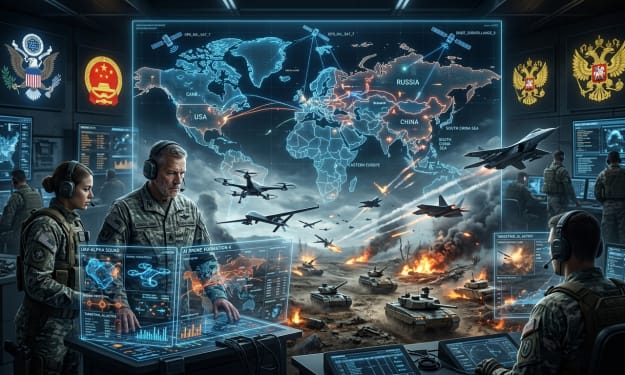
The Rise of Military Artificial Intelligence
The Rise of Military Artificial Intelligence In today’s rapidly changing world, one of the most important developments in global affairs is the rise of Artificial Intelligence in military systems. Many powerful countries are investing billions of dollars into AI technology to strengthen their defense capabilities and gain strategic advantages over their rivals. This new technological race is not only changing how wars are fought, but it is also reshaping the balance of global power.
By Wings of Time 7 months ago in Earth