Humanity
Chasing the storms . AI-Generated.
The wind howled a mournful song, tearing at the rickety shutters of Amelia's cottage perched precariously on the edge of the world. The sea, normally a serene canvas of turquoise and sapphire, churned with a fury that sent spray high enough to lick the porch roof. Inside, Amelia huddled by the fireplace, the flickering flames casting dancing shadows on the weathered walls. Her weathered hands, calloused from years of battling the elements, held a mug of steaming tea, a meager comfort against the storm raging outside.
By Luna Nightshade2 years ago in Earth
Flood
Flooding, a catastrophic event that has happened over the entire course of time, affects the climate. While floods can be essential for regular environment cycles, human-actuated changes, including urbanization and environmental change, have strengthened their effect. This exposition investigates how flooding harms the climate, taking into account different factors like environment annihilation, water contamination, soil corruption, biodiversity misfortune, and the drawn-out results of these effects on biological systems and human social orders.
By nadia khanom2 years ago in Earth
We Just Had the Hottest Summer on Record in the Northern Hemisphere
Los Angeles isn’t exactly known for its mild summers. Growing up in The Valley (San Fernando), those fateful months of every childhood year were spent hiding in neighborhood pools, running through summer camp sprinklers, and sitting in the back of minivans in bumper-to-bumper traffic trekking towards sandy shores along the coast. As a young kid, I lamented the thermostat reporting a balmy 90° Fahrenheit ( 32° C) day — or god-forbid the temperature climbed up to 100° F (38° C).
By Olivia L. Dobbs2 years ago in Earth
Reverberations of the Past
The unassuming community of Maplewood lay calm under a sweeping of harvest time leaves, their energetic varieties an unmistakable difference to the dim weight that loomed over Sarah's heart. It had been a half year since the mishap that guaranteed her more youthful sibling, Ethan, and each side of the town felt tormented by recollections of him. She might in any case hear his chuckling in the stirring leaves, see his splendid grin in the blurring daylight, and experience the glow of his presence in the cool wind.
By Ananta Kumar Dhar2 years ago in Earth
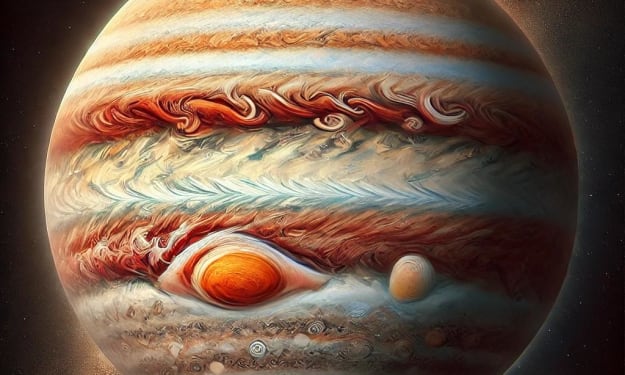
Jupiter The King of Planets . AI-Generated.
**Jupiter: The King of Planets** Jupiter, the largest planet in our solar system, is often referred to as the "King of Planets." With its immense size, powerful magnetic field, and vibrant cloud formations, it stands as one of the most fascinating celestial bodies.
By Antea Lumina Kala Matylda 2 years ago in Earth
As The World Burn
Cassandra, daughter of the King and Queen of Troy, knew that if her brother Paris went to Sparta and came back with Queen Helen, the destruction of Troy would follow. Cassandra had the gift of prophecy bestowed upon her by Apollo, but because she refused to give herself to the god, he added this curse: No one would believe her. Thousands of years separate us from this story. But dire prophecy, deeply rooted in truth, is staring us in the face. Like the ancient Trojans, we refuse to take action. The arrival of New York Climate Week that coincides each year with the gathering of global leaders for the UN General Assembly meetings must inspire us to do just that. Until recently, a stable climate persisted through the past ten thousand years of Earth’s history, enabling human economies and the civilizations that depend on them to flourish and grow. The integrity of nature, in all its complexity, provided this “Goldilocks” period – nestled comfortably between too cold and too hot — for humanity to thrive. But in recent decades, we’ve eroded nature’s integrity and exceeded its capacity to absorb the ever-increasing stresses we’ve thrown at it. Years ago, climate scientists saw the approach of the days of reckoning we are living through. They warned us—in thousands of pages of peer-reviewed publications, in tomes of assessment reports produced over 35 years by the venerable International Panel on Climate Change, in an infinity of PowerPoint presentations, and even at the movies. We know that nature regulates the earth’s climate through the powerful buffering effects of the world’s oceans and forests that absorb heat, dampen what would otherwise be unlivable temperature extremes and regulate the movement of water around the planet. Nature’s biogeochemical processes also maintain the balance and flux of carbon dioxide between the atmosphere and terrestrial and marine ecosystems. Carbon dioxide is the main “greenhouse gas” that locks in heat from the rays of the sun and keeps the Earth’s surface warm. The integrity of terrestrial and marine ecosystems had kept the balance of carbon dioxide in the atmosphere fairly constant for millenia, but that balance depended on keeping enormous reservoirs of fossilized carbon inert and buried beneath the Earth’s surface. Those deposits of coal, oil and gas formed from the biological residue of ancient ecosystems subjected to millions of years of pressure within the earth’s interior. At the beginning of the Industrial Revolution, we didn’t know that burning billions of tons of fossil fuels would wreak havoc on the climate we depend on. But we’ve known for decades, even as fossil fuel companies conspired to bury the truth. Late in the war, when Odysseus conceived the ruse of gifting to Troy a giant wooden horse, filled with the invading armies’ deadliest soldiers, Cassandra knew it was a trick to get the Trojans to bring the enemy inside the city gates. She shouted the truth at the top of her lungs, lit a torch and ran toward that wooden beast to burn it to the ground and incinerate the enemy within. But the people of Troy held her back. They loved that horse. And they knew Cassandra was out of her mind. Until that night, when the finest warriors ancient Greece could muster stealthily emerged from the hollow belly of the horse and destroyed their city. Like the ancient Trojans, we’re in denial. And like Cassandra, today’s climate scientists are tolerated but the urgency of their facts and fears is ultimately dismissed. The question at hand is whether, unlike the Trojans, we have the wherewithal to change our fate. The odds are not in our favor. Time is short. Because we’ve waited so long to act decisively, we now have just a few years left before we’re fully committed to a future hotter than any that has existed on earth since humanity emerged. What is to be done? The answers are not particularly complex. But their implications are manifold. First, we must rapidly reduce greenhouse gas emissions from every economic sector. Among others, the United Kingdom, Norway, and Costa Rica, have shown how to do this in the power, transport, and land-use sectors, respectively. The rest of the world must follow suit. Second, we must protect and strengthen the integrity of nature, which regulates the climate and reduces the impacts of the unnatural disasters we’ve wrought in the form of unprecedented heat waves, wildfires, and more powerful storm systems. Investing in nature and its stewards must move from the margins to the mainstream of our financial systems. Third, we must accelerate the removal of excess carbon dioxide from the atmosphere, through every sensible means available, from proven biological sequestration above- and below-ground in diverse forest and agricultural systems, to technological solutions that must still be proven effective and safe at scale. And fourth, we must adapt to the climate conditions on our already warmer planet, because we’ve taken too long to accept the facts that climate scientists have been shouting at us for decades. We can sympathize with the Trojans for ignoring Cassandra at their peril. After all, she was cursed by a god. As world leaders gather once again in New York City to address the climate crisis, what excuse do we have for following in their footsteps?
By Uzma Halepoto 2 years ago in Earth
Escape The Ordinary
We all living on a world, a planet named Earth, which is the smallest planet which revolve around the Sun, a star of our solar system. Which is a part of Milky way galaxy which has a black hole at its center the milky way galaxy is a part of a clusters and which is a part of local group and the universe is very huge compared to us. But all these can be created and destroyed but our soul is invincibility.
By Bharani Kumar2 years ago in Earth