Climate
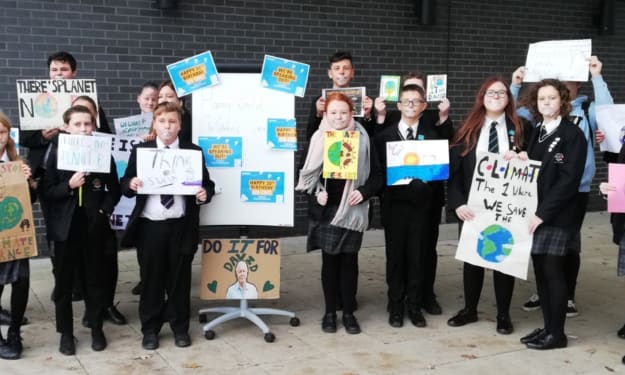
What can individuals and communities do to address climate change?
Currently, climate change is considered to be one of the most urgent and significant challenges facing humanity. It results from the emission of greenhouse gases into the atmosphere, which retain heat and increase the Earth's temperature. Climate change's consequences are already evident worldwide, manifesting in more severe weather phenomena, rising sea levels, and alterations in flora and fauna.
By Smita Bimbra3 years ago in Earth
Climate Anxiety and Eco-Grief
**Title: Whispers of the Vanishing Forest**In a quiet corner of the world, nestled deep within the embrace of a lush, ancient forest, lived a young woman named Elara. She had grown up under the verdant canopy, her life intertwined with the rhythms of nature. From the gentle rustling of leaves to the symphony of birdsong, every sound, every scent, every sight was a part of her very soul.But as Elara ventured further into adulthood, a growing unease gnawed at her heart. The forest, her beloved sanctuary, was changing. The once vibrant emerald leaves began to wither, their edges tinged with the faintest hint of brown. The streams that used to sing their melodious songs had grown quieter, their flow weakened by the relentless grasp of drought. Elara's heart ached with each fallen leaf, each parched streambed.The whispers of the vanishing forest haunted her every step.One crisp autumn morning, as the leaves began their descent to the forest floor, Elara decided to take a solitary journey deep into the heart of the woods. With a leather-bound journal and her father's old compass in hand, she ventured into the unknown. She needed to document the changes, to bear witness to the fading beauty of the world she held so dear.As she walked deeper into the forest, the canopy overhead grew denser, casting dappled shadows on the path. The once familiar trail had transformed into a maze of gnarled roots and tangled undergrowth. But Elara pressed on, her heart heavy with both determination and sorrow.She came upon a clearing where a once-mighty oak had stood, its roots a gnarled testament to centuries of life. Now, all that remained was a towering stump, the jagged wound of its felling a cruel reminder of the forest's vulnerability. Elara could feel the grief welling up within her, threatening to consume her like the encroaching darkness.Kneeling beside the stump, Elara ran her fingers over the rough, splintered surface. Her tears fell freely, mingling with the dew that clung to the leaves. She whispered an apology to the tree, as if her words could somehow soothe its spirit. "I'm sorry," she said, her voice choked with emotion. "I'm so, so sorry."As she continued her journey through the forest, Elara encountered other signs of distress. Withered ferns, their vibrant green replaced by a sickly yellow, crunched beneath her feet. Birds that once filled the air with their songs were noticeably absent. It was as if the very heart of the forest was breaking, and Elara couldn't bear to watch it suffer.Night fell, and Elara found herself in a small, moonlit glade. She opened her journal, its pages illuminated by the soft glow of fireflies. With trembling hands, she began to write. She poured her heart onto the pages, detailing the changes she had witnessed, the grief that gnawed at her, and the helplessness that threatened to overwhelm her.As she wrote, she heard a faint rustling in the underbrush. Elara looked up and saw a pair of luminous eyes peering at her from the darkness. A fox, its fur the color of autumn leaves, emerged from the shadows and approached her with cautious curiosity.Elara held her breath as the fox drew nearer, its gaze unwavering. It was as if the creature could sense her pain, her love for the forest, and the desperate need for connection. Slowly, she extended a hand, and the fox, with a gentle nuzzle, accepted her touch.Tears welled in Elara's eyes as she stroked the fox's fur. In that moment, she felt a profound connection with the natural world, a reminder that even in the face of adversity, there was still beauty, still life, and still hope. The forest may be changing, but it was not lost, not yet.With renewed determination, Elara made a promise to the forest and to the fox that she would not stand idly by. She would become a steward of the land, a guardian of the fragile balance between humanity and nature. She would fight for the world she loved, for the whispering leaves and the murmuring streams, and for the generations yet to come.As the first light of dawn broke through the trees, Elara left the glade, her heart lighter than it had been in days. The whispers of the vanishing forest were still there, but now they carried with them a message of resilience and hope. Elara would share her story, she would inspire others, and together they would write a new chapter for the forest and for the world.
By Christian Chukwuemeka3 years ago in Earth
"Navigating Climate Change"
Introduction The Earth's climate is undergoing unprecedented changes, driven by human activities such as burning fossil fuels, deforestation, and industrial processes. These changes are resulting in a wide range of environmental and societal challenges. This blog post will explore the current state of our climate and environment, the challenges we face, and some potential solutions to address these pressing issues.
By Paula Klein3 years ago in Earth
Breaking the Barrier: Light's Astonishing Journey Beyond the Speed of Light
What is light, and how does it behave? For centuries, scientists have been trying to answer these questions, but light's peculiar nature continues to surprise us. It displays characteristics of both particles and waves, and its behavior seems to depend on whether we are observing it or not. Although we thought we knew light's speed, recent studies suggest that it might not be entirely accurate.
By Saomai20033 years ago in Earth
"The Artistry of Nature"
For centuries, painters, poets, and philosophers have found inspiration in nature. Numerous pieces of music, literature, and art have been created as a result of its beauty, complexity, and diversity. Nature itself is a masterpiece, a singular artist who creates stunning landscapes, complicated patterns, and astounding phenomena. Nature is not just a source of inspiration. This essay will examine the artistic beauty that surrounds us every day in nature, from the fine veins of a leaf to the brilliant colors of a sunset. The Delicate Veins of a Leaf
By Misha story writer3 years ago in Earth
Why Nobody Raised the Titanic Yet + Other Rare Titanic Facts
Title: Why Nobody Raised the Titanic Yet + Other Rare Titanic Facts Introduction: The story of the RMS Titanic continues to captivate the world's imagination more than a century after its tragic sinking in 1912. This colossal vessel, deemed "unsinkable," met its doom on its maiden voyage, leaving over 1,500 passengers and crew members lost at sea. While the Titanic has been the subject of countless books, documentaries, and films, there are still many mysteries surrounding this iconic ship. In this article, we will explore why the Titanic has never been raised from its watery grave and delve into some lesser-known facts about this historic disaster.
By Pravin choudhary 3 years ago in Earth
The Silent Victims of Climate Change: A Cry for Help
In the vast discourse surrounding climate change, amidst scientific data, policy debates, and global agreements, we often overlook the profound emotional toll it takes on countless lives. While the impact on the environment is undeniable, the human stories buried beneath the statistics are equally compelling and heart-wrenching. This article aims to shed light on the emotional struggles faced by individuals and communities affected by climate change, as they grapple with loss, displacement, and uncertainty.
By Nathan Almeida3 years ago in Earth
The Silent Extinction
The Earth is currently facing a silent crisis of unparalleled magnitude - a crisis that often goes unnoticed amid the hustle and bustle of our daily lives. This crisis is the silent extinction, driven by global warming and climate change. It is a sobering reminder of the catastrophic consequences of our actions on the environment and the diverse species we share our planet with. This essay delves into the intricate web of cause and effect, exploring how global warming is pushing countless species towards the brink of extinction.
By chathumkaushika60023 years ago in Earth
A Journey of Hope. Content Warning.
Once upon a time, in a quaint coastal village named Oceantide, there lived a humble fisherman named Elias. His weathered hands and salt-encrusted boots told the story of a life intertwined with the sea. Oceantide had prospered for generations, its lifeblood being the bounty of the ocean. But, as the years passed, Elias noticed a change in the waters that troubled him deeply.
By Oshilim Anwuli First3 years ago in Earth
Why don’t we cover the desert with solar panels?
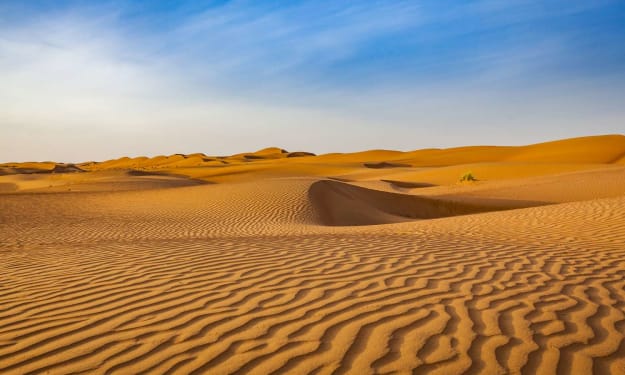
Every day, the sands of the Sahara Desert reach temperatures up to 80° Celsius. Stretching over roughly nine million square kilometers, this massive desert receives about 22 million terawatt hours of energy from the Sun every year. That’s well over 100 times more energy than humanity consumes annually. So, could covering the desert with solar panels solve our energy problems for good? Solar panels work when light particles hit their surface with enough energy to knock electrons out of their stable bonds. On their journey back to stability, these electrons produce electricity. However, there’s a limit to how much power panels can generate. Solar panels can only interact with certain wavelengths of light, making it impossible to convert over half the sunlight they receive. And even light particles they can convert often bounce off them without ever hitting an electron. But thanks to clever scientists and engineers and substantial government investment, solar panels are generating more electricity than ever. Anti-reflective coatings and patterns on the panels’ surface create more opportunities for incoming light particles to hit electrons. These techniques have increased commercial solar panel efficiency from the low-teens to 25%, with experimental models reaching up to 47%. What’s more, solar has gotten 89% cheaper over the last decade, thanks in part to global supply chains for other technologies that use the same materials. Together, these factors have made solar power the cheapest source of electricity on Earth. Countries including India, China, Egypt, and the US, have already taken these new panels into the desert. Their massive solar farms range from 15 to 56 square kilometers, and when the sun is high in the sky, these plants can provide energy for hundreds of thousands of local residents.But these farms also get extremely hot. Light that solar cells don’t convert or reflect is absorbed as heat, which reduces a panel’s efficiency. And the cooling systems employed by many farms can use huge amounts of energy powering fans or moving water to maintain optimal temperatures. Even with these systems, solar panels in the desert absorb far more heat than the natural sandy environment. This hasn’t been a problem on the scale of existing solar farms. But if we tried to cover the Sahara,this effect could create massive changes in the region's climate. Constructing solar farms already disrupts local ecosystems, but a plant of this scale could dramatically transform the desert landscape. Thankfully, solar panels aren’t our only option. And some of the largest solar plants in the world are trying a new approach: giant mirrors. Morocco’s Noor Power Plant, which will eventually cover roughly 30 square kilometers of the Sahara, is a concentrated solar power plant. This design reflects light onto a receiver, which converts that energy to heat, and then electricity. These mirrors still create a dangerous temperature shift for local wildlife, but they have less potential to transform the landscape. And since it takes time for the materials being heated to cool off, these plants often continue producing electricity past sunset. Whether they use panels or mirrors, industrial solar farms are often easy to fit into existing energy infrastructure. However, getting their electricity beyond local power grids is much more difficult. Some countries are working on ways to connect electric grids across the globe. And many farm store energy in massive batteries, or convert their electricity into clean gas that can be used later. But right now, these techniques are still too expensive and inefficient to rely on. Worse still, industrial renewables can share some of the same problems as fossil fuels,relying on destructive mining operations and carbon-emitting global supply chains. Fortunately, solar can exist on many scales, from industrial solar farms to smaller installations that power individual buildings and rural communities. These projects can supplement energy use or provide a passive source of energy for regions off the grid. And since solar panels rely on a few simple components, they’re quick to install and relatively easy to update. In fact, it’s this flexibility that enabled solar to become so cheap and ubiquitous over the last decade. So if we want to keep up with humanity's rising energy use, we'll need answers both big and small.
By Antonín Valda3 years ago in Earth
Beauty of heaven
Heaven, the celestial place that is frequently represented in different theological and mythical traditions, has long attracted people's attention. Heaven's beauty continues to be a source of intrigue and inspiration, regardless of whether one thinks of it as a real place or a metaphor for an ideal life. In order to shed light on this magical place, we shall study the ageless beauty of heaven in this article using many cultural and creative perspectives. A Heavenly Landscape
By Misha story writer3 years ago in Earth